

The Nationals finally agree to a 2050 net-zero target, but the real decisions on Australia's emissions are happening elsewhere
- Written by: John Quiggin, Professor, School of Economics, The University of Queensland
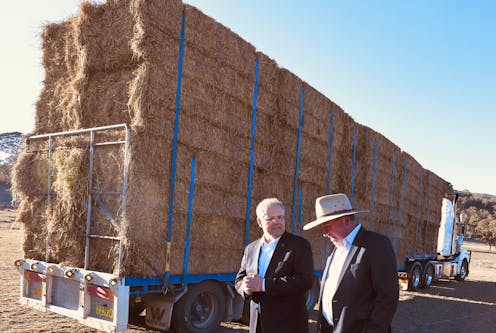
The National Party on Sunday agreed to a plan to cut Australia’s greenhouse gas emissions to net-zero by 2050, clearing the way for Prime Minister Scott Morrison to announce the target ahead of the Glasgow climate summit.
The exact terms upon which the Nationals will give their backing are not yet known. But for Nationals MPs to have withheld support for the target for several weeks, with all the political damage that entails, makes little sense.
The Morrison government, partly through its own doing, has almost no control over Australia’s emissions trajectory. The real decisions on that are being made elsewhere – by state governments and civil society, or outside the country altogether.
Morrison’s last-minute reach for a 2050 net-zero target is almost entirely symbolic, as was the Nationals’ resistance to it.
Fossil fools
Morrison was expected to attend the Glasgow summit with a 2030 emissions-reduction target far more ambitious than Australia has promised so far. But he ditched that plan after it became clear the Nationals would not support it.
Australia’s current 2030 emissions pledge – 26-28% cut based on 2005 levels – is insufficient. Emissions reduction of 35-40% in that timeframe is both feasible and necessary if Australia hopes to reach net-zero by 2050.
But if Australia reduces emissions in line with a net-zero target, it will not be the result of the Morrison government’s policies.
Instead, it will be down to state government initiatives and the world-beating enthusiasm of Australian households for rooftop solar. This enthusiasm is in part due to an incentive scheme from the Rudd-Gillard Labor era.
Australia’s biggest contribution to global warming comes in the form of coal and gas exports. But under the Paris Agreement, those emissions count towards the emissions total of the importing countries where the fuel is burned. The future of these exports depends primarily on decisions made by importing countries to implement their own Paris commitments
Most of our major coal and gas export markets have already committed to net-zero by 2050 (or, in China’s case, 2060). But exports of these fuels are likely to decline well before that date.
Electricity produced by new coal projects is more expensive than that produced by solar and wind anywhere in the world. As a result, around 76% of coal-fired power plant projects announced since 2015 have been cancelled.
Further cancellations and accelerated closure of existing plants will happen regardless of any decisions made in Australia.
Read more: Asia's energy pivot is a warning to Australia: clinging to coal is bad for the economy
Wishful, technocratic thinking
Even on domestic emissions, the Morrison government has little influence thanks to a variety of self-imposed limitations.
The great asset of the Commonwealth is its power to tax. However, the current government has effectively surrendered this option under the slogan “technology not taxes”. With the possible exception of tax cuts for electric vehicles, Labor has taken the same position.
Technological progress is indeed crucial. If it weren’t for the massive reduction in costs of wind and solar power, we would almost certainly be headed for climate catastrophe. But the Morrison government has little influence over global technological progress.
In practice, “technology not taxes” appears to be wishful thinking about options like carbon capture and sequestration (CCS) and (for some) nuclear power. Proponents of these technologies presumably believe they will make the emissions problem go away without crossing any ideological red lines.
But it’s been evident for at least a decade that neither of these technologies is likely to be a feasible option for Australia. Should there be a surprising new development that puts them back in the technology race, it will almost certainly come from overseas.
There are some technological options. The government could adopt vehicle emissions standards, and set them at levels that would accelerate the shift to electric vehicles. This proposal has been supported by the Climate Change Authority, Infrastructure Australia and even the Federal Chamber of Automotive Industries.
But having claimed in 2019 that such a policy would “end the weekend”, Morrison is in no hurry to change course. As with coal and gas, it’s likely the transition will be driven by external forces.
Most major vehicle manufacturers have committed to end the production of internal combustion engine vehicles by 2035. It’s likely that many popular models will cease being updated – or stop production altogether – before then.
Looking ahead
The Morrison government has ceased to be a major player in determining Australia’s future greenhouse gas emissions, and the speed with which they will fall.
But the National Party is right to demand, as it reportedly has, that the government implement transition policies for regional industries such as mining and agriculture. There will be plenty of demand for a wide range of minerals in a net-zero economy, though not for coal or gas. The transition away from these fuels is a major shift, but entirely feasible.
As for agriculture, it was always likely emissions reductions would be achieved primarily by subsidising farmers to reduce land clearing and methane emissions rather than through taxes or mandates.
But Australia’s agricultural sector would be a major loser under rapid global warming. If the National Party really cared about its electoral base, it would have been leading the charge for a net-zero emissions policy, not holding it back.
Authors: John Quiggin, Professor, School of Economics, The University of Queensland


















