

Labor doesn't have a 2030 target yet either – what do we know of the ALP's climate policy so far?
- Written by: Rebecca Pearse, Lecturer, Australian National University
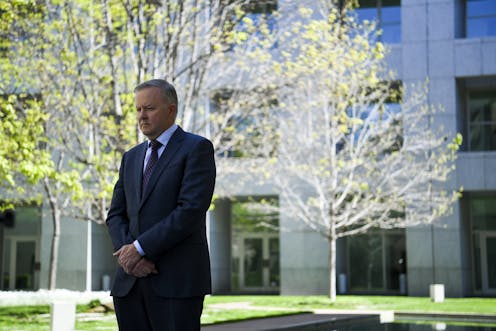
This week, the Morrison government finally released its plan to get Australia to net-zero emissions by 2050.
Labor leader Anthony Albanese was quick to dismiss the Coalition policy, describing it as a mere “vibe” with “nothing new” in it. His climate spokesperson Chris Bowen added
I’ve seen more detail in a fortune cookie.
These are fair comments. But Labor’s climate policy is also light on detail and the party won’t announce its full climate plan until after international climate talks in Glasgow, which finish on November 12.
What do we know about Labor’s policy so far? Will it be environmentally effective and fair?
No 2030 target
Global warming cannot exceed 1.5℃ this century if we hope to avoid catastrophic climate change. The Intergovernmental Panel on Climate Change (the United Nations body for assessing the science related to climate change) predicts global warming is on track for 2.7℃. We really do need to act fast.
Yet the ALP has no current plans to increase Australia’s 2030 emission reduction target. The party took a target of 45% below 2005 levels to the 2019 election. But this was short of what scientists have been calling for.
The Climate Council’s estimate for an appropriate climate target for Australia at the time was a 65% reduction. Today, they argue we can, and should, reach for a 75% reduction by 2030.
Australia’s 2030 target is important because “net-zero” is vague in the abstract – it basically means a managed balance between sources and sinks of carbon. We need to know what parts of the carbon cycle, and which industries, technologies, and groups of people are involved, and how.
Towards a green industrial strategy
The ALP has been signalling it wants to focus on labour issues at the heart of decarbonisation. As Bowen frequently observes, “good energy policy is good employment policy”.
After the tortuous carbon price debate of the Rudd-Gillard years and Labor’s shock defeat at the 2019 election, Albanese has announced a renewed focus on policies to promote a green “industrial revolution”. More recently, he has joined labour economists in arguing the pandemic exposes the Australian economy to fragile global supply chains.
Labor has proposed a A$15 billion national reconstruction fund for economic diversification and advanced manufacturing, including renewables.
Energy transition involves job losses in fossil-fuel based electricity generation and related mines and transport. There are significant opportunities for new employment in new green tech industries, but they don’t magically appear in the places jobs are being lost.
So any shift to a green industry policy should be meticulously planned and targeted to specific locations.
Supporting transitions in electricity and transport
Thanks to the renewable energy boom, electricity market decarbonisation is underway. Labor says it’s committed to underwriting the transition.
The ALP’s “rewiring the nation” policy commits A$20 billion to rebuild and modernise the grid, in line with a plan by the Australian Energy Market Operator. Labor is also proposing a public institution called Rewiring the Nation Corporation that may reintroduce some public ownership in the sector. For households and distributed energy off the grid, it promises more support for community batteries.
The ALP has also committed to more vocational training and a scheme for apprentice electricians to gain renewable energy skills. But we need more detail on how they propose to govern transition in the most affected regions.
It’s unclear if Labor still intends to create the Just Transition Authority announced under Bill Shorten’s leadership. These kinds of independent authorities are important for negotiating redundancy and retraining programmes and economic diversity initiatives in hard hit regions.
Transport systems are on the verge of a major transition too. The ALP has a tariff removal policy to make electric vehicles more affordable. It proposes to work with the unions and the sector to develop manufacturing capacity. But it could be doing more, for instance, through pollution standards or mandating large manufacturers meet targets for electric vehicle sales.
What about food and fuel?
All of this makes sense. But if net-zero is to become more than just a slogan, emissions reduction is urgently needed in other sectors such as agriculture and mining.
Decarbonising these sectors will be challenging in an economic, practical and political sense.
Labor’s policies to reduce emissions in the agriculture sector have focused on land carbon offsetting. Under this approach, farmers are encouraged to maintain vegetation and adopt farming practices that lead to more carbon being stored in soil and plants. This activity could be rewarded in the form of “credits” sold to polluting firms looking to compensate for (or “offset”) their ongoing emissions.
The Gillard government established the Carbon Farming Initiative as a voluntary land offset scheme linked to the short-lived compliance emissions trading scheme. This continued under the Coalition’s Direct Action Plan as a combined competitive grant programme and way to offset emissions under the Safeguard Mechanism which which sets a (loose) limit on the most polluting firms in Australia.
Both Labor and Coalition’s approaches to land carbon are a light touch. Offsets should not be heavily relied on to reach net-zero.
Read more: The clock is ticking on net-zero, farmers must not get a free pass
Meanwhile, Labor has never properly addressed the future of our export mineral and energy industries. Australia’s coal and gas exports will be exposed as trading partners such as South Korea, Japan and China pursue net-zero emissions targets.
And Labor will be under ongoing pressure from environmentalists and Indigenous groups who have long been calling for major reforms to both cultural heritage and environmental protection laws.
Capping pollution
Labor has said it will not seek an economy-wide carbon price instrument, like it had during the Gillard government. This means it will need other ways to legislate and regulate for emissions reductions. One possibility is to strengthen the existing “safeguard mechanism” without building a carbon market. In its current form, the mechanism has allowed big polluters to increase their emissions, but that could be changed.
If Labor went down that route, it would also need a separate policy to deal with emissions from agriculture. Effective climate policy doesn’t have to be top-down economy-wide carbon price. Sector-by-sector industrial policy and regulation could be a more realistic way to create incentives for innovation.
Looming election
The federal election due early next year is shaping up as another “climate election”.
We urgently need a government with vision for what jobs and livelihoods will look like in a decade of green industrial transformations. Labor is offering some new industrial details, but the emissions target and plans for mining and regional communities are vague.
We need the details in Albanese’s climate policy fortune cookie soon.
Authors: Rebecca Pearse, Lecturer, Australian National University


















