

Modern Australian
Times Advertising

Australia is about to be hit by a carbon tax whether the prime minister likes it or not, except the proceeds will go overseas

  • Written by Peter Martin, Visiting Fellow, Crawford School of Public Policy, Australian National University
Australia is about to be hit by a carbon tax whether the prime minister likes it or not, except the proceeds will go overseas

Ten years ago, in the lead-up to Australia’s short-lived carbon price or “carbon tax” (either description is valid), the deepest fear on the part of businesses was that they would lose out to untaxed firms overseas.

Instead of buying Australian carbon-taxed products, Australian and export customers would buy untaxed (possibly dirtier) products from somewhere else.

It would give late-movers (countries that hadn’t yet adopted a carbon tax) a “free kick” in industries from coal and steel to aluminium to liquefied natural gas to cement, to wine, to meat and dairy products, even to copy paper.

It’s why the Gillard government handed out free permits to so-called trade-exposed industries, so they wouldn’t face unfair competition.

As a band-aid, it sort of worked. The firms with the most to lose were bought off.

But it was hardly a solution. What if every country had done it? Then, wherever there was a carbon tax (and wherever there wasn’t), trade-exposed industries would be exempt. The tax wouldn’t do enough to bring down emissions.

We are about to face carbon tariffs

The European Union has cottoned on to the imperfect workarounds introduced by countries such as Australia, and is about to tackle things from the other direction.

Instead of treating foreign and local producers the same by letting them both off the hook, it’s going to place both on the hook.

It’s about to make sure producers in higher-emitting countries such as China (and Australia) can’t undercut producers who pay carbon prices.

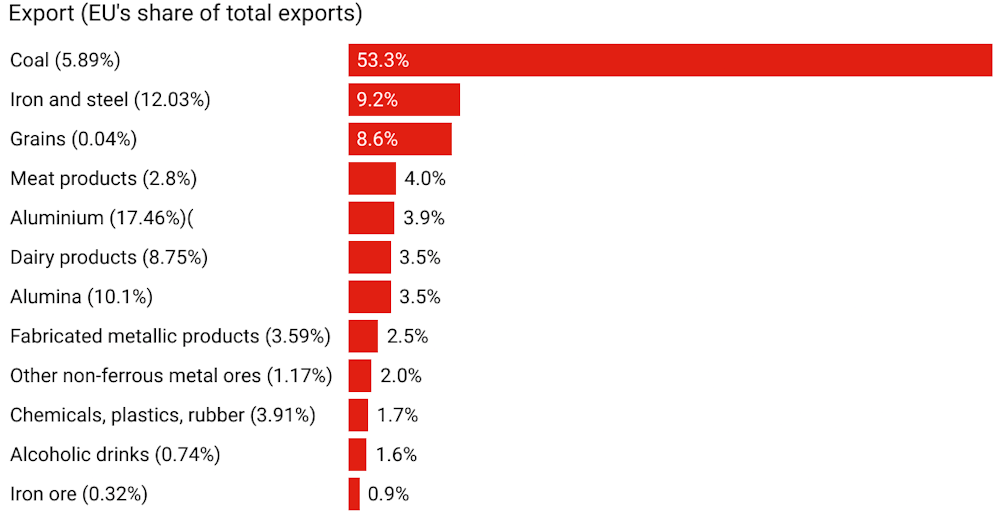
Australia Institute Unless foreign producers pay a carbon price like the one in Europe, the EU will impose a carbon price on their goods as they come in — a so-called Carbon Border Adjustment Mechanism, or “carbon tariff”. Australia’s Energy Minister Angus Taylor says he is “dead against” carbon tariffs, a stance that isn’t likely to carry much weight in France or any of the other 26 EU nations. Australia is familiar with the arguments for them From 2026, Europe will apply the tariff to direct emissions from imported iron, steel, cement, fertiliser, aluminium and electricity, with other products (and possibly indirect emissions) to be added later. That is, unless they come from a country with a carbon price. Canada is also exploring the idea, as part of “levelling the playing field”. So is US President Joe Biden, who wants to stop polluting countries “undermining our workers and manufacturers”. Their arguments line up with those heard in Australia in the lead-up to our carbon price: that unless there’s some sort of adjustment, a local carbon tax will push local employers towards “pollution havens” where emissions are untaxed. Read more: The EU is considering carbon tariffs on Australian exports. Is that legal? In practice, there’s little Australia can do to stop Europe and others imposing carbon tariffs. As Australia discovered when China blocked its exports of wine and barley, there’s little a free trade agreement, or even the World Trade Organisation, can do. The WTO was neutered when former US President Donald Trump blocked every appointment to its appellate body, leaving it unstaffed, a stance Biden hasn’t reversed. Even so, the EU believes such action would be allowed under trade rules, pointing to a precedent established by Australia, among other countries. Legality isn’t the point When Australia introduced the Goods and Services Tax in 2000, it passed laws allowing it to tax imports in the same way as locally produced products, a move it has recently extended to small parcels and services purchased online. Trade expert and Nobel Prizewinning economist Paul Krugman says he is prepared to argue the toss with politicians such as Australia’s trade minister about what’s legal and whether carbon tariffs would be “protectionist”. But he says that’s beside the point: Yes, protectionism has costs, but these costs are often exaggerated, and they’re trivial compared with the risks of runaway climate change. I mean, the Pacific Northwest — the Pacific Northwest! — has been baking under triple-digit temperatures, and we’re going to worry about the interpretation of Article III of the General Agreement on Tariffs and Trade? And some form of international sanctions against countries that don’t take steps to limit emissions is essential if we’re going to do anything about an existential environmental threat. Victoria University calculations suggest Europe’s carbon tariffs will push up the price of imported Australian iron, steel and grains by about 9%, and drive up the price of every other Australian import by less, apart from coal whose imported price would soar by 53%. The tariffs would be collected by Europe rather than Australia. They could be escaped if Australian makers of iron, steel and other products can find ways to cut emissions. Increase in price of exports to EU under carbon border adjustment mechanism Assumes an EU carbon price of 60 euro per tonne, which is roughly today’s price; assumes the CBAM covers CO2 emissions including fugitive emissions involved in production other than direct combustion emissions that are priced already by the EU Emissions Trading Scheme. The tariffs could also be avoided if Australia were to introduce a carbon price or something similar, and collected the money itself. This makes a compelling case for another look at an Australian carbon price. If Australian emissions are on the way down anyway, as Prime Minister Scott Morrison contends, it needn’t be set particularly high. If he is wrong, it would need to be set higher. Read more: No point protesting, Australia faces carbon levies unless it changes course One thing the sad story of Australia’s on-again, off-again, now on-again (through carbon tariffs) history of carbon pricing has shown is that politicians aren’t the best people to set the rates. In 2011, Prime Minister Julia Gillard set up an independent, Reserve Bank-like Climate Change Authority to advise on the carbon price and emissions targets, initially chaired by a former governor of the Reserve Bank. Astoundingly, despite attempts to abolish it, it still exists. It might yet have work to do. Authors: Peter Martin, Visiting Fellow, Crawford School of Public Policy, Australian National University

Read more https://theconversation.com/australia-is-about-to-be-hit-by-a-carbon-tax-whether-the-prime-minister-likes-it-or-not-except-the-proceeds-will-go-overseas-170959

Preparing Your Air Conditioner for Summer: What Most Homeowners Overlook

As temperatures rise, many homeowners switch on their air conditioning for the first time in months — only to find it’s not performing the way i...

What Actually Adds Value to Properties in Newcastle

Newcastle has seen steady growth over the past few years, with more buyers looking beyond Sydney for lifestyle, space, and long-term value. As dema...

What is Design and Build in Construction?

Imagine you’re about to start a new construction project, maybe it’s a custom home or a commercial building. You’ve got the idea, the land, an...

Commercial roof leak detection: why early action protects your building

Water ingress is one of the most disruptive and costly issues facing commercial properties. For property managers and facilities teams, even a minor...

Custom Photo Frames: Turning Everyday Moments into Lasting Displays

Photos capture moments, but how you display them determines how they’re experienced every day. A meaningful photograph deserves more than a generi...

Managed IT Services: A Smarter, More Predictable Way to Run Your Business Technology

If you’ve ever had your systems go down in the middle of a busy day, you’ll know how quickly things can unravel. Phones stop ringing, emails sto...

Landscaping Geelong — Coastal Elegance Meets Practical Design

A Landscape Shaped by Location Geelong occupies a unique position within Victoria’s broader landscape. It carries the energy of a growing city, y...

Electric Adjustable Beds: A Simpler Way To Sleep Better

Sleep should feel natural. It should come easily, without discomfort, without constant repositioning, and without waking up feeling sore. But for ma...

Healthy Snacking Sorted: Premium Beef Jerky

In today's fast-paced world, finding a snack that's both satisfying and genuinely good for you can feel like a mission. Many readily available optio...

What to Know Before Getting Dental Implants: A Guide for First-Time Patients

Dental implants Perth patients often look for a long-term solution for missing teeth without the hassle of dentures or bridges. If you are thinking ...

Why Protective Packaging Matters More Than Ever In Modern Shipping

In today’s fast-paced world of logistics and eCommerce, ensuring that products reach customers safely is a top priority. This is where a bubble wrap...

Pest Control Albury: Protecting Your Property From Hidden Damage And Health Risks

Pests rarely announce their arrival. They creep into spaces quietly, turning small, unnoticed corners into breeding grounds for bigger problems. Tha...

Why Root Canal Treatment Melbourne Is Essential For Saving Natural Teeth

Tooth pain has a way of demanding attention at the worst possible time. When the discomfort becomes persistent and intense, it often signals an infe...

How Bird Flight Diverters Help Protect Wildlife Around Power Infrastructure

Power infrastructure plays an essential role in modern life, but it can also create risks for wildlife, particularly birds moving through establishe...

What Businesses Should Look for in a Commercial Coffee Partner

Choosing a commercial coffee partner is not the same as choosing a machine. It is a broader decision that affects beverage quality, staff efficiency...

3PL Logistics Australia Driving Smarter Supply Chains And Faster Deliveries

In a world where customers expect speed almost as much as quality, logistics has become the silent heartbeat of every successful business. Behind th...

Why Professional Electrical Services Are Essential For Modern Properties

Electricity powers almost every aspect of daily life, from lighting and appliances to complex systems in homes and businesses. This makes choosing a...

What Not to Pack When Moving: The Essential Guide to Smart Packing

Moving house is one of those all-encompassing events in life and most people focus their energy on deciding what to pack. But knowing what not to pa...
















