

Modern Australian
The Times

Our top 1% of income earners is an increasingly entrenched elite

  • Written by Roger Wilkins, Professorial Fellow and Deputy Director (Research), HILDA Survey, Melbourne Institute of Applied Economic and Social Research, The University of Melbourne

Our top 1% of income earners is an increasingly entrenched elite

The share of total income collected by the top 1% of Australia’s income earners has been trending upwards since the 1980s. It is now about 9% of total income.

How concerned should we be about this? To some extent it depends on fluidity of membership of the top 1% (which in Australia means earning a pretax income of at least A$246,000).

If someone is part of the 1% this year but not last year, this would suggest income inequality is a fact of life but at least we still have social mobility: people have good and bad years, with the top 1% largely comprising people who happen to be having a good year. It won’t bother the other 99% of us so much.

But if the top 1% comprises the same people every year, we will be more concerned about an entrenched elite moving ever further away from the rest of us.

Our research – using newly available longitudinal tax data – has made it possible to evaluate the extent of “top-end mobility” over the past three decades. This is the first evidence on the extent to which membership of Australia’s top 1% (or other top income groups) changes from year to year.

Read more: Other Australians don't earn what you think. $59,538, is typical

We find there is considerable mobility at the top. For example, since 1991 at least a quarter of the top 1% in any given year have not been in the top 1% in the next year.

But there has been an appreciable decline in top income mobility.

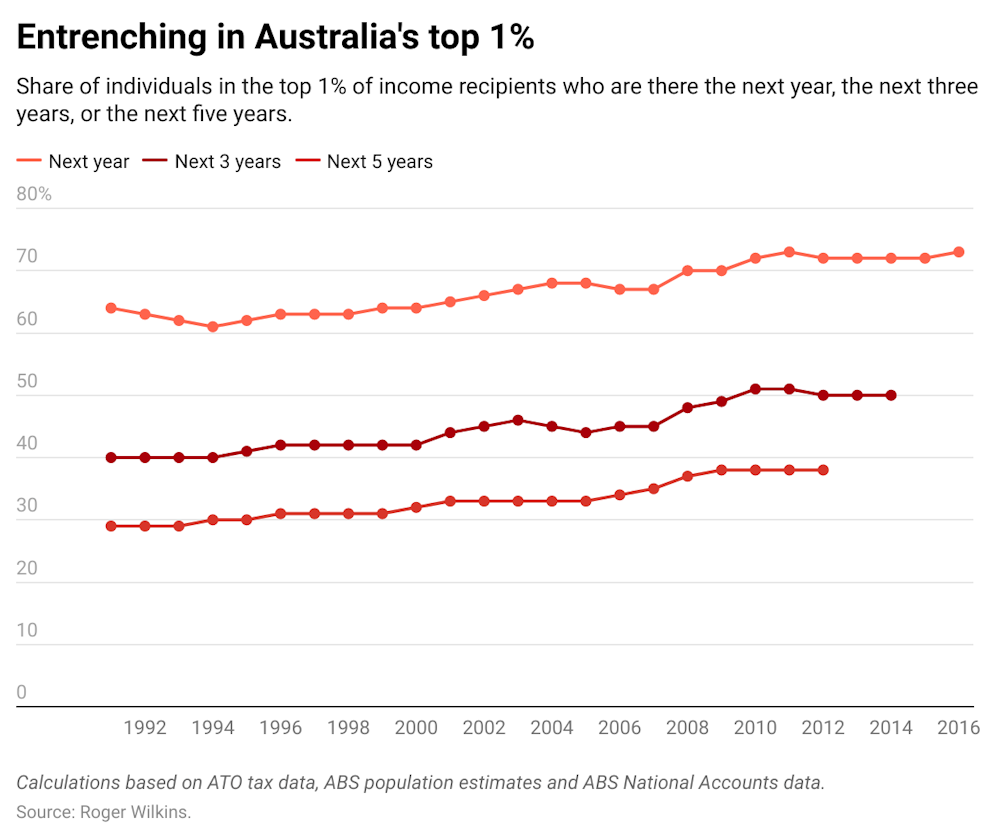
For example, 64% of people in the top 1% in 1991 were still in the top 1% a year later. 73% of those in the top 1% in 2016 were still there in 2017.

In 1991, 29% remained in the top 1% for the next three years. In 2012, 38% remained in the top 1% for the next three years.

What our results show

Our findings, based on a variety of approaches, show most of the decrease in movements in and out of the top 1% occurred in the mid-2000s and early 2010s. We found the same trend in the top 0.1% and top 10% income groups.

Splitting 1991 to 2015 into five periods of five years each, we find that half of those who appeared in the top 1% at any time between 1991 and 1995 were there for one year only. By 2011-15 the proportion of one-time entrants had dropped to 38%, meaning more people making it to the top 1% staying there for longer.

Another indicator of the increased “stickiness” at the top are higher re-entry rates: those dropping out of the top 1% are more likely to return in subsequent years.
CC BY-SA They are also less likely to fall far from the top 1%. In the 1990s the income of about 35% of those falling out of the top 1% declined far enough for them to no longer being in the top 5%. That is now happening to only about 20%. Read more: Here's why it's so hard to say whether inequality is going up or down Diminishing opportunities to get rich Interestingly, we find no evidence that lower mobility in and out of the top 1% is due to the 1% increasing its share of total income. The periods that saw mobility reduced – the mid-2000s and early 2010s – do not correspond to periods of rising top income shares. In other words, this is not a story about the rungs of the income ladder growing further apart and making climbing the ladder more difficult. But it is a story of diminishing opportunities to have a top income. Read more: Why Squid Game is actually a critique of meritocracy While national differences are difficult to assess because of comparability issues, Australi’s lack of mobility among its top 1% appears to be more pronounced than that found in other countries. For example, the US appears to show considerably more mobility. An in-depth account of why top incomes are increasingly stable is a story yet to be told. But it is hard to escape the conclusion that Australia has experienced declining economic dynamism, where the rich are increasingly dominated by old money, and where we have fewer entrepreneurs breaking into the income elite. The authors wish to acknowledge the contribution of Dean Hyslop, senior fellow with Motu Economic and Public Policy Research in New Zealand, to this research. Authors: Roger Wilkins, Professorial Fellow and Deputy Director (Research), HILDA Survey, Melbourne Institute of Applied Economic and Social Research, The University of Melbourne

Read more https://theconversation.com/our-top-1-of-income-earners-is-an-increasingly-entrenched-elite-170445


Why Regular Skills Updates Are Essential for Licensed Security Officers

A guard at a Brisbane shopping centre gets a call about a shoplifter who's turned aggressive.  They’ve done the job for six years. But their de-...

10 Benefits of Choosing Professional Tutoring Penrith Services

Every student has unique learning strengths, challenges, and academic goals. While classroom teaching provides essential knowledge and structure, so...

Sunshine Coast Baby Classes Prove Big Hit Among First-Time Mums

There's a movement gaining traction on the Sunshine Coast, providing a village of support, socialisation and relief for first-time mothers and babie...

Father's Day Gift Ideas for Men Who Are Hard to Buy For

Some dads are easy to buy for. Others do not want anything, already have everything, or give you the classic "don't worry about me" answer every yea...

Top 5 Mistakes That Wear Out Your Brakes Faster

Brakes don't need frequent replacements like oil changes do.   But a lot of the wear happens quietly, over months, because of habits most drivers...

Plantation Shutters vs Curtains: Which Is Better for Your New Home?

Moving into a new home is an exciting opportunity to personalise your space and make it your own. While many homeowners focus on furniture, flooring...

Celebration of Life vs Traditional Funeral: What's the Difference?

When saying goodbye to someone you love, there is no single way to honour their life. Every family has different traditions, beliefs, and preference...

Building Approval for Roofing Projects: What Homeowners Need to Know

Roofing projects are an important part of maintaining and protecting your home. Whether you're repairing storm damage, replacing an ageing roof, or ...

Chatswood Tutoring And Its Role In Academic Achievement

Academic success often requires more than classroom attendance alone. Students face increasing expectations as they progress through school, particu...

Why Laser Hair Removal Treatments Continue Growing In Popularity

Managing unwanted hair can become time-consuming and frustrating for many people, especially when shaving, waxing, and other temporary methods requi...

Choosing the Right Devices for a Flexible Workplace

For IT leaders managing large fleets, the device layer is where workforce productivity and security policy meet. The shift towards flexible and hybrid...

How Business Advisory Services Help Companies Achieve Sustainable Growth

Every business owner aims to build a profitable and sustainable organisation. While dedication, innovation, and hard work are important, achieving l...

Why Body Contouring Has Become A Popular Cosmetic Treatment

Many people maintain healthy lifestyles through regular exercise and balanced eating habits but still struggle with stubborn areas of fat that are d...

How to Choose the Right POS Hardware for Your Business in Australia

A lot of Australian business owners spend weeks researching POS software but buy hardware almost as an afterthought. That's a mistake. The wrong har...

Why Material Handling Hose Is Critical for Industrial Efficiency

A high-performance material handling hose is an essential component in industries that transport abrasive, dry, or bulk materials on a daily basis...

How to Choose the Right Lawyer in Melbourne for Your Situation

Choosing legal support can feel difficult, especially when the stakes are personal or business-related. The right lawyer in Melbourne should underst...

Hoteliers Look to Clever Value Adds to Increase Revenue

The Australian hospitality industry is still in recovery mode after a notoriously rough patch in recent years. While there has been a post-COVID tra...

Moving to Queensland? Here’s How to Prep Your Car for the Big Move North

There’s no sign of the northern migration slowing down, with thousands of southerners fleeing from chaotic lifestyles and cooler climates for a brig...















