

Stemming methane leaks from oil fields, pipelines and landfills could help us slow global warming quickly
- Written by: Kevin Trenberth, Distinguished Scholar, National Center for Atmospheric Research
Climate change is happening, and it’s mostly due to human activities that change the composition of the atmosphere, which in turn interferes with the natural flow of energy through the climate system.
Two greenhouse gases contribute most to this problem: carbon dioxide and methane. The result is global heating. The repercussions of rising temperatures include heavier rains, stronger storms, more intense droughts, heatwaves and wildfires.
Methane, which is more potent than carbon dioxide but has a shorter lifespan, reached record levels in the atmosphere last year, at about 2.5 times above those during the pre-industrial era.
Reducing methane emissions offers a way to rein in climate change quickly, at least to some extent, and to buy time while the world drastically reduces fossil fuel use.
The COP26 climate summit recognised this when more than 100 nations, representing 70% of the global economy, joined the Global Methane Pledge to cut methane emissions by 30% by 2030.
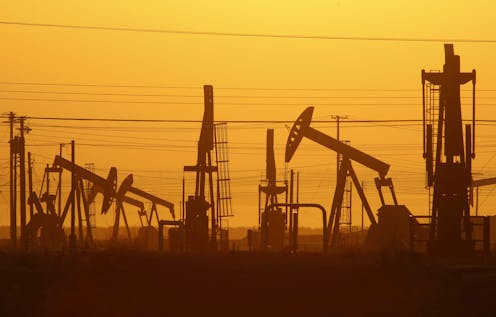
New Zealand joined, but Australia didn’t. Nearly all of the pledges relate to cuts in “fugitive emissions” of methane through leaks in the oil and gas sector, especially from fracking operations during the drilling of new wells and from old, abandoned wells that have not been sealed properly.
Read more: The new Global Methane Pledge can buy time while the world drastically reduces fossil fuel use
Methane on the rise again
Methane is a primary component of natural gas. It is emitted into the atmosphere from oil and natural gas wells and landfills. Surplus methane is often burned or vented into the atmosphere.
Coal mining, sewage ponds and various industrial processes contribute lesser amounts.
Globally, oil and gas operations account for 26% of methane emissions. Methane concentrations levelled off between 2000 and 2008, suggesting the short average lifetime of the gas depleted it from the atmosphere at about the rate of emissions.
But since then, methane levels have increased again, and this appears to be largely due to fracking and related activities in the oil and gas industry.
Reducing fugitive emissions makes economic sense
In a recent study, climate scientist Ilissa Ocko and colleagues suggest rapidly cutting methane can slow global warming quickly, and cuts can be made at a profit because they reduce leaks.
The research team considered all sectors and found 85% of methane emissions from the oil and gas industry could be readily abated by 2030 (50% are economically feasible, further 35% are technically feasible). For landfills, the respective numbers are 80% (16% and 64%).
In New Zealand, livestock is the main source of methane emissions, known as biogenic methane. The above research found only 32% of biogenic methane emissions could be cut readily (and only 2% are economically feasible, 30% technically possible). Livestock emissions are more manageable in feedlots, used in the northern hemisphere in winter, but more difficult for free-range cattle and sheep.
There are some optimistic reports about how biogenic methane emissions could be cut by changing the feed of cows, treating effluent ponds and using methane from landfills to generate electricity.
Tracking emissions
Under the UN Framework Convention on Climate Change (UNFCCC), countries have to report their emissions. But a recent report revealed a gap between countries’ reported emissions and observed increases in concentrations in the atmosphere. This also applies to methane emissions, although natural emissions also play a role.
Recent technology on satellites has enabled large emissions to be detected from space, and from next year MethaneSat is expected to be able to pinpoint even smaller emission sources. A US team will use the MethaneSat programme to focus on methane emissions from the oil and gas industry, while New Zealand will be mission control for the space-based tracking of agricultural emissions.
Spurious methane emissions were recently especially prominent in Russia, where 164 tonnes of methane leaked into the atmosphere during a single hour of repairs on a pipeline owned by state-controlled gas giant Gazprom, and in Australia.
While most methane emissions in New Zealand and Australia come from agriculture, Australia’s fugitive emissions from various mines are large, more than all of New Zealand’s contributions combined.
Recent and future prospects
Since 2016, Australia has made a modest reduction in fugitive emissions because of increased use of renewable energy and slightly reduced coal production. The COVID pandemic has also played a role.
Ilissa Ocko’s team concluded that rapid deployment of available technologies and strategies could cut anticipated global methane emissions by 57% in 2030, if action is taken promptly.
In New Zealand, many changes are desirable for other reasons, including land use and biodiversity protection. But it does not make sense to get out of step with other countries, which aren’t reducing methane from livestock, as that could put New Zealand farmers at a disadvantage.
In particular, New Zealand should not be too far out of step with Australia. Instead, the New Zealand government should step up its efforts to call the Australian government to account to substantively reduce all greenhouse gas emissions, especially fugitive methane emissions.
A price on carbon, created through a tax or carbon markets and designed to capture the cost of damages through climate change, may be enforced internationally through tariffs. This could be particularly critical for power generators and energy-intensive industries.
New Zealand has an Emissions Trading Scheme, but agricultural emissions are excluded.
Australian industry is especially vulnerable. Although many companies are making serious plans to adapt, their timeline is too long, with no prospect for containing global warming to 1.5℃ (above pre-industrial average temperatures).
While much more could be done with respect to methane emissions, notably in some countries, the longer term challenge remains the need to make substantial cuts to carbon dioxide emissions.
Authors: Kevin Trenberth, Distinguished Scholar, National Center for Atmospheric Research


















