

a history of Australia's bushfire reporting
- Written by Fiannuala Morgan, PhD Candidate, Australian National University
Australia’s Black Summer bushfires of 2019 and 2020 wreaked destruction across South-Eastern Australia. Images of flames crowned trees, engulfed fire trucks and people crowded on beaches and packed in boats were broadcast into our homes.
For European colonists in 19th century Australia, bushfires were a strange, but by no means uncommon phenomenon. Rather, they had become part of life, and also a focus of media attention.
In addition to journalistic reporting, Australian newspapers also published hundreds of serialised bushfire narratives, often concurrent with the fire season.
Reading these accounts together provides insight not only into shifting attitudes towards disaster, but also the way fire disaster itself is mythologised, memorialised or forgotten.

From reporting to literature
One of the earliest bushfire narratives, William Howitt’s short story Black Thursday (1856), is an adaptation of his own reporting on the fire disaster of the same name.
Black Thursday (February 7, 1851) was perhaps the first great fire disaster in settler Australian history. Although no official records exist, it is estimated that almost a quarter of the Victorian colony was burned.
Howitt’s literary account is partly a revision of his own reporting that drew together different newspaper accounts to present a sensational report of unprecedented destruction.
Howitt’s narrative is ultimately a tale of settler endurance that features protagonist Robert Patterson successfully navigating the difficulties of bush life. Nonetheless, he draws heavily on these journalistic accounts for both the narrative setting and the description of the fire itself.
Subsequent Black Thursday narratives, such as An Australian Squire (1878) by Rolf Boldrewood, present a more realistic reappraisal of the disaster. In this story newspaper reporting is integrated directly into the narrative to contextualise the scale of the disaster:
when the papers came in the accounts of loss and ruin over the length and breadth of the land were appalling.
Other narratives, such as the unusually didactic, The Burning Forest (1853) present bushfire reporting as only a partial record of what has taken place. This narrative offers a vivid account of a fire caused by a careless gold digger whose refusal to put out a campfire leads to the death of several members of a family.
The story concludes with an acknowledgement of the anonymity of the incident:
Taking place far from all civilisation, these circumstances did not reach the newspapers, and perhaps the travellers never knew the result of that burning log.
A record of fire
As fires increased in regularity and severity across the century, the way they were reported also changed, prompting some historians to conclude they were hardly reported on at all.
But, bushfire reporting remained relatively consistent across the 19th century, although the extensive multi-page features that followed disasters such as Black Thursday (1851) and Black Monday (1865) were eventually replaced by more succinct reporting.
Across the late 1870s and early 1880s Victoria experienced regular and devastating bushfires with the most fatal occurring in 1879. The fact Black Monday (February 27, 1865) is so quickly forgotten also attests to the severity of these fires.
Although Black Monday is initially reported as the colony’s second major fire disaster, the event is forgotten by the turn of the century when it is excluded from a list of significant fires in the Victorian Royal Commission into “Fire-Protection in Country Districts” (1900).
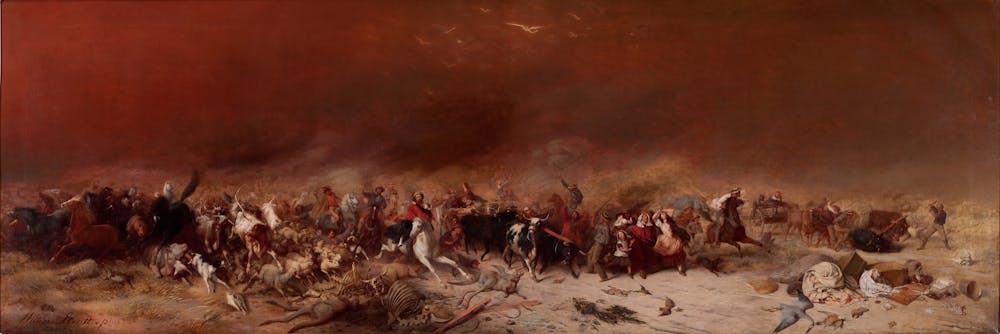 Black Thursday, February 6th. 1851, as depicted by William Strutt in 1864.
State Library Victoria
Black Thursday, February 6th. 1851, as depicted by William Strutt in 1864.
State Library Victoria
The role of bushfire fiction
Literary depictions of bushfires also changed over time. While Black Thursday narratives may have been the only ones to respond directly to historical events, others began to draw on identifiable seasonal patterns.
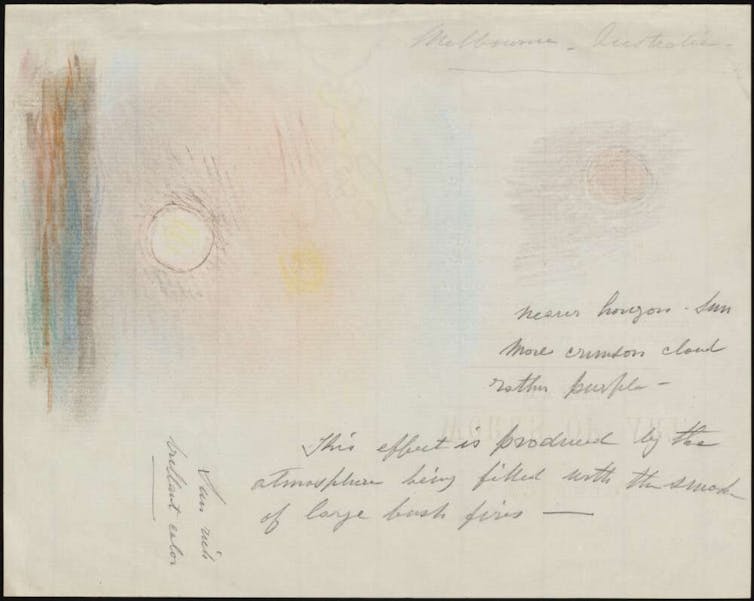
These stories often begin in the middle of a drought with the same imagery of an oppressive red sun. What is consistent in bushfire narratives across the 19th Century is the way they model fire preparation and precaution, albeit with varying degrees of insight into the reality of fire-fighting.
For example, Howitt’s tale of Black Thursday suggests that pre-emptive backburning and the creation of firebreaks is enough to save the settler home. Boldrewood’s account, however, demonstrates that in such exceptional circumstances no amount of preparation is sufficient and defence is impossible:
No man living could have stood near enough to the line of fire to go through the mockery of trying to stem it. Such was its force and fierceness…
Read more: 'Like volcanoes on the ranges': how Australian bushfire writing has changed with the climate
Black Thursday by William Howitt was consistently republished in Australian newspapers across the 19th century, and the story played an important role in preserving the cultural memory of the disaster.
Black summer and modern stories
Just as Howitt adapted his own reporting to memorialise bushfire disasters, modern reporting continues to do the same, such as the recent publication Black Summer, telling the story of the 2019-2020 bushfires from the perspective of journalists on the ground.
The ABC’s television series Fires also incorporates imagery that could be drawn directly from the footage that circulated around this time.
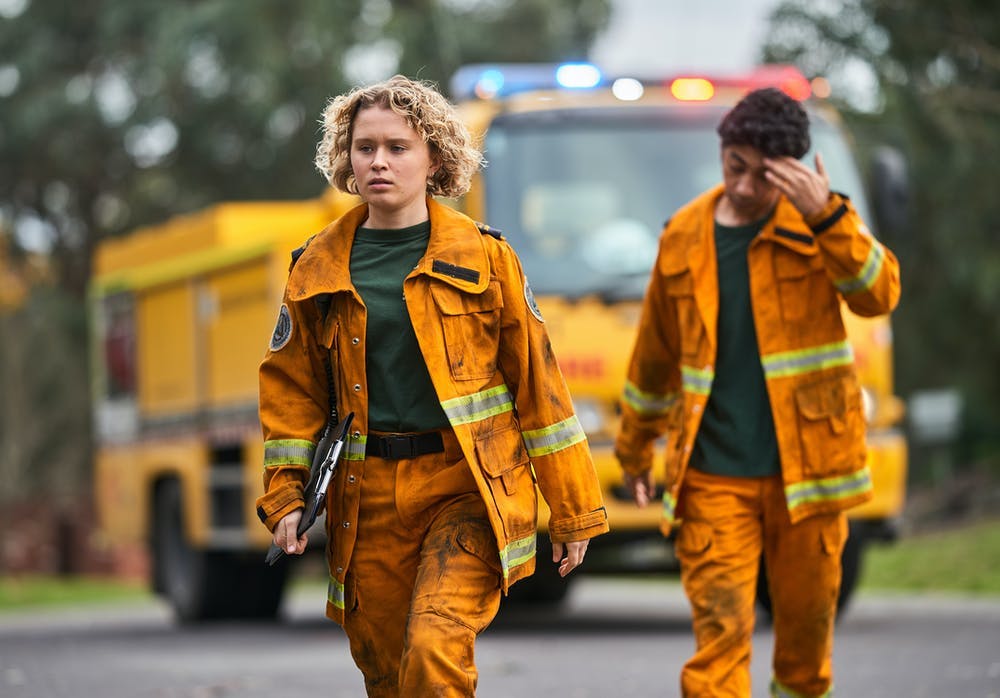 The new ABC TV drama Fires is a six-part series of interlinked stories inspired by the 2019-2020 Black Summer fire season.
Ben King/ABC
The new ABC TV drama Fires is a six-part series of interlinked stories inspired by the 2019-2020 Black Summer fire season.
Ben King/ABC
In both cases, adding a narrative to culturally identifiable footage and journalistic accounts of the Black Summer counteracts our propensity to forget – and unlike Black Monday, gives us the opportunity to ensure this time the practical lessons of disaster are learned.
Authors: Fiannuala Morgan, PhD Candidate, Australian National University

















