

Western Sydney will swelter through 46 days per year over 35°C by 2090, unless emissions drop significantly
- Written by: Hannah Melville-Rea, Research Fellow, New York University
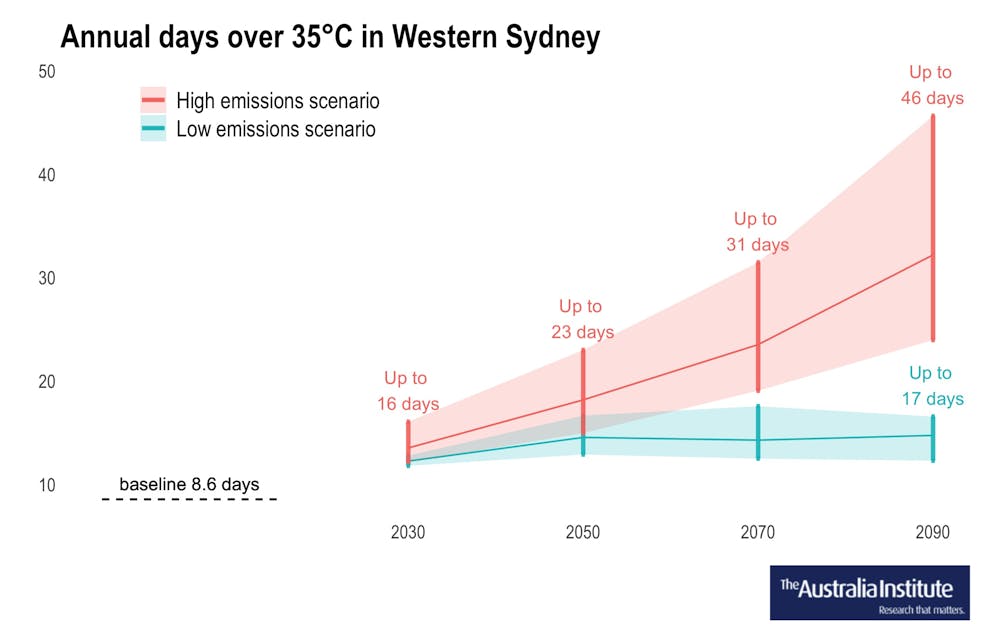
If emissions continue to accelerate, Western Sydney can expect to endure up to 46 days per year over 35℃ by 2090, a new analysis from the Australia Institute finds. This is a fivefold increase from the historical average of just under nine days of extreme heat per year.
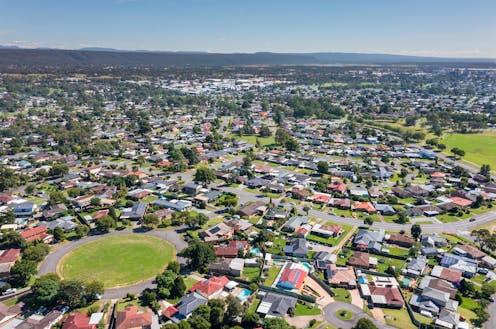
Western Sydney, home to around 2.5 million people, is highly vulnerable to extreme heat and is 8-10℃ hotter than east Sydney during heatwaves. The region is too far inland to benefit from coastal breezes, and lacks the altitude of the neighbouring Blue Mountains.
The furthest inland suburbs, such as Penrith, are hottest. Indeed, in early January, 2020, Penrith was the hottest place on Earth, reaching a scorching high of 48.9℃.
However, such a dramatic rise in extreme heat days is not inevitable. If global warming is limited to 1.5℃ this century, in line with the Paris Agreement, Western Sydney will have fewer than 17 days of 35℃ per year by 2090. Emissions reduction and smart urban design are urgent measures to protect Western Sydney-siders from heat stress.
Heatwaves are deadly
In Australia, heat accounts for more deaths than all other natural disasters combined. If the power goes out, it’s much harder to mitigate the stress.
In January 2009, during the devastating heatwave that preceded the Black Saturday fires, Melbourne experienced a power outage on a 44℃ day, leaving some 500,000 people in the heat without electricity. The heatwave alone killed 374 people, and cost Melbourne an estimated A$800 million.
Read more: The world endured 2 extra heatwave days per decade since 1950 – but the worst is yet to come
Heat also acutely affects worker productivity. The New South Wales treasury estimates that by 2061, the state could lose up to 2.7 million working days every year from reduced worker productivity in agriculture, construction, manufacturing and mining, due to heat.
However, under a low-emissions pathway, NSW estimates the loss in worker productivity could be limited to about 700,000 days. While this is still significant, it’s a quarter of cases compared to a high-emissions future.
To find out how climate change would affect Western Sydney, we analysed climate projections from the Bureau of Meteorology and CSIRO. We calculated temperature projections using a low-emissions scenario (where global warming is stopped at 1.5℃) and a high-emissions scenario (where global emissions continue unabated).
Examining 12 federal electorates that make up Western Sydney, we found the electorate of Lindsay, which includes the city of Penrith, will be most impacted. It can expect up to 58 days of 35℃ by 2090 under a high emissions scenario.
Who is impacted?
Western Sydney is uniquely prone to the “urban heat island” effect. The dense concrete and lack of green spaces absorbs and amplifies heat, raising temperatures to dangerous levels.
Residents without access to affordable air conditioning, with preexisting medical conditions or who work outdoors are most at risk of heat stress.
To understand the human impact of extreme heat, we partnered with extreme heat advocacy nonprofit Sweltering Cities. They conducted a targeted survey of Western Sydney in 2020, collecting insights from 682 respondents.
Gemma MacMillan is a single mum of a three-year-old boy, living in affordable housing in Ropes Cross. “In summer I have to keep my son Oliver inside as much as possible on hot days,” she says. “There’s no shade at all in my backyard.”
Gemma has lived in a house without air conditioning or ceiling fans. “In the past we’ve gone to stay with my ex-partner’s mum who has an air con, but now we’ve broken up and I worry about my son when it’s really hot.”
Even though retired chemist Rafael Perez has air conditioning, he says: “you’ve got to think of the cost. I’m not in a position to have it on all the time so I turn it off as soon as I can.”
In fact, despite Western Sydney having, on average, lower income levels, residents in areas such as Penrith are paying on average up to $100 per month more in electricity bills than those living closer to the coast.
Reflecting on his 22 years in the neighbourhood, Rafael says, “there used to be a lot more trees when I moved here, now there is a lot more concrete.”
What needs to change?
Reducing emissions is the difference between 1.5 months and 17 days of extreme heat per year in Western Sydney.
Thankfully, there is appetite for change. Earlier this month, for example, prominent cricketer Pat Cummins launched Cricketers for Climate in Penrith, a movement for Australian cricket clubs to achieve net-zero emissions over the next decade. The initiative highlights how the climate crisis threatens our ability to play sports, and positions athletes as advocates for climate action.
Additionally, the upcoming federal election could provide the policy window to increase climate ambition, as Western Sydney has a number of highly contested swing seats. According to the Sweltering Cities survey, 92.5% of Western Sydney residents say they want politicians and political parties to have policies on heat.
What do these policies look like? At the local level, we need to design our cities and homes to protect vulnerable members of the community. The NSW government recently announced a move to ban dark roofs. Lighter coloured roofs reflect heat, and can reduce indoor temperatures by 10℃ during heatwaves.
Read more: Climate explained: how white roofs help to reflect the sun's heat
Increasing green spaces, ensuring bus stops and parks are adequately shaded, and providing affordable access to air conditioning are also crucial steps to making Western Sydney safe.
Most importantly, preventing extreme heat requires a significant emissions reduction. Australia’s national target of a 26-28% emissions reduction from 2005 is consistent with warming of 4℃, if all other countries were to follow a similar level of ambition. At the state level, instead of planning new coal mines, NSW should accelerate its transition to renewable energy.
Authors: Hannah Melville-Rea, Research Fellow, New York University


















