

How Tasmania's major digital blackout was fixed, and how another could be avoided – an electrical engineer explains
- Written by: Thas Ampalavanapillai Nirmalathas, Professor of Electrical and Electronic Engineering and Deputy Dean Research at Faculty of Engineering and Information Technology, The University of Melbourne
Tasmanians yesterday suffered a six-hour digital blackout, with phone and internet services down across the state. Some radio and television broadcasts were also affected, as well as banking and electronic payment services.
The impact was so severe that Tasmania’s connectivity to the rest of the world was reportedly reduced by 70%, before services slowly began being restored around 6pm.
The state is connected to the Australian mainland (and the rest of the world) by three fibre-optic cables. Two are deployed by Telstra, and the third is owned by the Tasmanian government and laid along the BassLink electricity cable into Victoria.
By an astounding coincidence, different construction crews cut the two Telstra cables in two separate incidents: one was cut at around 11am in Victoria, near Frankston, and the other was cut at a remote location in Tasmania at around 1pm.
It’s not clear how this happened, given the perennial advice for construction crews to “dial before your dig”. It could be the crews were working with inaccurate information, and didn’t realise they were digging on the cables’ routes.
The breaks in the two cables led to a major disruption to all internet and telecommunication services in Tasmania. Priority services, such as triple zero calls, were kept alive using the third cable.
A complicated setup
Undersea fibre-optic cables are made of bundles of glass fibres, each one about as thick as a strand of human hair. Information is carried along these fibre strands at high speeds in the form of light pulses.
The fibres are carefully arranged inside the cable, with each strand supported by a strengthening sheath. The entire cable is also protected by an outer waterproof sheath, making it suitable for undersea deployment.
Undersea cables leave the shore via special landing sites and loosely sit on the ocean floor. They can suffer damage from anchors of passing ships, or natural disasters – which happened during the recent volcanic eruption in Tonga. But these incidents are very rare.
On the shore, the cables are laid underground and only accessible at key network exchange locations.
Read more: The Tonga volcanic eruption has revealed the vulnerabilities in our global telecommunication system
Repair logistics
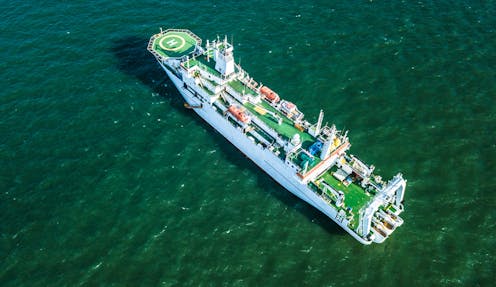
Repairing damage to undersea cables requires specialist ships that draw the cable to the ocean’s surface. One by one, the individual glass fibre strands are separated, cleaved with a diamond blade (to achieve clean polished ends on the strands), and then fused or welded back together to complete the repair.
The repaired link is mechanically strengthened with a protective covering, after which the network engineers run a range of tests before the link can carry network traffic again.
In yesterday’s events, however, the damage to the two fibre-optic cables happened along their land routes, so repair crews could fix them relatively quickly. Had the cables been damaged at undersea locations, repairs could have taken days.
Any delays yesterday would have mainly been a result of getting the right equipment and technical crews to the locations – especially the more remote one on the Tasmanian side.
What’s the fix?
The digital blackout highlighted Tasmania’s over-reliance on the current fibre links. The Tasmanian government has in the past failed to be part of other undersea cable projects that could have provided a more diverse connection between Tasmania and the mainland.
The state could run into more trouble in the future, should it fail to bolster its connective capabilities.
As the distance between Tasmania and the mainland is about 200km, deploying wireless links (such as those used by radio towers) wouldn’t be realistic. This would require very high antenna towers and multiple repeaters in the sea.
And while NBN satellites could be used to provide some connectivity, undersea cables remain the best option.
Ideally, there should be investment not only in establishing a potential fourth cable link, but also in upgrading the existing infrastructure to broaden its capacity. Cables would still be impacted during adverse events, but the entire system would become much more resilient overall.
Diversity in the cable network is also critical, especially in terms of the physical cable routes. In situations where links are damaged, we need to be able to reconfigure the network quickly (and without human intervention). So even if a fault happens, signals can be automatically rerouted to bypass faulty links.
With the world’s increasing dependence on digital connectivity, and the emergence of 5G, operators like Telstra and newcomer HyperOne are planning to build new national fibre networks.
In February Telstra announced plans to expand its current network in Australia, with roughly A$1.6 billion worth of upgrades expected – but specifics about where and how the money will be spent aren’t known.
HyperOne also has plans to build additional undersea cables linking Perth, Adelaide, Melbourne, Launceston, Hobart and Sydney. This could provide more diversified connectivity to Tasmania.
Authors: Thas Ampalavanapillai Nirmalathas, Professor of Electrical and Electronic Engineering and Deputy Dean Research at Faculty of Engineering and Information Technology, The University of Melbourne


















