

From 'Toby Tosspot' to 'Mr Harbourside Mansion', personal insults are an Australian tradition
- Written by: Frank Bongiorno, Professor of History, ANU College of Arts and Social Sciences, Australian National University
The insults have been flying thick and fast. Malcolm Turnbull is “Mr Harbourside Mansion”, “Top Hat” Malcolm, “the slick merchant banker”, “the top end of town” man. It is a measure of the unhappiness in the Coalition that not all of these epithets were invented by Labor.
Meanwhile, Bill Shorten is, according to Turnbull, a “sycophant”, a “groveller”, a “man who abandoned workers” while he “tucked his knees under” the table of billionaires like the late businessman Richard Pratt.
The red faces, raised voices and flying spittle that accompany the parliamentary trade in insults are meant to convey passion and spontaneity. But we can be confident the lines have been sorted well in advance.
Turnbull’s insults, for example, made in parliament just recently, largely repeat things he said in February last year when he called Shorten “a social-climbing sycophant” and “would-be tribune of the people”. On the other side, Labor has been seeking to present Turnbull as an out-of-touch Sydney snob from the day he took office.
Do such insults work? We know from the research of Australian political scientists – such as my colleagues here at the Australian National University who produce the Australian Election Study – that elections have become increasingly personalised. Most voters do not comb through policy documents. Rather, they use the party leader as a means of making judgments about the things that matter to them.
Read more: An evening with the treasurer: how governments belt out budget hits and hope someone is listening
So, the Labor Party hopes that, if it can make enough mud stick to Turnbull, it can present him as unqualified to make decisions about the welfare of ordinary people. Being so rich, they suggest, he is out of touch with their concerns.
The Coalition hopes that if it can make its mud stick, Shorten will be seen as a self-serving opportunist who built a union and political career by taking advantage of the workers he was supposed to represent.
There is nothing new here; the appeal on each side is a traditional one.
Labor cartoonists of a previous era would often draw Mr Fat – an obese capitalist – complete with top hat, tails and cigar, the very embodiment of greed and excess. They would sometimes set him beside a brawny, manly worker determined to resist his wiles.
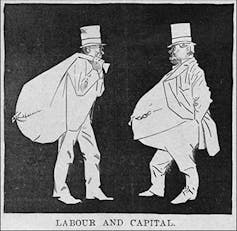 Phil May, ‘Poverty and Wealth; It all depends on the position of the bundle’, Bulletin, c. 1887.
State Library of New South Wales via Monash University Publishing
Phil May, ‘Poverty and Wealth; It all depends on the position of the bundle’, Bulletin, c. 1887.
State Library of New South Wales via Monash University Publishing
The anti-Labor images of the union boss as a parasite on the working man, and of the Labor politician as self-serving careerist, have existed as long as the Labor Party itself.
Political name-calling and insults are sometimes like water off a duck’s back. But others can stick. The radical Daniel Deniehy’s lampooning of William Wentworth and his followers in 1854 for wanting to create “a bunyip aristocracy” of titled men to fill a colonial upper house was recalled for generations. (Personally, I’ve always thought the funniest jibe was Deniehy’s suggestion that James Macarthur’s coat of arms as “Earl of Camden” should include a rum keg, a reference to his father’s role in the commerce and politics of early New South Wales.)
Paul Keating’s question about an Andrew Peacock leadership comeback – “Can a soufflé rise twice?” – was perfect in every way, as was his designation of Liberal leader John Hewson, “the feral abacus”.
But Keating’s quips went down better with the press gallery and the intelligentsia than the ordinary punter, and he had to endure insinuations that an enthusiast for Italian suits and French clocks could not be a true Labor man.
Bob Hawke, more than Shorten, acquired a large coterie of “close personal friends” among the rich and the filthy rich. But this was probably an advantage in his early days as prime minister, when he talked of consensus between workers and bosses in the national interest. As the feeling developed that his friends were doing very nicely while most others were doing it tough, the term “rich Labor mates” became shorthand for the idea that Hawke and Keating had sold out the workers.
Hawke was “the silver bodgie”, a reference to the colour of his still luxuriant hair, somewhat like that of a 1950s “bodgie”, a stylish youth somewhat in the James Dean mould.
But some of our political leaders have had nicknames that were more distinctly pejorative. The Sydney Bulletin called Australia’s first prime minister, Edmund Barton, “Toby Tosspot”: he had been known as “Toby” much of his life and a “tosspot” was a vulgar term for an enthusiastic drinker.
“Affable Alfred”, for Deakin, was affectionate but could be used by opponents sarcastically when he wasn’t being quite so affable. “Jolly John”, for John Gorton, sounds affectionate, until you recall that it was a reference to his erratic personal behaviour.
“Honest John” – for Howard – was mainly used ironically rather than descriptively. But Howard’s own claim that Kim Beazley lacked “ticker” is usually seen as having worked on voters looking for strong leadership and doubtful the Labor opposition leader could provide it.
Read more: Mis-red: why Bill Shorten is not a socialist
Robert Menzies’ critics on the left called him “Pig Iron Bob” after his role, as a member of the Lyons government, in opposing union bans on the shipping of pig iron to Japan. The epithet, which stuck throughout his long career, was intended to remind people of Menzies’ poor judgment and association with the policy of appeasement of the Axis powers. It was a potent rhetorical weapon during the 1940s and even became the subject of radical folksong but, as the years of his prime ministership rolled on after the war, it seemed to do him no obvious harm.
Highly personal assaults can backfire badly. The best example from Australian politics is Country Party leader Earle Page’s savage attack on Menzies in 1939 for failing to enlist in the first world war. Menzies had wanted to serve but already had brothers at the front, so remained behind as the result of a family decision.
Page’s career never recovered from the disgust that his attack induced. That didn’t stop the mischievous Labor firebrand, Eddie Ward, from later joking that Menzies’ brilliant military career had been cut short by the war. It’s a tough place, the federal parliament.
Authors: Frank Bongiorno, Professor of History, ANU College of Arts and Social Sciences, Australian National University


















