

There are some single-use plastics we truly need. The rest we can live without
- Written by: Paul Harvey, Researcher of Environmental Science, Macquarie University
A Senate report this week recommended a ban on single-use plastics such as takeaway food containers and plastic-lined coffee cups by 2023.
This week will see Australians take a significant step towards that plastic-free future, with major supermarkets turning their backs on throwaway plastic bags, and an outright ban on free plastic bags at shops in Queensland and Western Australia.
Read more: Plastic-free campaigns don't have to shock or shame. Shoppers are already on board
It is remarkable how far we have already come in the effort to reduce our plastic pollution. We are rapidly reaching the point at which the relevant question is not “which plastics can we do without?”, but “which single-use plastics do we genuinely need?”
Legitimate uses
Most of us will get along just fine without throwaway plastic in our daily lives. But there are nevertheless many legitimate applications for single-use plastics.
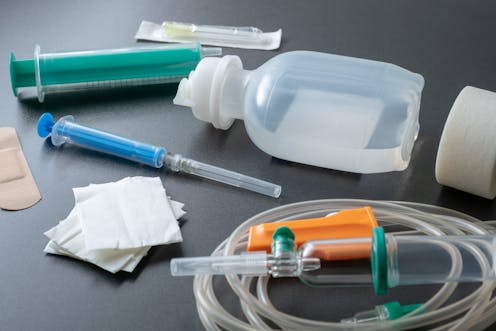
Take medicine, for example, where single-use plastics are a key part of infection control. Having a blood test requires gloves made from plastic, a plastic syringe, and a plastic vial, all of which are single-use to control contamination and infection. While glass is often suggested as an alternative, this introduces challenges in cleaning, transport and availability, particularly in emergency situations where resources may be limited.
Single-use plastics also play a role in scientific research. Many scientists cringe as they look at their waste bin at the end of a session in the lab. Typically, it will be filled with pipettes, gloves, vials, sample bags, and the list goes on.
These items are used for their strength and resilience, and because they prevent cross-contamination of sampling. As with medical applications, many substitute materials do not provide the protection or stability that single-use plastics do.
Single-use plastics are often used to package food and water. While this is unnecessary in most settings, certain situations do require single-use packaging to ensure food and water safety. Domestic food aid, emergency responses, and international aid efforts all require food and water that can be stored without refrigeration and distributed when and where it’s needed. Often this means packaging it in lightweight, single-use plastics.
While the proposed bans on single-use plastics should be recognised and applauded as an important step forward in the global fight to prevent plastic pollution, we should ensure that we have thought through all the scenarios where single-use plastic may be a legitimate necessity.
Consider the case of someone with a disability who can only eat with the aid of a flexible plastic straw. Without appropriate exemptions, a federal legislative ban on single-use plastic straws could prevent people in need from accessing a basic medical aid.
Mass plastic begone
There is no doubt that single-use plastics are a major source of pollution. Recent research has shown plastic pollution to be as ubiquitous in the global environment as the more familiar pollutants like lead. Plastic has been found at the deepest depths of our oceans and the greatest heights of our mountains. No country on Earth is immune to plastic pollution, from tropical islands to deserts. All of this pollution has happened in less than a century.
As a society we are realising the damage that single-use plastic is doing to the environment. That’s why a carefully legislated ban on almost all single-use plastics is a good idea. From throwaway food containers, to drinking straws, to coffee cups – we can live without almost all of it.
If you take a stroll down a busy city block today, you will see a people clutching reusable coffee cups, or eating food wrapped in brown paper, or carrying a drink bottle that they can refill at a free public water station. We as a society are changing.
We are also seeing a shift in governance and policy. Earlier this year, the European Union announced a ban on single-use plastic products with readily available alternatives. Seattle has been on a path to ban single-use plastics for many years, with the latest efforts aimed at banning plastic utensils, straws and cocktail picks. The move away from single-use plastics has even been adopted by McDonald’s, which will trial plastic-free straws later this year.
Read more: How 'nudge theory' can help shops avoid a backlash over plastic bag bans
Amid these trends, we need to ensure that we have the right strategy to accommodate those who still depend on single-use plastics. This would include thinking seriously and developing single-use products that have a reduced environmental impact and can be used in these applications.
For the rest of us who need to kick our single-use plastic addiction, you can start today (if you haven’t already) by saying no to plastic straws and taking a reusable cup to your favourite coffee cart.
Authors: Paul Harvey, Researcher of Environmental Science, Macquarie University


















