

As borders open and international travel resumes, will New Zealand's sky-high aviation emissions take off again?
- Written by: Robert McLachlan, Professor in Applied Mathematics, Massey University
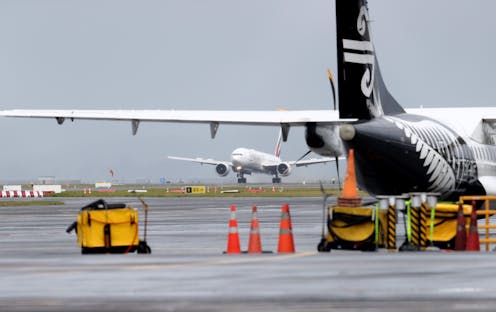
After two years of entry restrictions, New Zealand is re-opening its borders. Already, New Zealanders can re-enter the country without quarantine; they will be followed by Australians on April 12 and the rest of the world on May 1.
Families will be able to reunite. Grandparents will be able to visit new grandchildren for the first time. And the tourist industry is very keen to get cracking again.
But as international travel resumes, we should make sure flying doesn’t return to 2019 levels. That was incompatible with a safe climate and global emissions targets. At 2019 levels, there would be just ten years of flying left in the carbon budget for 1.5℃.
In 2019, New Zealand aviation emissions were 4.9 million tonnes of carbon dioxide (CO₂), having risen 43% since 2014 to become the sixth highest in the world per capita. At 12% of New Zealand’s total CO₂ emissions, they were a substantial chunk to be dealt with.
Domestic aviation is included in New Zealand’s Emissions Trading Scheme (NZETS) and carbon budgets. International aviation emissions are measured but are not included in national targets or regulations.
Last November, at COP26 in Glasgow, New Zealand joined the International Aviation Climate Ambition Coalition and committed to:
Preparing up-to-date state action plans detailing ambitious and concrete national action to reduce aviation emissions and submitting these plans to ICAO [International Civil Aviation Organization] well in advance of the 41st ICAO assembly.
This assembly of the UN’s International Civil Aviation Organization will take place in September 2022.
How to cut aviation emissions
In a new report, economist Paul Callister and I look at all the options. What would “ambitious and concrete action” to reduce aviation emissions look like for New Zealand?
Change is in the air. There are new proposals for net zero aviation by 2050 from the EU, the UK, the International Air Transport Association, the International Energy Association, and Air New Zealand.
In New Zealand, a two-seater electric plane with a 130km range crossed the Cook Strait for the first time in November last year. Unfortunately, its larger cousins won’t be here soon enough or in large enough numbers to affect emissions overall.
Despite the media attention on electric and hydrogen aircraft, they do not feature strongly in New Zealand’s plans. Larger electric aircraft don’t exist yet and we need to act sooner than they will become available.
Better fuel technology
Offsetting (by planting trees, for example) is a temporary fix. It transfers risk to the next generation and does not get at the root of the problem, which is burning fossil fuels. Most pathways do not rely on much offsetting.
For the next few decades, emissions will be determined by traffic volumes, efficiency and sustainable aviation fuel.
Efficiency can be encouraged by using the most fuel-efficient planes (and possibly banning the others), filling them as much as possible, flying efficiently and increasing the price of fuel through a carbon charge or a sustainable fuel mandate, or both.
Read more: NZ tourism can use the disruption of COVID-19 to drive sustainable change — and be more competitive
Sustainable aviation fuel is the main technological solution on the table. By 2035, New Zealand could conceivably build two NZ$520 million wood-based biofuel plants, producing 57 million litres a year each, and one 100MW e-fuel plant producing 40 million litres a year. Together they would provide 8% of New Zealand’s jet fuel at 2019 levels of demand.
However, neither of these technologies are yet in commercial use; the first demonstration plants are only now under construction. The uncertainties are large.
Traffic volumes are affected by price and regulation. Industry projections of very high growth (up to 120% by 2050) are not compatible with the Paris Agreement.
The present free ride for international aviation (no GST, no carbon charge, no fuel tax) is an obstacle. But now that the EU is considering a tax on jet fuel, this could change.
Curbing frequent flying
Flying less is the main remaining tool in the toolkit. Air travel is strikingly unevenly distributed. In Europe, 90% of households have aviation emissions of 0.1 tonnes of CO₂ per person per year (equivalent to one Auckland–Sydney return trip every four years); 9% emit 0.8 tonnes (Auckland–LA every two years); and the top 1%, 22.6 tonnes (Auckland–London six times a year).
So less frequent flying, especially by the hyper-mobile, has to be part of the solution. Non-flyers cannot reduce their aviation emissions. The Jump campaign asks people to limit flights to one 1500km return flight every three years, a level derived from a study of urban lifestyles compatible with 1.5℃.
Read more: NZ tourism can use the disruption of COVID-19 to drive sustainable change — and be more competitive
The natural experiment of the COVID pandemic prompts the question of how essential such frequent flying is to well-being.
Stats New Zealand monitors well-being following international guidelines. While 81% of the population reported high overall life satisfaction in 2018, this rose to 86% in 2021. People adopted substitutes for international travel, including telecommunications, domestic tourism and local tourism.
The economy also grew, up 3.4% from 2019 to 2021.
However, there are confounding factors, namely the government stimulus, social solidarity and knowledge of the health risks of travel.
A recent UK study considers the role of curbing excess energy consumption in a fair transition. After comparing ten possible definitions of “excess”, they conclude that:
excess is whatever people can agree it is, based on ideas of “fairness” and “just” levels of consumption that can be rationalised, defended and justified to others … any policies that are used to target excess consumption and excessive consumers must be similarly reasonable and justifiable, based on the principles of deliberative democracy and exploring options, impacts and fairness with members of the public.
Two key events of the past decade reinforce the urgency of the situation. The first is the proven ability of the New Zealand aviation industry to increase emissions at a staggering rate when unregulated, as observed from 2014 to 2019. The second is COVID. Ensuring that aviation emissions remain permanently well below 2019 levels will make the longer-term task significantly easier.
Authors: Robert McLachlan, Professor in Applied Mathematics, Massey University


















