

Look up #happycity and here's what you'll find
- Written by: Sofie Pringle, PhD researcher & consultant, Queensland University of Technology
City planners and designers want to build cities that are liveable, healthy and smart. Yet, in the abundance of research and guidelines on how to make healthy cities, happiness seems to be missing.
Research shows urban environments have an impact on our well-being and mental health, affect our behaviour and moods, interactions, day-to-day lives and even alter how our brain functions.
Read more: Tweet all about it – people in parks feel more positive
Our recent study found people associate their happiness with particular natural and built elements in the environment. This highlights how we can improve the design of cities to enhance people’s happiness.
Searching Instagram
In the first part of our study, we searched Instagram for images of the city people associated with happiness. We did this using four hashtags:
- #cityhappy
- #happycity
- #cityofhappiness
- #urbanhappiness
The images came from all corners of the globe, with no geographical limitation.
We sifted through hundreds of images, excluding photographs that were “selfies”, had non-urban attributes, or if they included people posing. Overall, we narrowed it down to 196 images, all of which exhibited characteristics of an urban area.
We found photographs tagged with one of the above hashtags consistently featured particular design elements. These were:
- open space
- natural elements (vegetation, sand, rocks)
- historic or heritage buildings
- colour
- medium density buildings (up to six storeys)
- water
- human scale buildings (horizontal rather than vertical).
The same features came up time and again, irrespective of demographic and geographic location. This supports the idea there may be universal urban features that enhance happiness.
We then tested these themes on Brisbane residents through an online questionnaire.
 Water and vegetation came up time and again as relating to happiness.
screenshot/Instagram
Water and vegetation came up time and again as relating to happiness.
screenshot/Instagram
Online survey
Twenty-two people took part in the online survey. They were asked to evaluate their happiness relative to different features, characteristics and images of areas in Brisbane. The survey comprised a series of multiple choice, selection and rating questions.
The results showed participants associated happiness with the same features as those who had posted on Instagram using the above hashtags. Most common to happiness was open space (86% of respondents) and natural lighting (81%).
Read more: Sustainable cities need more than parks, cafes and a riverwalk
Natural spaces with greenery such as parks, gardens and areas with trees, as well as areas that had water, had a significant positive impact on respondents’ happiness. Proximity to facilities, walkability of the area, green belts and views to mountains were also significant factors.
Historic or heritage character buildings ranked pretty highly (72%), over the more modern style buildings. Laneways also scored pretty highly (72%) as did views of the city (68%) and colour (59%). We noticed people liked other things, such as the materials used on sidewalks, roads and building facades.
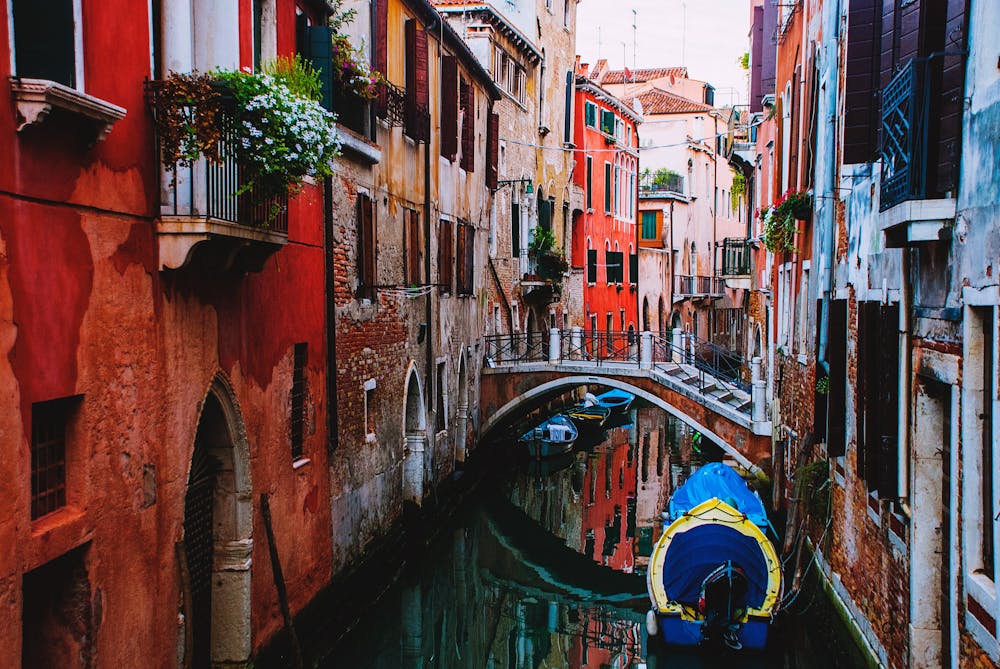 Colourful buildings, like these in Venice, are associated with happiness.
Toa Heftiba/Flickr
Colourful buildings, like these in Venice, are associated with happiness.
Toa Heftiba/Flickr
This pilot study confirms there are specific elements which can be incorporated and factored into the planning and design of cities to enhance people’s happiness. Our further research is currently building on these initial findings, focusing on the relationship between density, urban design and happiness.
How can we use this?
Happiness is a major component of human well-being. But it isn’t factored into the widely recognised quality of life (including health, well-being and a number of economic factors) and liveability (including the standard of living) surveys of cities.
Some evidence suggests average happiness levels in Western nations haven’t improved in the last 68 years (since 1950). This is despite first-world incomes more than doubling in that time.
Read more: What might explain the unhappiness epidemic?
Happiness studies look at the links between human “subjective well-being” and the environment. We can determine people’s preferences, subjective view and association with elements of the built environment through research, and then apply the lessons to design to improve the quality of the urban environment.
Our research highlights the key elements to be cognisant of in urban transformation projects and designing for future urban areas. These findings show we can use such knowledge and apply this to existing cities to retrofit them for happiness.
People are increasingly leaving the broad acre, single detached home to live in denser, more compact urban areas. There are many benefits to this urban settlement. But to make this lifestyle compatible with human happiness and foster mental health, the design, planning and governing policy needs to consider such factors.
Density can be done well, if happiness becomes part of the equation.
Authors: Sofie Pringle, PhD researcher & consultant, Queensland University of Technology
Read more http://theconversation.com/look-up-happycity-and-heres-what-youll-find-97248


















