

There's $1.3 billion for women's safety in the budget and it's nowhere near enough
- Written by: Kate Fitz-Gibbon, Director, Monash Gender and Family Violence Prevention Centre; Associate Professor of Criminology, Faculty of Arts, Monash University
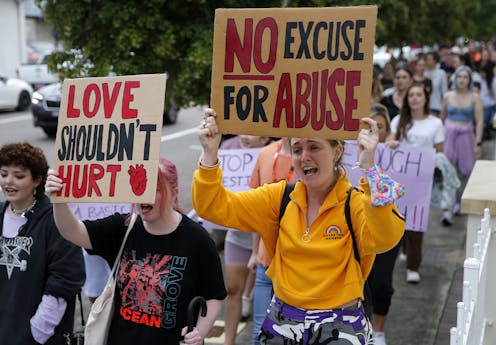
Halfway through his budget speech on Tuesday night, Treasurer Josh Frydenberg acknowledged the women’s safety crisis in Australia.
one in four women are subject to domestic violence and tragically, every 11 days, an Australian woman loses her life at the hands of her current or former partner.
He announced A$1.3 billion for women’s safety, a slight increase from the $1.1 billion committed last year.
However, in the absence of a new National Plan to end Violence against Women and Children, the commitments are piecemeal and lack detail. Many are not even new.
What has the government announced?
The $1.3 billion budget spend includes:
$222 million in prevention initiatives, including the previously announced $104.4 million over 5 years to support the work of Our Watch, Australia’s leading prevention organisation and a funds for consent education
$52.4 million over 4 years to protect victim-survivors against cross-examination by family violence perpetrators
$20 million over 4 years to establish a women’s trauma recovery centre at the Illawarra Women’s Health Centre
$3.4 million to support the implementation of recommendations from the Respect@Work report
$6 million over 4 years to update the federal government’s respectful relationships education online platform
While these are positive moves, we must compare priorities.
Take for example, $3.7 billion for fast rail in the budget, or $9.9 billion for cyber capabilities. The rhetorical commitment to the importance of women’s safety is not borne out by financial investment.
Where does the budget focus attention?
We also have ongoing concerns about the way violence against women is framed by the budget.
The Women’s Statement (a separate budget booklet) focuses on prevention as a women’s issue, with targeted efforts for key populations. It never mentions men as central to this work.
Prevention work is absolutely critical to reducing violence against women, but we need men to be a core part of this, and we need to name the problem of men’s violence.
Funding for First Nations services
The budget repeats the announcement for a dedicated Aboriginal and Torres Strait Islander Action Plan led by the Aboriginal and Torres Strait Islander Advisory Council on family, domestic and sexual violence.
This is an important step, but the commitment is overshadowed by stark omissions elsewhere in the budget. Efforts to better support First Nations women experiencing family violence will not be helped by the budget’s failure to adequately fund Aboriginal family violence and legal services.
Read more: A cost-of-living budget: cuts, spends, and everything you need to know at a glance
As peak groups such as Change the Record note:
Aboriginal and Torres Strait Islander Legal Services are suffering from a demand we cannot meet due to severe under-resourcing [and] understaffing […] Adequate funding for [Aboriginal and Torres Strait Islander Legal Services] means that Aboriginal and Torres Strait Islander people can access culturally safe legal support when and where they need it.
The budget also announced the continuation of financial and legal support for temporary visa holders if they experiencing family violence. But there is no extension of this measure. Again, it remains a piecemeal response that does not fix the limited access to support for temporary visa holders, or the need for reform to the visa and migration pathways for non-citizens who experience family violence.
Who is accountable?
The budget includes a previously announced $22.4 million over five years to establish the National Domestic, Family and Sexual Violence Commission. This would monitor and oversee the implementation of the next national plan.
The commission could be an important accountability mechanism, but we need to get this right. If we’ve learned anything from developing the new national plan, it is that politics and bureaucracy can often get in the way of urgent work.
The current national plan expires in July and as yet, there is no set date for the release of the next one.
Our verdict
Our key message is the detail matters. We need to pay careful attention to implementation, to sustained commitments and to evaluation of what works in practice.
We need to ensure conversations about violence against women always include men. We must recognise it is men’s violence that we are primarily seeking to address and eliminate. Men have been largely absent from the commitments made to address violence against women. The budget repeats this mistake.
We need a federal commitment that is not focused on announcements and addressing the key headline “issues”. Instead, we need a commitment to recognising the systemic ways women’s inequality is linked to violence, and how violence and abuse is sustained via inequality.
Women’s safety does not exist in a vacuum. Glaring concerns continue, around un- and underemployment, slow wage growth, the cost of living, gender inequality and superannuation and the long-term impact on women working in the least valued jobs.
As Frydenberg rightly acknowledged in his speech, the human cost of not getting this right is ever present. In the last week, five women have been killed in Australia, allegedly by male violence.
This is urgent and the budget is not offering the transformational level of funding required to match the Morrison government’s stated objective to “eliminate” violence against women and children.
Authors: Kate Fitz-Gibbon, Director, Monash Gender and Family Violence Prevention Centre; Associate Professor of Criminology, Faculty of Arts, Monash University


















