

the government spends big on its 'khaki election' strategy, but neglects diplomacy and other 'soft' power
- Written by: Peter J. Dean, Chair of Defence Studies and Director, UWA Defence and Security Institute, The University of Western Australia
The Morrison government has been signalling for some time that it wants the 2022 federal election to be a so-called “khaki election”: one big on defence and national security.
So what was in the budget to support this aim?
The big funding announcement on budget night was an additional A$9.9 billion over ten years for the Australian Signals Directorate (ASD) for offensive and defensive cyber capabilities. That will mean a doubling of ASD’s budget over the next few years.
Interestingly, 85% of ASD’s funding will come from defence funding – specifically, out of Defence’s Integrated Investment Program (IIP) or its capability acquisitions. This is an interesting offset, and points to a freeing up of funding in the IIP that may well be due to the cancellation of the French-designed attack class submarine program.
Read more: A cost-of-living budget: cuts, spends, and everything you need to know at a glance
At the moment, defence has no contract for a new submarine. Under the “AUKUS” agreement with the United States and United Kingdom, the 18-month consultation phase is still ongoing. The budget papers note that “the costs of [this] consultation will be met from within the existing Defence budget”.
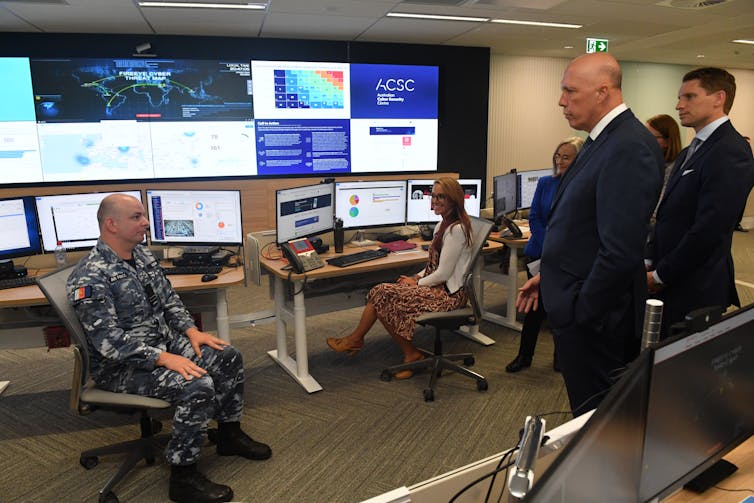
The focus on cyber is a sage investment from the government. It comes off the back of the launch of ASD’s new cyber and foreign intelligence facility on March 22, and Prime Minister Scott Morrison’s announcement of a cyber and critical technology centre inside our peak intelligence assessment agency, the Office of National Intelligence.
In his speech on Monday night at a Parliament House dinner to mark the 70th anniversary of the ANZUS security pact, Morrison announced:
This multi-agency centre will ensure Australia, working with our allies, can better anticipate and capitalise on emerging technologies.
These two initiatives seem intricately woven into the fabric of the AUKUS deal announced last year. They represent a focus on “critical investment[s] in our digital sovereignty”.
A less rosy outlook for veterans’ affairs
It is worth noting it was not all smooth sailing in the preparation of the budget in terms of defence. While Morrison and Defence Minister Peter Dutton were happy to splash money on defence capabilities, over in veterans’ affairs things were not so rosy.
Veterans’ Affairs Minister Andrew Gee launched a very public attack on his own government, revealing he had been on the verge of resigning because he was being refused funding for his department.
This has long been an area of great concern for the defence community. In his spray, Gee revealed he had 60,000 unprocessed claims within his department, labelling the situation a “national disgrace”.
Off the back of a Royal Commission into Defence and Veterans Suicide, and the underperformance of veterans’ affairs, this pre-election internal battle was both colossally bad policy and ham-fisted politics.
Meanwhile, diplomacy is neglected
One of the key aims of the 2020 Defence Strategic Update was a focus on “shaping” Australia’s strategic environment. A key part of defence’s international engagement is defence cooperation. But as journalist Andrew Green noted, Australia is spending $2.5 million less on this than last year.
Given the concerns about a potential Chinese base in the Pacific, however, Greene also notes the government has budgeted $24,000 more this year for the Solomon Islands.
One of the key tools for Australia to shape the regional environment is through diplomacy. It’s hard to believe Morrison when he argues that:
…in these uncertain times it is vital that Australia is well-positioned to tackle the challenges our country and our region face,
while his government continues its woeful neglect of DFAT, with spending on diplomacy cut from $1.33 billion this year to $1.25 billion in 2025-26.
This continues the long-term underfunding of diplomacy and foreign aid at the very time the government is shrieking about competition in China and a deteriorating international environment.
What this part of the budget reveals is the ongoing problem of the lack of an integrated, whole of government approach to national security. We do not have a national security strategy to guide and direct government efforts. Instead, we are seeing large injections of funds into hard power through defence while soft power, aid, diplomacy, education, climate policy and a host of other key areas are bled of funds or stagnate.
This means that despite the strong rhetoric from the government on the risk and threats we face in international security, there is only piecemeal national security policy-making.
Magical numbers and the federal election
As noted in a previous column , the government has been running hard on defence and national security in the shadow election.
It wants voters to focus on its record spending on defence and Labor’s supposed failures in this area in their last term in office. In fact, Treasurer Josh Frydenberg led his budget speech with the government’s main line of attack on the opposition during his budget speech:
…those opposite let defence spending to fall to its lowest levels since 1938.
Frydenberg was specifically referencing Labor’s defence spending in 2013 as percentage of gross domestic product (GDP): 1.56%. This contrasts with the government’s commitment of 2% of GDP and its realisation of 2.11% in the 2022-23 budget. This is the government’s “magical number”, and it will continue to hammer this home to the electorate at any chance.
However, GDP is rather an odd measure for defence spending. It compares it to the total cost of goods and services in the economy. There is no automatic link between the security of a nation and the percentage of its GDP spent on defence, it doesn’t make for good strategic planning and its highly misleading as a form of historical and regional comparison.
What’s more, few portfolios in government are measured this way – does anyone know the percentage of spending on housing, education, health care or social services related to GDP?
Labor will mostly likely zero in on 6.1% as its “magical number”. That is the percentage of actual government spending on defence in the budget. Since Morrison became treasurer and then prime minster, this has been on a downward trend.
Spending on defence has fallen as a percentage of government outlays in the budget, from 7.53% in 2015-16 to 5.1% in 2020-21. It is now estimated at 6.1% in 2022-23.
Labor, in its last year in office in 2012-13, spent 6.65%. Its average spend on defence in its six years in office (2007-13) was 7.15%. During Morrison’s past six years as treasurer and prime minister it was only 6.42%.
In the end, the government is right to say it is spending records amounts on defence. However, Labor is also right to say that as a percentage of the actual budget, it spent considerably more than this government has.
As we move from the shadow to the real election campaign in the coming days, expect to hear a lot more about the ins and outs of defence spending.
Authors: Peter J. Dean, Chair of Defence Studies and Director, UWA Defence and Security Institute, The University of Western Australia


















