

Prawn white spot virus, and how we tracked down its source in Asia
- Written by: Wayne Knibb, Professor, University of the Sunshine Coast
This week Four Corners aired Outbreak – an investigation into alleged “quarantine failures putting the Australian economy at risk”.
The story in part reviewed how a pathogen known as White Spot Syndrome Virus (WSSV) had decimated prawn farms located along the Logan River in Queensland.
Some of my published research was presented as part of this ABC report. These data, with earlier reports, support the argument that Australia’s biosecurity arrangements were breached by WSSV from Asia. The most likely route of infection appears to be via imported infected retail prawns – the ones we buy raw and frozen in supermarkets – perhaps used by fishers as bait.
We have the tools to be able to detect the origin of WSSV in imported seafood products. It’s hard to understand why these weren’t being used widely to good effect as part of our biosecurity protocols.
Read more: Why Australia imports so many veggie seeds (and do we really need to treat them with fungicides?)
What is White Spot Syndrome Virus (WSSV)?
WSSV is a very large DNA virus, the sole member of the Whispovirus genus of viruses. It has many unique genes not present in any other species.
It is a dangerous, virulent virus for prawns and other crustaceans; it can produce rapid onset of mass mortality (80% or more) in farmed prawns within days. However WSSV does not infect humans.
After being first detected in Taiwan and China in 1992, WSSV spread world wide. Within a decade or so it had infected all prawn-producing countries except Australia. WSSV has caused billions of dollars worth of damage and impacted the economy of whole nations.
Read more: Australian commercial fish populations drop by a third over ten years
Outbreak in 2016
Until 2016, the Australian prawn industry was considered free of WSSV.
In November-December 2016, there was an outbreak of WSSV in commercial Penaeus monodon prawn farms located on the Logan River in Queensland, northeast Australia. This resulted, directly and indirectly, in the loss of all prawn production on the Logan river.
In May 2017 Barnaby Joyce – who was Acting Prime Minister and Minister for Agriculture and Water Resources at the time – reportedly said of the outbreak “neither my department nor Biosecurity Queensland have been able to determine the cause at this point, and there are a number of plausible pathways.”
Knowledge of the source and pathway of the infection is important to prepare against future incursions. It’s also important if compensation is claimed by affected fishers and farmers for losses and by the Queensland State Government for eradication costs.
Read more: New Zealand's hoki fishery under scrutiny after claims of fish dumping, misreporting
Was the virus already in Australia?
Possible explanations for the presence of WSSV in the Queensland prawn stocks included:
- Pathway 1: WSSV present in Australia without prior detection
- Pathway 2: WSSV introduced via aquatic feed or feed supplements
- Pathway 3: WSSV introduced in imported raw prawns used as bait.
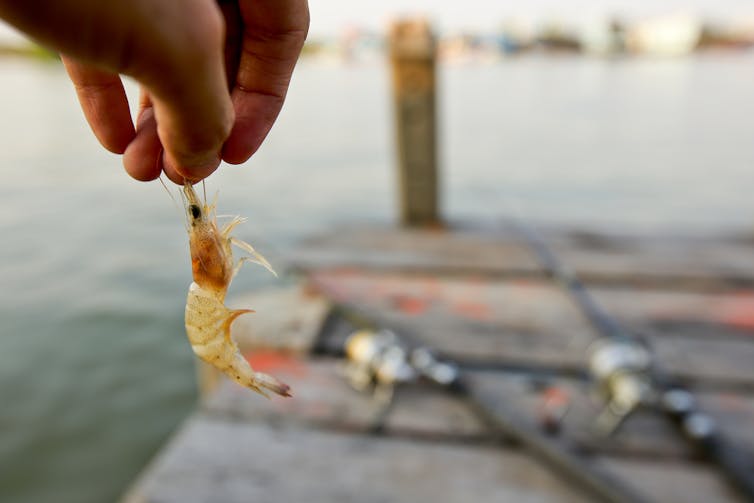 Raw prawns are commonly used as bait for fishing in Australian waterways.
from www.shutterstock.com
Raw prawns are commonly used as bait for fishing in Australian waterways.
from www.shutterstock.com
My colleagues and I obtained DNA sequences from farmed shrimp at the time of the outbreak, and we used genetic technologies to examine the virus DNA in those samples. As reference samples for comparison, we had WSSV DNA originally from infected prawns farmed in two locations in Vietnam.
We found that DNA sequences from a particular region (known as a “conserved region”) of the Australian WSSV were identical to the overseas WSSV strains.
If the virus had been in Australia without prior detection, we would have expected to see changes in this area of DNA. These results rule out Pathway 1 above, and lead us to conclude an exotic virus has breached Australia’s biosecurity.
Read more: Curious Kids: Why do crab and prawn shells go red after they have been cooked?
How did it get here?
To further refine knowledge of the source, we scanned the whole WSSV genome and developed primers (these are molecules used to target areas for DNA amplification and detection) specific for key variable regions. These regions are parts of the virus DNA that vary across viruses from different geographical areas, and can potentially identify the origin of an infection.
We compared these DNA sequences to sequences we obtained from a number of other sources:
- farmed, WSSV-infected Vietnamese prawns
- imported prawns bought from supermarkets (from several countries)
- those previously published by other scientists.
A very close match was made with sequences detected in WSSV-infected prawns from China.
As part of this published study, we incidentally found more than 90% of imported retail processed prawns samples were positive to WSSV. We tested around a dozen items sourced from local Sunshine Coast retail outlets.
We also tested prawn feeds from the time of the Logan River outbreak – albeit from only two samples – and found no WSSV DNA.
The only place we detected WSSV was in imported prawn retail products. This finding confirms a report of WSSV found in imported prawns in 2004.
Prawns used as bait
The only hypothesis that stands up in light of our evidence is that WSSV was introduced into Queensland waterways through uncooked, imported prawns bought in supermarkets and used by people as bait. This issue that was raised as a potential problem in 2006 by Queensland Fisheries Minister Tim Mulherin.
It’s possible the WSSV virus is now endemic in Australia. In other countries where white spot has become established, I’m not aware of any report that WSSV has subsequently been eradicated.
To me this suggests we need to do biosecurity science better. If we embedded this process in some type of independent statutory authority – like the relatively independent Research Development Corporations – we could create greater effectiveness in warning Australia about importation risks. This approach would also allow more robust science to develop, and facilitate the safe import of potentially dangerous products like prawns.
Australia is an island nation, and it must trade. But it needs to do this safely.
Authors: Wayne Knibb, Professor, University of the Sunshine Coast
Read more http://theconversation.com/prawn-white-spot-virus-and-how-we-tracked-down-its-source-in-asia-99290


















