

All new smaller size! Why getting less with shrinkflation is preferable to paying more
- Written by: Jun Yao, Senior Lecturer in Marketing, Macquarie University

Have you noticed your favourite chocolate is a little smaller, there are fewer biscuits in the same-sized package or bags of chips contain more air?
If you haven’t, you’re not alone.
What marketers call a “contents reduction strategy” is more popularly known as “shrinkflation” – reducing the size of a product while the price remains the same.
It’s a comparatively recent phenomenon in the supermarket business, reflecting the pressure on manufacturers to keep prices down. In fact the word “shrinkflation” entered the lexicon only in 2009.
Since then, manufacturers have “shrunk” everything from jars of Vegemite, Maltesers, Tim Tams, Freddo Frogs and Corn Flakes. In the United Kingdom, the Office for National Statistics counted 2,529 examples between 2012 and 2017.
So why does shrinkflation seem preferable when it is effectively the same as putting up the price?
To investigate this, we conducted experiments playing with consumer perceptions of changes in prices and volume sizes. Our results show the innate cognitive bias shoppers have towards focusing on price, no matter what.
How we tested the shrinkflation effect
In our experiments we wanted to measure the relative effect of different strategies to increase a product’s per-unit price.
We simulated this in real-world conditions by manipulating shoppers’ perceptions of products for sale in a supermarket in Brisbane, then measured the differences in sales. The experiment took six weeks and involved five products – coconut rolls, confectionery, biscuits, soy milk and coconut water.
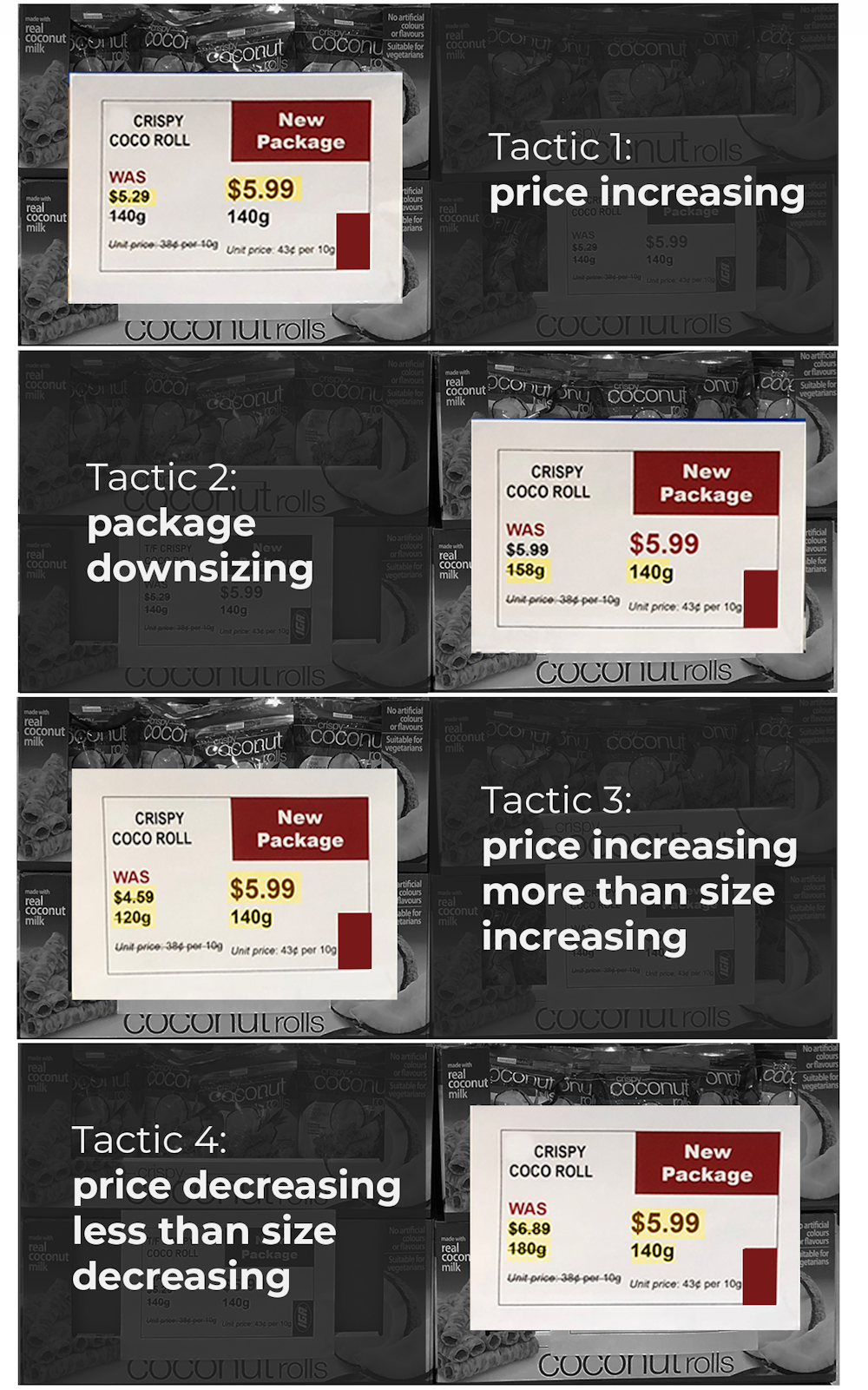
The product and price never changed but the signs indicating the previous price and size did. In each case the “before” per-unit price was also shown – an identical 38 cents per 10 grams.
The other two weeks were used as “control” weeks. In one week we displayed a “New Package” shelf ticket. In the other control week we displayed a regular shelf ticket without the words “New Package”.
What we found
Even though the changes signalled by the shelf tickets represented an identical increase in per-unit price, the sale results suggest shoppers found our shrinkflation variant the most attractive.
The following chart shows the sales figures for all five products over the six weeks. With tactic 4 (our shrinkflation variant) 530 units were sold. This compares with 448 sales with tactic 3; 435 sales for tactic 2 (standard shrinkflation), and 391 sales for tactic 1.
The power of framing
These results demonstrate the commercial power of psychological “framing”.
First, there is the “silver lining effect” – a mixed outcome consisting of a small gain (a lower price) and a larger loss (an even smaller size) is more favourable than a net outcome consisting of just a smaller loss (price increasing or package downsizing) alone.
This effect is tied to the “loss-aversion theory” developed by psychologists Daniel Kahneman and Amos Tversky, which says people value losses and gains differently.
Read more: The behavioural economics of discounting, and why Kogan would profit from discount deception
Second, price is more noticeable and is given more weight than size. Thus shoppers were influenced more by the price drop than by the reduction in package size.
We attribute this to an automatic cognitive response – people have inherent preference toward lower prices.
Unit pricing is important, but not enough
In most developed countries, consumer protection laws require retailers to display unit prices to enable shoppers to cut through the proliferation of marketing signals designed to attract attention.
 Shutterstock
However, there’s no obligation to show the “before” unit price, so it’s difficult to gauge unit price changes.
Read more:
Archibald argy bargy as Ben Quilty wins populist prize
It seems to be equally important for retailers to advertise unit price changes to help consumers make more informed purchases.
But our results confirm what marketers have clearly gleaned over the past decade. Consumers’ cognitive biases are strong. So you can expect ever more shrinkflation and for ever more “price drop”, “discount”, “new price” and “price match” tickets to adorn supermarket shelves.
Authors: Jun Yao, Senior Lecturer in Marketing, Macquarie University
Shutterstock
However, there’s no obligation to show the “before” unit price, so it’s difficult to gauge unit price changes.
Read more:
Archibald argy bargy as Ben Quilty wins populist prize
It seems to be equally important for retailers to advertise unit price changes to help consumers make more informed purchases.
But our results confirm what marketers have clearly gleaned over the past decade. Consumers’ cognitive biases are strong. So you can expect ever more shrinkflation and for ever more “price drop”, “discount”, “new price” and “price match” tickets to adorn supermarket shelves.
Authors: Jun Yao, Senior Lecturer in Marketing, Macquarie University 

















