

Australia should have a universal basic income for artists. Here's what that could look like
- Written by: Jo Caust, Associate Professor and Principal Fellow (Hon), School of Culture and Communication, The University of Melbourne
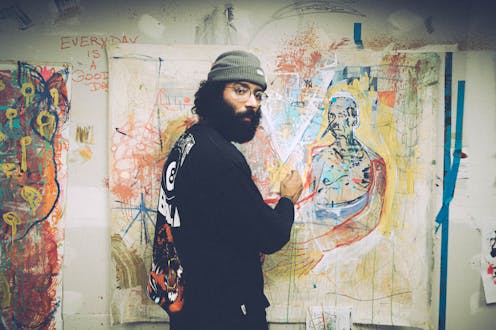
While artists struggle to get noticed in the Australian political arena, particularly in the lead up to an election, other nations take their artists more seriously – even seeing them as critical to a successful and vibrant community.
When I talked to artists during the pandemic, it became evident they needed four conditions in place to be able to practice successfully as artists: a regular income, a place to do their work, capacity to do their work and validation of their work.
Without these conditions, productivity and mental health suffer.
The Republic of Ireland has recently instituted a new scheme to provide three-year support for up to 2,000 individual artists, piloting a form of universal basic income.
Artists will be expected to meet at least two out of three qualifying terms to apply for the scheme: have earned an income from the arts, have an existing body of work and/or be members of a recognised arts body, such as a trade union.
Successful artists and creative workers will be given a weekly income of €325 (A$479), and be able to earn additional money without this basic income being affected.
The Irish Minister for the Arts Catherine Martin hopes this first model can be broadened to include all practising Irish artists in the future.
She sees it as a simple and economic method to protect artists from precarious existences while benefiting the community as whole.
Read more: Could the idea of a universal basic income work in Australia?
International support for artists
The Irish scheme for a universal basic income for artists isn’t the only model.
In the US, several states and private foundations have developed schemes to provide direct support to artists as an outcome of the pandemic.
In May 2021, the City of New York paid 3,000 artists no-strings-attached grants of US$5,000 (A$7,080). Additional grants were provided for public art works, exhibitions, workshops and showcase events.
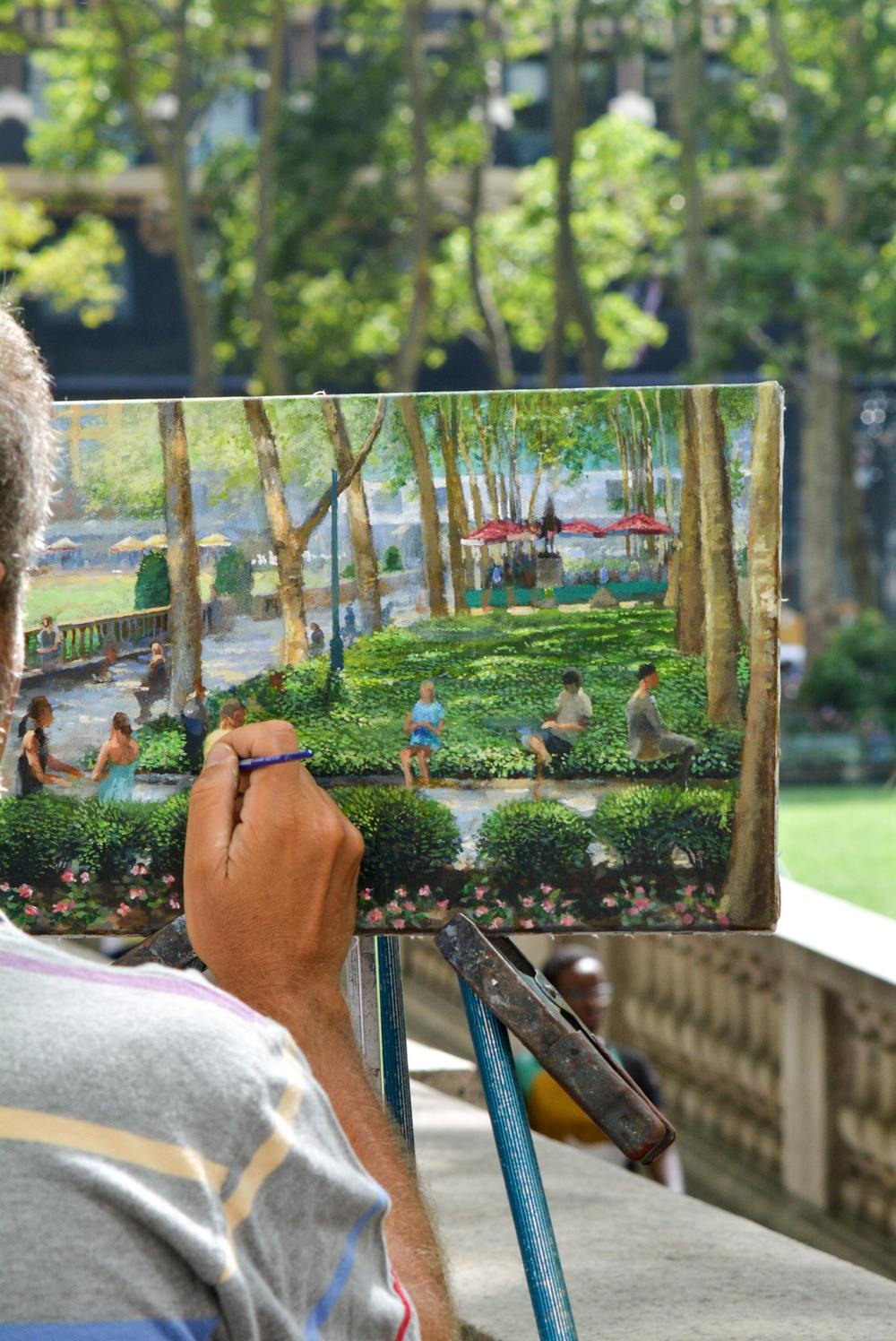
In June 2021, the philanthropic Mellon Foundation announced a new program called Creatives Rebuild New York to provide 2,400 New York artists with a guaranteed monthly income of US$1,000 (A$1,415) for 18 months.
The program employed another 300 artists and creative workers on an annual salary of US$65,000 (A$92,000) to work in collaboration with community organisations and local authorities for two years. They will also receive other benefits and dedicated time to work on their artistic practice. Both these programs were designed by artists.
The city of San Francisco provided US$1,000 per month for 130 local artists for six months from mid-2021. Thanks to philanthropic support from Twitter founder Jack Dorsey, the scheme expanded to support 180 artists for 18 months.
The city of St Paul in Minnesota, with a population of just over 300,000, has initiated a program to give 25 artists a guaranteed unrestricted income of US$500 (A$708) per month for a period of 18 months.
Closer to home, the House of the Arts (HOTA) on the Gold Coast recognised the economic dilemma of local artists during the pandemic.
In 2021, they employed four artists to work three days a week for six months on their own creative projects at HOTA. They were given a regular salary, a studio to work in, and were invited to participate in the organisational planning of HOTA.
Could we recreate this in Australia?
In Australia, some artists were eligible for schemes like JobKeeper and JobSeeker during 2020 and into early 2021, which could provide a model for how to support artists with a basic income going forward.
But in 2020-21 the Australia Council only funded 584 individual artists, a drop of nearly 50% since 2012-13.
Ireland’s three-year pilot program for artists will cost the government around €25 million (A$37 million). With a population about a fifth of Australia’s, a similar scheme applied here using the same ratio could provide funding to 10,000 individual artists at a cost of A$185 million over three years.
This would be a drop in the ocean for the Australian federal budget, but it could be a game changer for the community, the arts and artists.
Read more: Why arts and culture appear to be the big losers in this budget
A universal basic income provides a regular amount of money that allows the individual to live above the breadline. It can transform an individual’s life while having a positive impact on the whole of society.
Schemes that provide an ongoing income to individual artists – such as royalty schemes, lending rights and long-term leasing of artwork by government bodies and corporations – are all important, but the amounts received from them for the majority of artists are usually quite limited.
 An Australian model could support 10,000 artists at a cost of $185 million over three years.
Carolin Thiergart/Unsplash
An Australian model could support 10,000 artists at a cost of $185 million over three years.
Carolin Thiergart/Unsplash
Just imagine if every Australian arts centre, library, school, university, hospital, local council and government department employed an artist in residence. The artist gets an income while the institution gets an extraordinary input of ideas and imagination that can transform their environment.
We need to stop patronising our artists by giving them tiny grants and making them go through endless hoops and form filling to gratefully receive them.
Artists are essential to our community. It is time to demonstrate – like Ireland and New York – the success of our artists reflects our healthy and vibrant nation, and pay them accordingly.
Authors: Jo Caust, Associate Professor and Principal Fellow (Hon), School of Culture and Communication, The University of Melbourne


















