

Analysis of 5,500 apartment developments reveals your new home may not be as energy efficient as you think
- Written by: Michael Ambrose, Research Team Leader, CSIRO
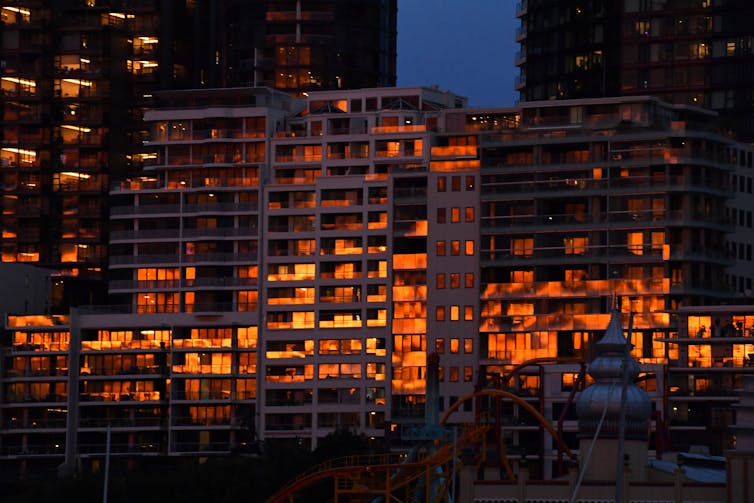
Apartment living is booming in Australia. Many people choose apartments for their good energy efficiency, which reduces the need for heating and cooling and leads to lower power bills. But not every apartment is as energy efficient as the development advertises.
All proposed new dwellings, including apartments, require an energy rating certificate. Generally, apartments achieve a higher average energy star rating than houses in the same area.
However, the method used to assess and report the energy efficiency of new developments – averaged across the entire development – could lead some purchasers to believe their new apartment is more energy efficient than it is.
My colleagues and I collected energy rating profiles for more than 5,500 apartment developments across Australia to explore what’s really going on. In many cases, we found clusters of apartments far below the energy star rating for the complex as a whole.
To comply with building codes, apartment developments must average 6 stars in energy efficiency. Julian Smith/AAPAverages can be misleading
Australia’s home energy star ratings are formally known as the Nationwide House Energy Rating Scheme (NatHERS). The scheme measures the “thermal performance” of a new home – or how well it remains at a comfortable temperature without artificial heating or cooling.
Last year in New South Wales, 58% of all energy rating certificates issued were for new apartments, reflecting the popularity of this type of dwelling.
In some areas, demand for apartments is skyrocketing. In the ACT, for example, 33% of certificates issued last year were for apartments, up from 7% four years earlier.
For a residential development to comply with the National Construction Code, the average rating across all apartments must be at least 6 stars. The maximum rating is 10 stars. Across Australia last year, the average rating of new apartments was 6.6 stars, compared to an average of 6.2 stars for houses.
This averaging process means some apartments may be above the average and some below. It may also mean some individual apartments don’t meet the minimum 6 star requirement.
In fact, there may be a significant cluster of apartments that rate below 6 stars – for example, west-facing apartments exposed to the afternoon sun that require a lot of cooling.
Conversely, a small number of apartments may rate well above 6 stars. These may be north-facing apartments that are also well insulated by other apartments above, below and on either side. These apartments will pull up the average star rating of the development.
This is a legitimate approach to energy ratings of apartment blocks. But it does raise an important question: do buyers know the energy rating of their individual apartment – especially those apartments with a below-average rating?
Read more: Low-energy homes don't just save money, they improve lives
Sunset views may be nice, but west-facing apartments can also require lots of cooling. Mick Tsikas/AAPCrunching the numbers
We collected data from NatHERS certificates for more than 5,500 apartment developments across Australia comprising both the certificates for individual apartments and the rating of developments as a whole.
Generally, ratings for individual apartments were close to the average of the entire complex. But in about 19% of apartment developments, at least 10% of apartments rated 5 stars or lower.
The chart below shows the star rating distribution for a development in Melbourne with about 150 apartments. The average star rating for the development was 6.2 stars. However, 47% of apartments rated below 6 stars while 23% rated above 7 stars.

We also examined a large development in Sydney with more than 400 apartments. The development has an average rating of 7 stars. However, as illustrated below, 16% of apartments rate below 6 stars and 1% (five apartments) are below 5 stars.
Those five apartment owners will likely have much higher energy costs than most of their neighbours. But they may not have realised that at the time of purchase, and the sale price may not have reflected this poorer energy performance.
Know what you’re buying
Energy ratings are mandatory for all new individual dwellings in Australia. However, providing the result to consumers is not.
Recent research has shown most real estate advertisements do not promote a home’s energy rating, and real agents often don’t know what the rating is.
Energy rating certificates could be included as standard in the information provided to someone looking to buy an apartment.
But in the meantime, if you’re planning on buying a new apartment, ask for a copy of the energy rating certificate. Only then will you know what you’re paying for.
Authors: Michael Ambrose, Research Team Leader, CSIRO


















