

Labor’s renewable target is much more ambitious than it seems. We need the best bang-for-buck policy responses
- Written by: Bruce Mountain, Director, Victoria Energy Policy Centre, Victoria University
Earlier today, Prime Minister Anthony Albanese gave his first major climate change speech, touting Australia’s future as a renewable superpower and promising Labor’s ambitious new renewable target would “unlock $52 billion of private sector investment.”
This follows Labor’s pre-election commitment to cut Australia’s greenhouse gas emissions by 43% below 2005 levels by the end of the decade, while boosting renewable electricity production to 82% of our electricity supply.
These goals are entwined. To cut emissions, we have to rapidly switch to renewables. That’s because the largest and cheapest emissions reductions are found by shifting electricity production to renewable sources. Since winning office, the Labor government has left no doubt about its commitment to these goals.
While the Greens have called for more rapid action, the goal to get to 82% renewables is much bigger than it seems. For the first time in a decade, the federal government is well out ahead of the states. Making this a reality, however, means tackling key missing parts of the clean energy shift: storage and grid modernisation. To galvanise change, my colleagues and I propose setting targets (and supporting policy) for storage as well as ramping up the renewable energy target.

Is the new government target really that big?
The government’s target isn’t plucked from thin air. It comes from the future scenario that Australia’s energy market operator, AEMO, said was deemed most likely by experts and stakeholders among all scenarios modelled in its 2022 Integrated System Plan.
If this 82% target is achieved, it really will be a step change. This target is four-fifths bigger than the targets of any of the coal-dependent eastern states, home to most of our population.
Victoria and Queensland are aiming for 50% renewables by 2030, while the New South Wales electricity roadmap is also consistent with a target of around 50%. Getting an extra 32% of renewables beyond this is ambitious, but entirely possible.
Tasmania hit 100% renewables last year and South Australia is well on its way to 100% renewables. But these successes are partly offset by the fossil fuel dependence of Western Australia, the Northern Territory and smaller grids elsewhere.
To reach 82% nationally, this means we will require roughly the same proportion of renewable electricity in the three big coal states. While the coal states are making progress, the federal government clearly wants them to go much faster.
How can we get there? Modelling by the market operator shows we need to build 45 gigawatts more wind and solar generation, plus 15GW of storage by the end of the decade. That will cost an estimated $115 billion for renewable energy and storage. Victoria and NSW in particular envisage private capital driving this investment.
In Australia, we have had policies encouraging renewable energy for 22 years. That’s given us about 32GW of renewable generation, of which about two-thirds is solar on the roofs of homes and businesses. Over this period, just 1GW of storage has been added – all of it from chemical batteries.
In short, this means we are set for a great acceleration. To achieve the 82% target means building renewables around five times faster than we have over the past two decades, and building storage at about ten times the rate of the past five years.
Undertaking this massive transformation so quickly will require serious policy support. To that end, we’ve proposed a Renewable Electricity Storage Target, to accelerate the storage build.
Read more: Tasmania's reached net-zero emissions and 100% renewables – but climate action doesn't stop there
We believe this would work, as it is based on the highly successful Renewable Energy Targets supported by successive federal Labor governments, and it can be developed and implemented quickly.
To supercharge the renewable expansion will also require policy support. We don’t have to reinvent the wheel. Greatly expanding the Renewable Energy Target is one proven way to do this.
Producing the power is useless if we can’t transmit it. Modernising our grid is crucial too. Here, too, all three coal states are making good headway in innovative arrangements to improve transmission and grid access.
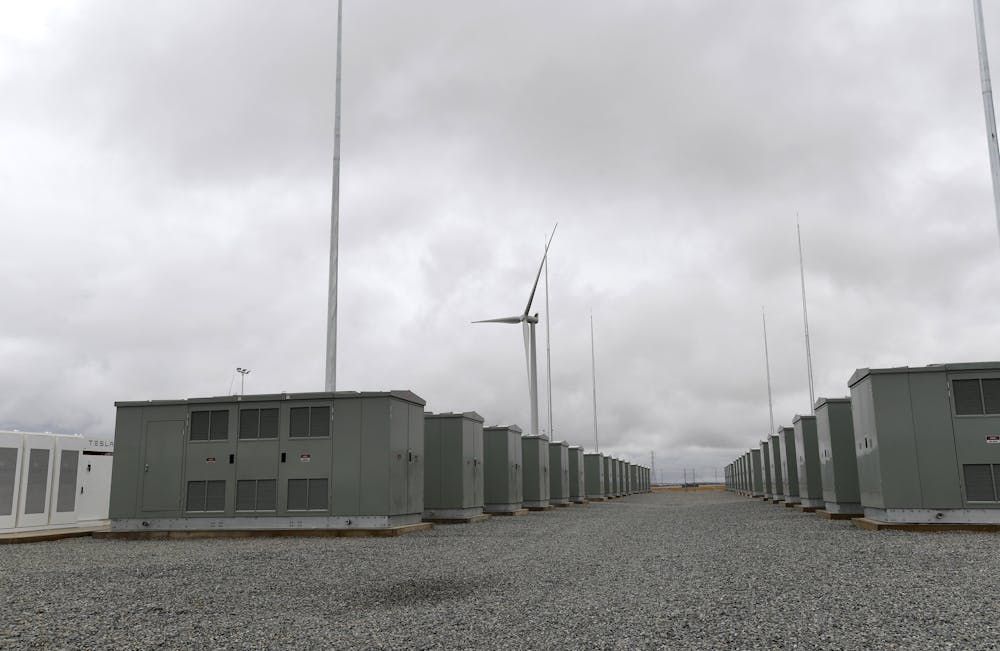 Storage like this grid-scale battery installed in 2017 in South Australia will have to be rolled out quickly.
David Mariuz/AAP
Storage like this grid-scale battery installed in 2017 in South Australia will have to be rolled out quickly.
David Mariuz/AAP
Power prices are likely to be a stumbling block
There’s no obvious financing issue for transmission. The challenges here are about connection, regulatory approval and community support. The Albanese government can help by letting a thousand flowers bloom rather than constraining developments through centrally imposed uniformity.
Before the election, Labor promised to cut household power bills by $275 per year by 2025. Wholesale electricity prices climbed to stratospheric highs before the May election, and have stayed there ever since. Unless these prices drop – and it is increasingly uncertain they will – households will be facing huge retail electricity price increases.
This is likely to pose serious problems for many low-income households. The federal government will be pressured to do something about it. But this, too, will be hard, given there are much tougher budgets flagged.
Does this mean the 82% target is unattainable? No, but arcane debates on market design must play second fiddle to decisive storage and renewable electricity policy. And the government will have to plan very carefully how it directs public money to achieve its goals – while helping the states to put out menacing energy price spot fires as well.
Read more: A 21st-century reinvention of the electric grid is crucial for solving the climate change crisis
Authors: Bruce Mountain, Director, Victoria Energy Policy Centre, Victoria University


















