

In NSW there have been significant wins for First Nations land rights. But unprocessed claims still outnumber the successes
- Written by: Lydia McGrady, PhD Candidate, University of Technology Sydney
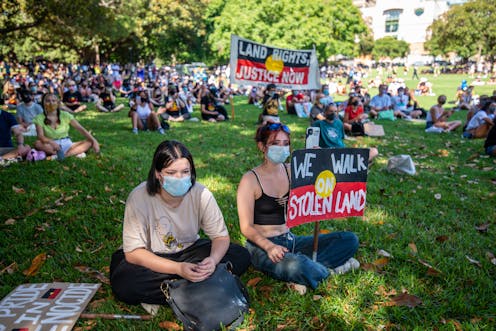
For First Nations people, land is the most important aspect of life and well-being. Successful land rights claims for Aboriginal and Torres Strait Islander peoples are the result of years of protest and advocacy.
This success led to the creation of land rights Acts across Australia. However, the recent figures of unprocessed land claims in New South Wales point to failures in the processes of land rights for Aboriginal communities.
Successful land rights claims lead not only to rights to land, but also to the ability to provide health and housing services for Aboriginal communities. When land rights claims are denied or prolonged, First Nations Peoples’ health and well-being can suffer, from not being allowed ownership of their own Country.
In approving land rights for First Nations People, there is potential for economic independence for communities through the establishment of more community-led land councils, with revenue providing for community benefit programs.
So what’s happening in NSW?
In NSW, the creation of land councils across the state led to the successful granting more than 3,000 land rights claims. However, this is just a fraction of the number of unprocessed claims, of which there were reportedly 37,000 as of 2020 – many of them having been lodged more than a decade earlier.
The number in 2022 has climbed higher still, and is now 38,200.
Based on the current rate of approvals, it would not be until 2044 that these claims would be processed. These claims impact more than 1.12 million hectares of land.
The auditor-general’s 2022 report suggests neither the NSW Department of Premier and Cabinet nor the NSW Department of Planning and Environment has the resources needed to process all these land rights claims in a timely manner.
The NSW Department of Planning and Environment may not been meeting its statutory requirement to process claims resulting in ongoing delays. This has resulted in Aboriginal land councils and communities being denied rights to land because their claims remain unprocessed for many years.
Without land rights claims being processed, communities may lack access to basic services and economic development as well as being denied their rights to land.
A history of fighting for our land
The issue of land rights for First Nations peoples claims stretches back many decades. However, there have been responses from affected communities that have provided positive outcomes.
One example is the Wave Hill strikes in 1966 began as a call for wages and grew into advocacy which demanded the return of land. This land was given back by Prime Minister Gough Whitlam in 1972. After the failure of the Gove land rights case, the Whitlam government launched the Woodward Commission to examine how land could be given back to Aboriginal communities. The result was the first land rights Act passed by the Fraser government in 1976. This allowed for the purchase of land by the government or granting of Crown lands for claims to be held for Aboriginal communities.
Similar Acts were then passed in the following years, including the Aboriginal Land Rights Act 1983 (NSW). Through this Act, land councils were created which could make claims to land as compensation for communities and to promote economic growth. The Act in NSW, however, only allows the claiming of Crown land – that is, unoccupied land held by the state.
Legislative challenges
The land claims must refer to land that is not impacted by native title, so it is essential to know the difference between land rights and native title.
Land rights are classified as claims to land made by Aboriginal land councils, whereas native title are claims by Traditional Owners. The establishment of native title was a result of the Mabo (No. 2) decision and led to the creation of the Native Title Act 1993. Land rights legislation predates this and can often lead to overlap between land rights and native title claims which can impact various cultural groups’ claims to Country.
Aboriginal land councils are organisations created by the Act and run by community leaders, whereas Traditional Owners have a traditional claim to land based on ongoing occupation.
Read more: The NSW government needs to stop prosecuting Aboriginal fishers if it really wants to Close the Gap
Improvements to the land claims process
However the 2022 report lists possible improvements to allow for the processing of land rights claims. These suggestions include improved governance, a ten-year plan, staff education programs and procedural updates to the registrar system.
The NSW Department of Planning and Environment should also have better communication and cooperation with land councils. This would be the greatest improvement to the process ensuring First Nations land councils are able to be heard.
Local Aboriginal Land Councils have described the ongoing failing as a lack of transparency. However, there are some positives emerging.
In mid-2020 the NSW Department of Planning and Environment created an Aboriginal Land Strategy Directorate, increased staffing and set targets. This resulted, in the second half of 2021, the granting of 207 claims, many more than previous years.
In addition, consultation with Aboriginal land councils has resulted in the prioritising of claims. Despite this, many more claims need to be processed. It leads to hope that the latest 2022 auditor-general report will lead to more substantial policy reform.
Authors: Lydia McGrady, PhD Candidate, University of Technology Sydney


















