

the Edinburgh Festival turns 75, alive and well after two years of pandemic disruption
- Written by: Sarah Thomasson, Lecturer in Theatre, Te Herenga Waka — Victoria University of Wellington
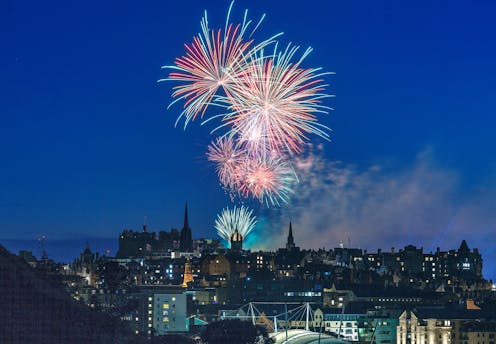
After two years of pandemic programming, with performers and audiences moved into virtual online venues, the Edinburgh International Festival celebrates its 75th anniversary this year with the best possible birthday present – the return of a full programme of live performances.
Part of Edinburgh’s immense cultural legacy has been to inspire similar events around the world to innovate to sustain their infrastructure – including in Aotearoa New Zealand and Australia, whose own festivals are modelled on the Scottish original.
But COVID has had a massive impact. All arts festivals have had to quickly cancel and “unproduce” live events, or offer online alternatives, as restrictions on mass gatherings and international travel undermined their very reason for existence.
While organisers and performers have shown ingenuity and resilience, they are very aware that digital technology cannot replicate the joy of live performance. All the more reason to celebrate its return 2022.
A launch pad for talent
As the world’s leading festival city, Edinburgh today hosts 11 events throughout the year, six of them in summer. These have launched the careers of countless unknowns who have gone on to become household names.
The playwright Tom Stoppard premiered Rosencrantz and Guildenstern are Dead in 1966, and British theatre greats Peter Cook, Dudley Moore, Alan Bennett and Jonathan Miller all appeared in a single year, 1960, in their Beyond the Fringe production.
Read more: Edinburgh festivals: how they became the world's biggest arts event
Two decades later, in 1981, Hugh Laurie, Stephen Fry and Emma Thompson, along with their Cambridge Footlights peers, received a Perrier Award (precursor to the Edinburgh Comedy Awards). More recently, in 2013, Phoebe Waller-Bridge’s Fleabag received a Fringe First award for new writing before being reinvented as the hit television series.
Consequently, Edinburgh has come to be seen as a necessary rite of passage for theatre, circus and comedy performers from around the world, including Australia and New Zealand. Each year, the Fringe lures artists hoping to become the next Rose Matafeo or Hannah Gadsby.
Edinburgh’s global influence
Edinburgh’s reputation as a festival city began with the Edinburgh International Festival of Music and Drama in 1947. Conceived as a cultural salve to the social wounds of WWII, its founders aimed to rejuvenate European culture, restore postwar diplomatic relations and rebuild the Scottish economy.
Its success soon prompted a wave of similar events around the world, including the original Auckland Festival (1949-82), its successor the Auckland Arts Festival/Te Ahurei Toi o Tāmaki (2003), and Wellington’s Aotearoa New Zealand Festival of the Arts (1986).
In his foreword to the 1956 programme, mayor John Luxford hailed Auckland’s festival as following “a less ambitious but no less worthy pattern” to Edinburgh’s. In Australia, too, the founders of the Adelaide Festival in 1960 promoted their festival as a “more modest” version of Edinburgh.
(Fittingly, perhaps, the 75th festival opens with a performance of Macro by Adelaide’s contemporary circus performers Gravity & Other Myths and Australian First Nations dance-theatre troupe Djuki Mala.)
International arts festivals are now annual events in most Australian state and territory capitals. In most cases they are scheduled alongside other arts and sporting events to capitalise on the festive atmosphere and draw visitors to the city.
Read more: A tale of two festivals: the history of the Edinburgh Fringe
Cancelled culture
Nowadays, Edinburgh’s success is largely due to its most famous summer festival, the Edinburgh Festival Fringe. Begun in opposition to the perceived elitism and lack of Scottish representation in the “official” festival, it has since pioneered an open-access model that welcomes any artist who can find a venue to host them.
The festivals are economically important, too. Edinburgh’s summer festivals saw a record-breaking 4.4 million attendances in 2019. In total, the festivals had an estimated £313 million benefit to the Scottish economy when last measured in 2015.
Read more: What 70 years of the Edinburgh Festival has done for the arts – and the economy
But with success comes inevitable problems. The festivals have also seen complaints from residents about access to public spaces and blocked views of Edinburgh Castle. There has also been criticism of the Fringe for alleged mismanagement, the high cost of participation, and the risk of normalising precarious labour practices.
In 2018, a Fair Fringe campaign successfully pressured the City of Edinburgh Council to adopt charters to improve pay and conditions. But it was the pandemic that presented a genuine existential threat when Edinburgh’s summer festivals were cancelled for the first time in 2020.
Live performance returns
Internationally, arts festivals responded creatively to support artists, venues and crews whose livelihoods have been affected. The expansion of outdoor venues and reduced seating capacities helped provide audiences with cultural connection during an unsettling time.
In 2021, Edinburgh made tentative steps to open up, presenting a restricted programme supported by a free digital “At Home” offering to 350,000 online viewers from 50 countries. In Auckland and Sydney, border closures saw festivals prioritise and highlight local work with their “100% Aotearoa” and “Australian Made” seasons.
Read more: Without visiting headliners, can local artists save our festivals?
Fringe festivals, too, experimented with online alternatives, although their ability to adapt was largely determined by the level of government support they received. In the end, though, digital festival offerings are largely make-do measures born of extraordinary circumstances.
Not all shows translate well online and not all audiences have adequate digital access. These necessary experiments have sustained the festival ecosystem through the pandemic, but enthusiasm for them inevitably wanes.
As festival goers return to the venues and streets of Edinburgh this month, they will celebrate the magic of being together – performers and audiences – in a shared space for a short time.
The joy of live performance is about presence, the ability to eyeball the performer in front of you, or feel anticipation spread through a crowd. These festivals have offered this experience for 75 years. This year, more than ever, we will cherish it.
Authors: Sarah Thomasson, Lecturer in Theatre, Te Herenga Waka — Victoria University of Wellington


















