

Google AI


Modern Australian

Linguistics locates the beginnings of the Austronesian expansion – with Indigenous seafaring people in eastern Taiwan

  • Written by: Victoria Chen, Senior Lecturer, Te Herenga Waka — Victoria University of Wellington

Linguistics locates the beginnings of the Austronesian expansion – with Indigenous seafaring people in eastern Taiwan

The study of Indigenous languages spoken in maritime South-East Asia today has shed new light on the beginnings of the Austronesian expansion. This was the last major migration of people spreading out across the Pacific Ocean and, ultimately, settling Aotearoa.

Scientists all agree that people speaking Austronesian languages started out from Taiwan and settled the Philippines around 4,000 years ago. They used sails as early as 2,000 years ago. Together with other maritime technologies, this allowed them to disperse to the islands of the Indo-Pacific ocean.

There they assimilated with existing populations and eventually reached as far as Easter Island to the east, Madagascar to the west, Hawaii to the north and New Zealand to the south.

This map shows the direction of the Austronesian expansion from Taiwan into the Pacific.
This map shows the direction of the Austronesian expansion from Taiwan into the Pacific. PNAS 112/44 Matisoo-Smith et al, CC BY-ND

But linguists had found little evidence about where precisely the migration started and which Indigenous group was involved in the expansion.

Our new research provides this missing linguistic evidence, based on an overlooked grammatical affix. It suggests the Amis of eastern Taiwan are the closest relative of the Malayo-Polynesian people (including Māori) in the Austronesian language family.

This finding complements recent research in archaeology and genetics, which also suggests the Austronesian expansion likely began along the east coast of Taiwan. Contemporary Indigenous groups in this part of Taiwan are known to have long-standing seafaring traditions.

Landscape image showing a small settlement.
The Amis of eastern Taiwan are the closest relative of the Malayo-Polynesian people, including Māori. Author provided

The Austronesian language tree

Austronesian is the second-largest language family in the world. Austronesian languages are spoken from Madagascar to Polynesia, including te reo Māori, and have been the focus of considerable research. But many basic questions remain about the origin and primary dispersal of this language group.

The consensus over the past 50 years had been that Malayo-Polynesian is an Austronesian primary branch with no identifiable closer relationship with any language in the homeland:
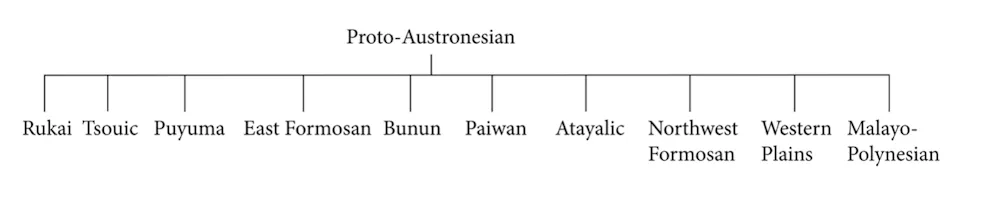
However, archaeological evidence indicates a 1,000-year pause prior to the migration. This suggests Malayo-Polynesian should have split off from a certain Indigenous group in Taiwan, rather than starting up as an independent branch. In our research, we discovered new evidence relating to Malayo-Polynesian’s root. It comes from a special use of the grammatical affix ma in four Indigenous Austronesian languages. Spreading along the east coast of Taiwan, all four languages (Amis, Kavalan, Basay-Trobiawan, Siraya) show a special use of ma that allows the actor of an action to be included in the sentence, for example: Amis: Ma-curah ni Kulas ku lumaq. Kulas burned the house. This sentence structure is strictly banned in all other Indigenous languages of Taiwan, but is widely observed in Malayo-Polynesian languages. Tagalog: Ma-sunog ni Kulas ang bahay. Kulas will burn the house. Strong seafaring traditions Intriguingly, all four languages have known seafaring traditions, and all belong to the East Formosan primary branch of Austronesian. Their shared use of ma with Malayo-Polynesian thus suggests a new subgrouping in which these two groups share a common origin. This hypothesis suggests the East Formosan people – including the Amis, the largest Indigenous group of Taiwan – are most closely related to Malayo-Polynesian, including Māori, in the Austronesian homeland. It also traces the starting point of Austronesian expansion to eastern Taiwan, where three of these four languages are still spoken today. Read more: What wind, currents and geography tell us about how people first settled Oceania Our findings point to a revised linguistic subgrouping more consistent with the socio-historical view that a seafaring community began the out-of-Taiwan expansion. It coincides with recent findings in archaeology, which put the starting point of the Austronesian expansion in eastern Taiwan. It also aligns with three recent genetic studies. All three reveal a particularly close connection between the Amis and Malayo-Polynesian populations. Read more: Who were the Toaleans? Ancient woman's DNA provides first evidence for the origin of a mysterious lost culture Exclusively shared vocabulary between Amis and Malayo-Polynesian languages lends further support to this idea. The Amis word poki for vagina, for example, is etymologically unrelated to equivalent words found in other Austronesian languages of Taiwan. Instead, it has the same linguistic derivation as the corresponding words in various Malayo-Polynesian languages. Papora (Taiwan) huci, Thao (Taiwan) kuti, Bunun (Taiwan) kuti, Paiwan (Taiwan) kutji, Puyuma (Taiwan) kuti. Amis (Taiwan) poki, Tagalog (Philippines) púki, Malay (Malaysia) puki, Javanese (Indonesia) puki, Tetun (Timor) huʔi-n, Gitua (Papua New Guinea) pugi. Future investigation of more shared traits between Malayo-Polynesian and East Formosan languages will shed further light on their relationships. Authors: Victoria Chen, Senior Lecturer, Te Herenga Waka — Victoria University of Wellington

Read more https://theconversation.com/linguistics-locates-the-beginnings-of-the-austronesian-expansion-with-indigenous-seafaring-people-in-eastern-taiwan-186547

What to Do When an Older Car Is No Longer Worth Keeping in Melbourne

Ever looked at another repair quote and wondered whether your old car is still worth the trouble? It is a common turning point for Melbourne motoris...

Your Baby's First Year: A Local Guide to Feeding, Sleep, and When to Get Extra Support

Ask ten parents in a Brisbane mothers' group how their baby is feeding or sleeping, and expect ten different answers.  Someone's baby sleeps throug...

Kitchen and Laundry Makeover Ideas That Don't Require a Full Renovation

Full kitchen renos are expensive — and most people don't actually need one.  They need the kitchen to stop looking like it's stuck in 2009, or they...

How Technology Is Reshaping the Modern Australian Commercial Kitchen

The commercial kitchen has always been shaped by technology. Refrigeration changed how ingredients could be stored, modern ventilation transformed k...

The Number on a Roller Blind Fabric That Nobody Explains

Somewhere in the fabric book, next to the colour name, there is a percentage. Three per cent. Five per cent. Ten per cent. Nobody explains it, most c...

What’s Trending in Men’s Jewellery This Father’s Day!

Finding a Father’s Day gift that feels personal, stylish and genuinely wearable is not always easy. While socks and novelty mugs have traditionally ...

Road Signs: Understanding Their Role in Clear and Effective Signage

Effective signage and display hardware can help businesses communicate information, promote products and organise customer or visitor movement. Road...

Bottle Label Printing: Key Factors to Consider Before Your Next Packaging Run

Effective packaging begins with understanding the product, bottle material, artwork and production requirements when planning bottle label printing. H...

Planning a Long-Distance Move With Interstate Movers Melbourne

Moving between states involves more planning than a typical local relocation. Along with packing and transporting household belongings, you need to...

Understanding the Role of an I/O Controller in Industrial Automation

Modern industrial systems depend on accurate communication between sensors, machines and control systems. An I/O controller can help manage this commu...

How the Right Mining Hose Supports Demanding Operations

Mining environments place considerable demands on equipment used for material transfer, water management and processing. Hoses operating in these co...

Simple Ideas for Making Social Gatherings More Memorable

We have all been to those parties where everyone just stands around the kitchen island, staring at their phones, waiting for someone else to make a mo...

Outdoor Wall Lights: Improving Exterior Lighting Around Your Home

Lighting can influence how a room looks, feels and functions, so the right fitting should be selected according to both appearance and practical req...

Commercial Office Cleaning: Combining Routine Office Cleaning With Melbourne Service

Keeping a workplace clean requires a service that can accommodate everyday tasks as well as the particular needs of the business. Professional comme...

Caravan Sales in Queensland: How to Find the Right Caravan for Sale QLD

Caravan ownership is about more than having somewhere to sleep while travelling. For many Queenslanders, it is one of the best ways to explore regio...

What Sir Walter Buffalo Turf Actually Costs in 2026 (And Why Quotes Vary So Much)

Two quotes landed on a Hills District homeowner's kitchen table last spring for the exact same 80-square-metre backyard. One said $12 a metre. The o...

Nearly 1,300 NSW Hospital Beds Are Occupied By People Who Are Ready To Go Home

1,276 people in NSW hospitals have been medically cleared for discharge but remain in hospital because they're still waiting for NDIS or aged care sup...

National Survey Launched to Measure Operational Impacts of Federal NDIS Policy Reforms

The effects of recent NDIS reforms are beginning to move beyond policy papers and into day to day service delivery. A new national survey is asking ...
















