

Australia may be heading for emissions trading between big polluters
- Written by: Ian A. MacKenzie, Associate Professor in Economics, The University of Queensland
Could Australia soon have a form of emissions trading? Yes, if Labor’s much-anticipated paper on fixing Australia’s mediocre emissions-reduction framework, released today, is any guide.
At present, Australia relies on the controversial safeguard mechanism to encourage big emitters such as fossil fuel power plants and manufacturers to reduce their pollution. This framework – alongside the Emissions Reduction Fund – was introduced during the Coalition years to reduce carbon dioxide pollution at low cost.
The problem is, it didn’t work. Emissions from large polluters have remained high since it was introduced in 2016. As the discussion paper states:
Emissions limits, known as baselines, have allowed business-as-usual operations and aggregate emissions from Safeguard facilities to grow.
Labor’s discussion paper flags ways to make the mechanism work as intended – most significantly by letting companies sell credits created by cutting emissions by more than they are required to. Companies finding it harder to slash emissions can buy these. Creating this market would effectively create a very useful carbon currency.
You might think this sounds abstract. It’s not. Fixing this mechanism would have a major impact on our future emissions – and the likelihood of reaching our committed emission goals. Getting this right matters.
So what is the safeguard mechanism and why does it matter?
The safeguard mechanism is a framework to control emissions from large polluters – defined as those emitting more than 100,000 tonnes of carbon dioxide equivalent annually.
This includes industries such as electricity generation, mining, and oil and gas extraction.
It works by giving each facility a benchmark level of emissions they are not allowed to exceed.
If a facility does exceed their benchmark, the regulator gives them a few easy options: reduce emissions, ask for their benchmark to increase, or buy and surrender Australian Carbon Credit Units. These credits come from someone else’s emissions reductions, which the original polluter has to pay for.
The problem is the current safeguard mechanism is not fit for purpose.
As I’ve previously pointed out, the system is easily gamed. Many high-polluting firms have simply asked for larger benchmarks – and often got them. You can see the incentive – asking for a larger, “better fitting” benchmark is the cheapest option of all, requiring absolutely no change on the company’s part.
This is the fundamental flaw: there is no economic incentive for large polluters to cut their emissions.
Better systems already exist in other countries. For instance, large polluters in the United States and European Union are targeted using pollution markets that have robust economic incentives.
In such schemes, companies that find it very expensive to reduce pollution can buy pollution credits from the market. Alternatively, companies that find it cheap to reduce emissions can sell their credits and make money. Labor’s new discussion paper draws heavily on these successful schemes.
Even better, the government can raise serious revenue from this market by initially auctioning off pollution credits. It’s a win-win: polluters pay and gain a strong incentive to reduce emissions, and the government obtains much-needed revenue at a time when budgets are stretched from the pandemic.
The public funds raised can be significant: the carbon market set up by 12 states in the eastern US has auctioned off pollution allowances since 2008, raising A$5.45 billion to date.
If we want to reach Labor’s target of cutting emissions by 43% (relative to 2005 levels) over the coming eight years, we need a fully functional market-based approach.
So what are the proposed changes?
The paper sets out the main proposals for developing the safeguard mechanism, including how to set a baseline of emissions for polluters (and how this should decline over time), the use of offsets, and the introduction of trading.
Trading would be the most significant change. Some companies will pursue emissions reduction with greater vigour – or may find it easier to do so than those in harder-to-abate sectors such as aluminium smelting or steel-making. The ability to sell these avoided emissions rewards these companies. The companies buying the credits have an incentive to cut emissions over time to avoid this cost.
Another proposal is to allow banking and borrowing of these credits over time. This would allow firms reducing emissions today to save credits for the future or, if needed, borrow some from the future.
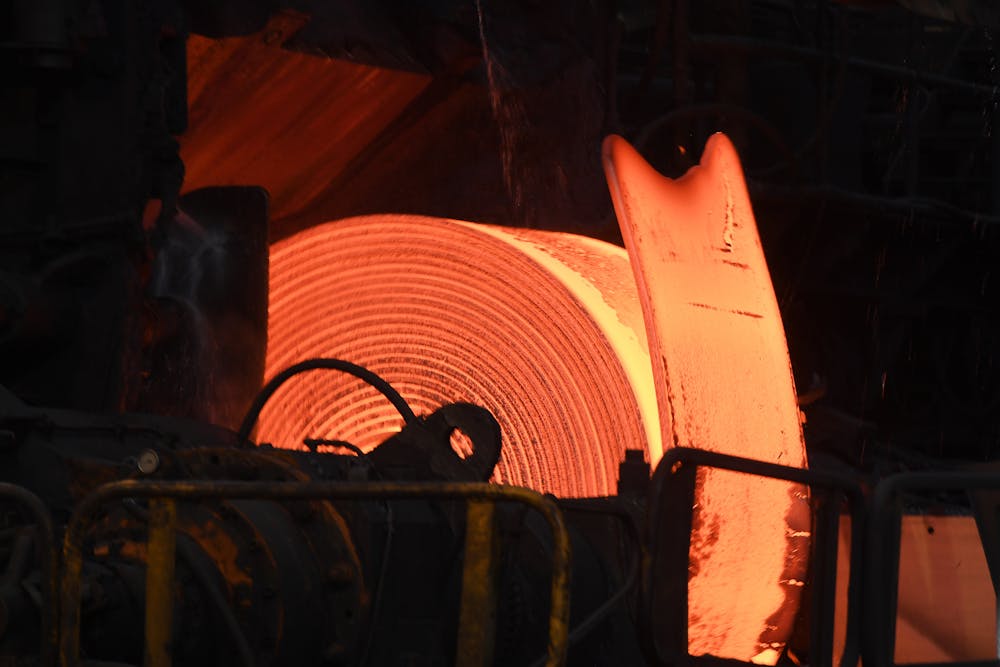 Major emitters such as BlueScope’s Port Kembla steel plant near Wollongong are subject to the safeguard mechanism.
Dean Levins/AAP
Major emitters such as BlueScope’s Port Kembla steel plant near Wollongong are subject to the safeguard mechanism.
Dean Levins/AAP
The big question: will it work?
From an economist’s perspective, this is good news.
Allowing firms to trade credits will make the safeguard mechanism more cost-effective and create incentives to actually cut emissions – something lacking in the old version.
But it could work even better.
Under the current proposal, companies in the scheme cannot trade with firms outside it. This cuts the number of market participants and could limit the cost-effectiveness of the scheme. Labor should look at widening the scope and creating a fully fledged market.
And while banking and borrowing pollution credits has been shown to work reasonably well in other countries, we know it has to be managed well.
If the scheme isn’t properly managed, companies could borrow credits and simply never pay them back. Banked carbon credits could actually lead to higher emissions in the future, when companies draw down on them.
In the EU this became a real concern when the stockpile of banked allowances grew too large. In response, the European scheme’s regulator had to remove them from the market. The Australian government must learn from this and design the scheme carefully.
But overall? Take this as good news. It is a step towards a goal that has long been out of reach: a well-functioning pollution market.
Authors: Ian A. MacKenzie, Associate Professor in Economics, The University of Queensland


















