

After 45 years, the 5-billion-year legacy of the Voyager 2 interstellar probe is just beginning
- Written by: Alice Gorman, Associate Professor in Archaeology and Space Studies, Flinders University
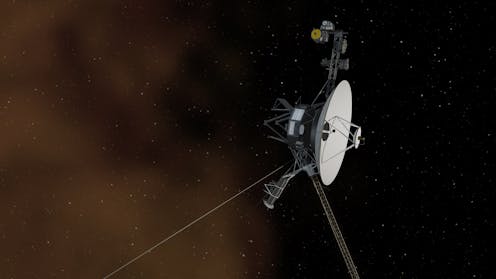
On August 20 1977, 45 years ago, an extraordinary spacecraft left this planet on a journey like no other. Voyager 2 was going to show us, for the first time, what the outer solar system planets looked like close-up. It was like sending a fly to New York City and asking it to report back.
Voyager 1 was launched after Voyager 2, on September 5. Attached to the flank of each Voyager was a Golden Record carrying greetings, sounds, images and music from Earth.
The spacecraft were more or less twins, but they had different trajectories and scientific instruments. While both flew by Jupiter and Saturn, Voyager 1 then sped onwards to interstellar space. Voyager 2 tarried to make the only visit ever to the ice giants, Uranus and Neptune.
The many-coloured worlds
Arriving at Uranus in 1986, Voyager 2 mapped pale blue-green clouds and a possible “dark spot”, which was later confirmed by the Hubble Space Telescope. There was an unexpected magnetic field, which dragged a corkscrew trail of particles behind the planet as it rolled in its orbit. Ten new moons were discovered, including the grey, cratered Puck, and two new coal-black rings.
Three years later Voyager 2 reached Neptune and sent home images of teal and cobalt clouds swirled by winds up to 18,000 kilometres per hour. A slate-coloured “great dark spot” indicated a storm the diameter of Earth. The largest moon, Triton, was blushed pink from methane ice and spouted geysers of frozen nitrogen.
No spacecraft has been back since.
Messages to the future
Even more than these glimpses of the far icy planets, what fascinates people about the Voyager mission is the famous Golden Records. A committee led by visionary astronomer Carl Sagan worked for over a year to assemble materials to represent planet Earth. The music garners the most attention as the “mix tape for the universe”, but it’s not the only highlight.
One of the sounds of Earth is the manufacture of stone tools, or “knapping”. This is the most durable technology humans and their ancestors have devised, in use from around 3 million years ago to the present day. For most of human existence, the sound of stone striking stone to detach a sharp-edged cutting flake was heard daily in every community.
On the record, you can hear the thuds of stone against the sound of heartbeats.
In one of the 116 images, a Black scientist in a lab coat bends over a microscope, tiered earrings falling gracefully from her ears. The earrings were the subject of some debate: would a future alien viewer recognise the concept of “jewellery”? It was hoped this image, together with the photomicrograph of cells dividing in image 17, would help viewers figure out that the science of microscopy was known on our planet.
People recorded messages in 55 languages. Some are ancient languages, such as Akkadian and Hittite, not heard on Earth for thousands of years. The most common words used are “greetings”, “peace” and “friend”. The Portuguese greeting, spoken by Janet Sternberg, says simply “Peace and happiness to all”.
The long farewell
Finally, in 2018, Voyager 2 joined Voyager 1 beyond the heliopause, where the solar wind is turned back by winds from interstellar space. Our galaxy is 100,000 light-years across, and Voyager 2 is now just under 18 light-hours away from Earth.
Both spacecraft send reedy signals that wend their way between the planets to the three antennas which are still listening: Tidbinbilla, Goldstone and Madrid.
Before they can truly leave, the Voyagers will have to travel through the Oort Cloud, a vast, dark sphere of icy objects surrounding the solar system, for another 20,000 years.
Slowly, Voyager 2’s systems are being shut down to eke out the power as long as possible. But sometime in the 2030s there will be none left.
Even after Voyager 2 stops transmitting, it won’t be completely dead. The half-life of the plutonium-238 in its nuclear power source is 87.7 years, while that of the the small patch of uranium-238 coating on the Golden Record is 4.5 billion years. Both elements are slowly turning into lead.
The radioactive transmutation of the elements is a kind of reverse alchemy at a cosmic time scale. This process of becoming will not end until there is nothing on Voyager 2 left to be transformed.
Cultural significance
Constant bombardment by dust particles will gradually erode the surfaces of Voyager 2, likely at a higher rate than Voyager 1 because it’s travelling through different regions of interstellar space. However, its Golden Record should be at least partially legible after 5 billion years.
The Earth portrayed on the Golden Records will probably be unrecognisable even 100 years from now. The spacecraft and the records will remain as a fragmentary archaeological record for an unknowable future.
While the Golden Records are endlessly fascinating, the true cultural significance of the Voyagers lies in their location. The spacecraft are boundary markers showing the physical extent of human engagement with the universe.
When the Voyagers cease transmission, it will be like losing a sense. Telescopes can only show us so much: there is no substitute for being there.
Who will follow in their path?
Authors: Alice Gorman, Associate Professor in Archaeology and Space Studies, Flinders University


















