

Australia's pursuit of 'killer robots' could put the trans-Tasman alliance with New Zealand on shaky ground
- Written by: Sian Troath, Postdoctoral fellow, University of Canterbury
Australia’s recently announced defence review, intended to be the most thorough in almost four decades, will give us a good idea of how Australia sees its role in an increasingly tense strategic environment.
As New Zealand’s only formal military ally, Australia’s defence choices will have significant implications, both for New Zealand and regional geopolitics.
There are several areas of contention in the trans-Tasman relationship. One is Australia’s pursuit of nuclear-powered submarines, which clashes with New Zealand’s anti-nuclear stance. Another lies in the two countries’ diverging approaches to autonomous weapons systems (AWS), colloquially known as “killer robots”.
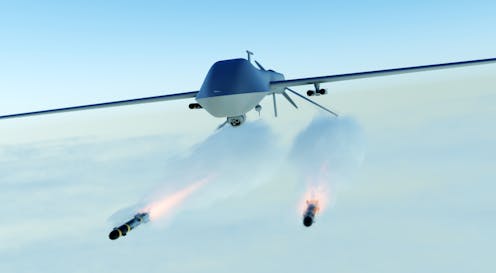
In general, AWS are considered to be “weapons systems that, once activated, can select and engage targets without further human intervention”. There is, however, no internationally agreed definition.
New Zealand is involved with international attempts to ban and regulate AWS. It seeks a ban on systems that “are not sufficiently predictable or controllable to meet legal or ethical requirements” and advocates for “rules or limits to govern the development and use of AWS”.
If this seems vague to you, it should. This ambiguity in definition makes it difficult to determine which systems New Zealand seeks to ban or regulate.
Australia’s prioritisation of AWS
Australia, meanwhile, has been developing what it more commonly refers to as robotics and autonomous systems (RAS) with gusto. Since 2016, Australia has identified RAS as a priority area of development and substantially increased funding.
The Australian navy, army and defence force (ADF) have each released concept documents since 2018, discussing RAS and their associated benefits, risks, challenges and opportunities.
Key systems Australia is pursuing include the autonomous aircraft Ghost Bat, three different kinds of extra-large underwater autonomous vehicles and autonomous trucks.
Why is Australia seeking to develop these technologies?
The short answer is three-fold: seeking military advantage, saving lives and economics.
Australia and its allies and partners, particularly the US, are fearful of losing the technological superiority they have long held over rivals such as China.
Large military capabilities, like nuclear-powered submarines, take both time and money to acquire. Australia is further limited in what it can do by the size of its defence force. RAS are seen as a way to potentially maintain advantage, and to do more with less.
RAS are also seen as a way to save lives. A survey of Australian military personnel found they considered reduction of harm and injury to defence personnel, allied personnel and civilians among the most important potential benefits of RAS.
Read more: UN fails to agree on 'killer robot' ban as nations pour billions into autonomous weapons research
The Australian Defence Force also believes RAS will be cheaper than large platforms. Inflation means money already committed to defence has less purchasing power. RAS present an opportunity to achieve the same outcomes at a lower cost.
Meanwhile, in 2018, the Australian government outlined its intention to become a top-ten defence exporter. There are keen hopes the Ghost Bat will become a successful defence export.
At the same time, the government is keen to build closer ties between defence, industry and academia. Industry and academia both vie for defence funding, and this drives development of RAS.
Of course, the technology is new. It’s not guaranteed RAS will save lives, save money or achieve military advantage. The extent to which RAS will be used, and what they will be used for, is not foreseeable. It is in this uncertainty that New Zealand must make judgments about AWS and alliance management.
What this means for the trans-Tasman relationship
The nuclear-powered submarines captured attention when Australia’s new AUKUS partnership with the US and UK was announced, but its primary purpose is a much broader partnership that shares defence technology, including RAS.
The most recent statement from the AUKUS working groups says they “will seek opportunities to engage allies and close partners”. Last week, US Deputy Secretary of State Wendy Sherman made it clear New Zealand was one such partner.
Australia’s focus on RAS, particularly in the context of AUKUS, may soon bring alliance questions to the fore. Strategic studies expert Robert Ayson has argued AUKUS, combined with increased strategic tension, means that “year by year New Zealand’s alliance commitment to the defence of Australia will carry bigger implications”. AWS will play a role in these implications.
Read more: Nukes, allies, weapons and cost: 4 big questions NZ's defence review must address
AWS may seem an insignificant trans-Tasman difference compared to the use of nuclear technologies. But AWS come with a lot more uncertainty and fuzziness than, say, banning nuclear-powered submarines in New Zealand waters. This fuzziness creates ample room for misperceptions and poor communication.
Trust in alliance relationships is easily damaged, and difficult to manage. Clear communication and ensuring a good understanding of each other’s positions is essential. The ambiguity of AWS makes these things difficult.
New Zealand and Australia may need to clarify their respective positions before Australia’s defence review is released next March. Otherwise, they run the risk of fuelling misunderstandings at a delicate moment for trans-Tasman relations.
Authors: Sian Troath, Postdoctoral fellow, University of Canterbury


















