

Google AI


Modern Australian

Microplastics are common in homes across 29 countries. New research shows who's most at risk

  • Written by: Mark Patrick Taylor, Chief Environmental Scientist, EPA Victoria; Honorary Professor, School of Natural Sciences, Macquarie University

Microplastics are common in homes across 29 countries. New research shows who's most at risk

The evidence is clear: microplastics have contaminated every corner of the globe. We can’t escape exposure to these tiny bits of plastic (less than 5mm across) in the environment, which includes the homes where people spend most of their time.

Recent research has discovered microplastics in the blood of humans. However, the question of harm to humans remains unresolved. Despite concerns that some substances in microplastics could cause cancer or damage our DNA, we still have a poor grasp of the true risks of harm.

Our study of global microplastics exposure inside homes across 29 countries, published today, shows people living in lower-income countries and young children are at greater risk of exposure. But our analysis of the chemical composition of microplastics in the home shows the specific health risk is surprisingly low. The study covered all the continents, including Australia.

The current challenge in understanding health risks from microplastics is the very limited data on toxic effects of the petrochemicals used in plastics production.

A recurrent theme in the environmental health research literature is that early concerns about suspect chemicals and related compounds, including those found in plastics, were eventually justified. The effects of suspect substances only become clear after extensive toxicological and epidemiological research.

Read more: You're eating microplastics in ways you don't even realise

What did the new study look at?

Our study investigated three main questions relating to exposure to microplastics inside homes:

  1. what are the impacts in different countries across the world?

  2. who is most at risk?

  3. what are the specific health risks?

We reached out to residents across 29 countries to collect their indoor atmospheric dust over a one-month period. At 108 homes sampled across these countries, we also collected information about households and behaviours. This helped us to better understand possible sources and causes of microplastics in dust. These data included:

  • how often floors were cleaned

  • flooring type

  • presence or absence of children

  • number of people living in each home

  • percentage of full-time workers.

In each home, atmospheric dust particles were collected in specially cleaned and prepared glass Petri dishes. We measured the levels of microplastics in the collected dust using a suite of microscopic techniques and instruments. We used infrared spectroscopy – which identifies substances by how they interact with light – to determine the chemical composition of these microplastics.

Read more: House dust from 35 countries reveals our global toxic contaminant exposure and health risk

What did the study find?

The household dust contained a wide variety of synthetic polymer fibres. The most common were:

  • polyester (as polyethylene terephthalate) at 9.1%, which is used in clothing fabrics

  • polyamide (7.7%), which is mainly used in textiles

  • polyvinyls (5.8%), which are used in floor varnishes

  • polyurethane (4.4%), which is used in surface coatings of furniture and in bedding

  • polyethylene (3.6%), a common polymer used in food containers and reusable bags.
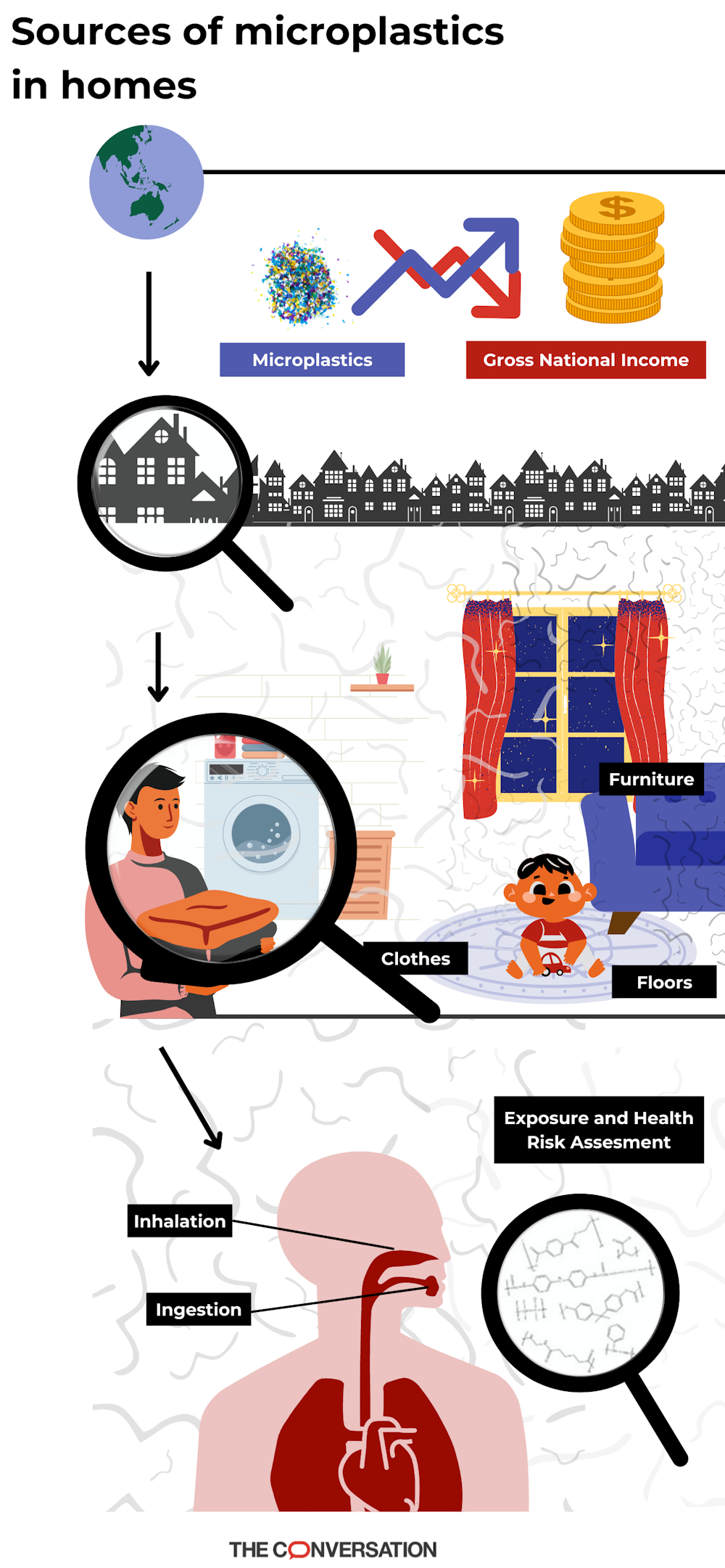
Author provided, The Conversation We examined the prevalence and risk of microplastics according to the gross national income of each country, grouped as low, medium and high-income (such as Australia). Overall, we found lower-income countries have higher loads of microplastics, which were deposited at an average daily rate of 3,518 fibres per square metre. The rates for medium-income and high-income countries were 1,268 and 1,257 fibres/m²/day. In low-income countries, the most prevalent synthetic polymer fibres were made of polyurethane (11.1% of all fibres in samples). In high-income countries, polyamide and polyester were the most prevalent microplastic types (11.2% and 9.8% respectively). So what are the health risks? For the first time we could attribute the health risk across countries according to incomes. Our analyses showed lower-income countries are at higher risk from microplastic pollution. This aligns with research findings on other toxic exposures – poorer countries and people are most at risk from pollution. Nevertheless, we found the overall risk from microplastics exposure was low. We used the US Environmental Protection Agency’s toxicity information on polymers in the microplastics to calculate health risk based on the types and levels we detected. Low-income countries had a higher lifetime risk of cancers due to indoor microplastic exposure at 4.7 people per million. High-income countries were next at 1.9 per million, with medium-income countries at 1.2 per million. We attributed these differences in cancer risk to the different percentages of carcinogenic substances in the microplastics found in household dust. We calculated the sum of the carcinogenic risk from inhalation and ingestion of the following chemicals in the microplastic fibres: vinyl chloride (polyvinyl chloride), acrylonitrile (polyacrylics) and propylene oxide (polyurethane). Because toxicity data for polymers are limited, the assessment was a minimum estimate of true risk. Children are at greater risk irrespective of income, which is true for many types of environmental exposures. This is because of their smaller size and weight, and tendency to have more contact with the floor and to put their hands in their mouths more often than adults. Our analysis indicated that the microplastics came mainly from sources inside the home, and not from outside. Synthetic polymer-based materials are used widely in high-income countries in products such as carpets, furniture, clothing and food containers. We anticipated levels of microplastic shedding in the home might be greater in these countries. However, analysis of the data showed the only factor obviously linked with levels of microplastics in deposited dust was how often they were vacuumed. Frequent vacuuming reduces microplastic levels. Vacuuming was more frequent in higher-income countries. Factors that influence the type of cleaning include people’s preference for sweeping and mopping versus vacuuming, as well as their access to and capacity to afford electronic vacuum cleaners. Person vacuuming a rug on a timber floor in the home The levels of microplastics in the home appear to be reduced by frequent vacuuming. Liliana Drew/Pexels Read more: We're all ingesting microplastics at home, and these might be toxic for our health. Here are some tips to reduce your risk What can we do to reduce the risks? Based on this and our previous study data, it is clear vacuuming regularly, instead of sweeping, is associated with less airborne microplastics indoors. Other obvious actions – such as choosing natural fibres for clothing, carpets and furnishings instead of petrochemical-based polymer fibres – can reduce the shedding of microplastics indoors. Future research needs to focus on developing more complete profiles of the harmful effects of each of the toxic petrochemical-based synthetic polymers that can produce microplastics. This will give us a better understanding of the risks of exposure to these ubiquitous pollutants. Authors: Mark Patrick Taylor, Chief Environmental Scientist, EPA Victoria; Honorary Professor, School of Natural Sciences, Macquarie University

Read more https://theconversation.com/microplastics-are-common-in-homes-across-29-countries-new-research-shows-whos-most-at-risk-189051

The Fire Safety Checklist Every Australian Short-Stay Host Should Run

Picture an Airbnb guest arriving late, tired, in a place they’ve never been. They don’t know where the exits are, which door leads to the garage, or h...

Better Business Photos Without Misleading Customers: An Australian Guide

A timber dining set looks inviting against a sunny deck, with cushions, lanterns and enough chairs for the whole family. But imagine the retailer sell...

Understanding a dental implant Melbourne Treatment Plan

A dental implant Melbourne patients may consider is one option for replacing a missing tooth, but suitability depends on oral health, bone support a...

How 3PL Logistics Australia Supports Faster and More Efficient Supply Chains

Why Has 3PL Logistics Become Important for Growing Businesses?  Gone are the days when supply chains were simpler and in minimal quantity. Now, the...

Common Skin Concerns and Treatment Options Available in Melbourne

Skin concerns can develop gradually or become noticeable following changes in age, lifestyle, sun exposure or hormonal factors. Pigmentation, rednes...

Why a Code-Compliant Home Can Still Feel Uncomfortable

When people build or renovate a home, they usually expect that meeting current building requirements will also produce a comfortable place to live. ...

Breach of Contract in Business: What Are Your Options?

Contracts are essential to business relationships. They establish expectations, allocate responsibilities and provide a framework for delivering goods...

How Pest Control Companies Can Rank for the Problems Customers Search First

Introduction SEO for Pest Control needs to start with the customer’s problem. Most people do not search for pest services in a neat or technical wa...

What Are the Benefits of Renovating an Older Home in Sydney?

Sydney has plenty of character homes, from Federation cottages to mid-century brick homes. Renovating rather than rebuilding can preserve what makes t...

Pool and Deck Design: How to Plan the Perfect Outdoor Living Space for Your Sydney Home

For many Australians, the backyard is where life happens. Summer barbecues, weekend swims and long evenings outdoors are all part of the lifestyle, ...

Is Solar Pool Heating Worth It? What Sydney Homeowners Should Know

There's nothing quite like a backyard pool on a hot Sydney day. But once autumn rolls in, many pools sit unused for months because the water is simp...

Planning a Luxury House Move: A Week-by-Week Timeline for Prestige Sydney Homes

Selling or buying a prestige home is a major milestone. Whether it's a waterfront residence in Birchgrove, a grand Federation home in Haberfield or ...

Downsizing or Upgrading Your Caravan? Here's How to Sell It Without the Hassle

Selling a caravan can feel like a major task, especially when you are unsure about its value, paperwork, or how to find a buyer. Whether you are dow...

The Best Overseas Adventure Holidays for Australians Who Love the Outdoors

Australia offers no shortage of incredible outdoor experiences, but sometimes the best way to satisfy your sense of adventure is to head overseas. A...

Cape Town Wine Shuttle: Winelands Tasting & Tours

Embark on an unforgettable journey through the picturesque Cape Winelands, where world-class wines and breathtaking scenery await. Our Cape Town Win...

Metal Fabrication: Choosing Metal Fabrication Melbourne Services for Custom Projects

What Modern Metal Fabrication Involves From individual components to complete structures, metal fabrication brings together processes such as desig...

Why Giant Rats Tail Grass Keeps Coming Back After Spraying

Giant Rats Tail Grass (GRT) is one of the most frustrating pasture weeds for farmers and lifestyle property owners. You spray an infested area, see th...

When Custom Cardboard Boxes Make Sense for Your Business

Custom cardboard boxes can be useful when a standard carton does not fit a product, packing method or presentation requirement particularly well. A ...

















