

Australia is well-placed to make the long-overdue repatriation of Islamic State women and children work
- Written by Greg Barton, Chair in Global Islamic Politics, Alfred Deakin Institute for Citizenship and Globalisation, Deakin University
National security is not a zero-sum game. If the past two decades have taught us anything about breaking the cycle of terrorist violence, it is that in the longer-run, treating people well – upholding justice and acting with compassion and humanity – keeps everyone safer.
It should not be considered controversial that, three and half years after the final collapse of the Islamic State (IS) caliphate, the Australian government is finally moving to repatriate the 60-plus Australians detained in camps in Syrian Democratic Forces (SDF)-controlled northern Syria.
Read more: ASIO's language shift on terrorism is a welcome acknowledgment of the power of words
Why the repatriation has taken so long
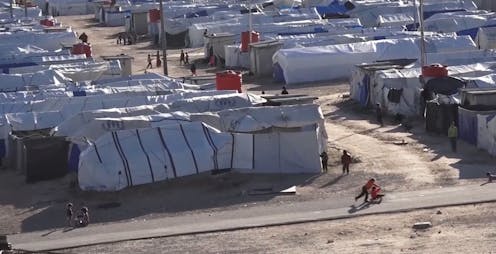
Around 20 Australian women and 40 children born to them have been languishing in hellish conditions in two SDF camps near the Iraqi border since the SDF defeated IS and liberated territory under its rule.
When the al-Hawl camp rapidly became massively overcrowded in the first months of 2019, holding 60,000 women and children, including thousands of foreigners along with Iraqis and Syrians, the SDF began urging its western allies to repatriate their citizens to ease the load.
Other, mostly poorer, countries in the Middle East and Asia swung into action, accepting responsibility to deal with their people. Most western nations took a different approach, citing national security grounds at home to support the SDF becoming dumping grounds for people they didn’t want and problems that they didn’t want to deal with.
From the outset, their cynical behaviour was called out as being inconsistent with their legal obligations. It was also callous and short-sighted. It was not only that tens of thousands of children, born in, or taken to, IS territory by western mothers were innocent victims of terrorism deserving rescuing. There was also a compelling argument that, left without help, those who survived would grow up to become the next generation of terrorist fighters.
Australian politicians, following the lead of Britain (but not the US), doubled-down on policies designed to close the door on them ever coming to Australia. This included stripping Australian citizenship wherever possible.
This was despite almost all security practitioners and agencies speaking openly against such a move. From ASIO down, the case was made that keeping people offshore, and denying citizenship obligations, was actually counter to the interests of national security.
In February 2019, the Home Affairs Minister introduced legislation enabling temporary exclusion orders to be applied to those who had travelled overseas and associated with a terrorist organisation. This delayed their return to Australia for up to two years on the grounds they may “represent a threat to public safety”. This would appear to have been designed specifically to forestall the repatriation of Australians from SDF camps.
The brutal social dynamics of the massively overcrowded Al-Hawl are dominated by hardcore IS women enforcing control and punishing dissent. The remnant IS fighters maintain strong lines of communication within the camps. Beating and killings are common, along with high rates of death and disease. IS fighters have also launched multiple assaults on the camps to set their people free.
It is clear those who were not already radicalised are at great risk of becoming hardened and angry. And, in an era when digital communication and social media are weaponised by terrorist groups like IS, preventing radicalised Australians from returning does not eliminate the potential for them to influence and do harm in Australian society in future.
Australia is well-placed to deal with returned IS supporters
Ironically, of all countries, Australia is in one of the strongest positions to deal effectively with returning foreign terrorist fighters (FTFs) and IS supporters. Not only does Australia enjoy the natural advantage of being a wealthy island continent with well-equipped police forces and other agencies – as well as effective biometric identification measures at ports of entry – it also has one of the clearest and strongest legislative frameworks for efficient and effective prosecution.
Amendments to counter terrorism legislation in October 2014 meant that travelling to and residing in a proscribed area constituted an offence, unless it could be proven there was no association with IS. This is thought to apply to at least nine of 16 Australian women in al-Roj camp, where the majority of Australians were relocated to remove them from the control of IS hardliners in al-Hawl.
Britain, like many European countries, together with Canada, faces a difficult challenge in proving that IS returnees have been actively involved in acts of terrorism. The main challenge has been obtaining robust evidence from a conflict zone of terrorist activities that is admissible in a court of law. France, along with several other European states, has recently begun to repatriate its citizens, strengthening the case for Australian action.
Australia is also well equipped to run effective rehabiliation programs. The work is not easy, but it is clear what needs to be done, and Australia has the resources to make it work.
The humanitarian imperative, particularly when it comes to meeting the rights and needs of children, is compelling. Their parents need to face justice, but that is vastly more manageable in Australia than in an overcrowded camp not designed for processing terrorism detainees.
Authors: Greg Barton, Chair in Global Islamic Politics, Alfred Deakin Institute for Citizenship and Globalisation, Deakin University

















