

Shantaram – the Black white man's burden
- Written by Sunil Badami, Academic Lead, Digital Transformation for Creative Industries, University of Technology Sydney
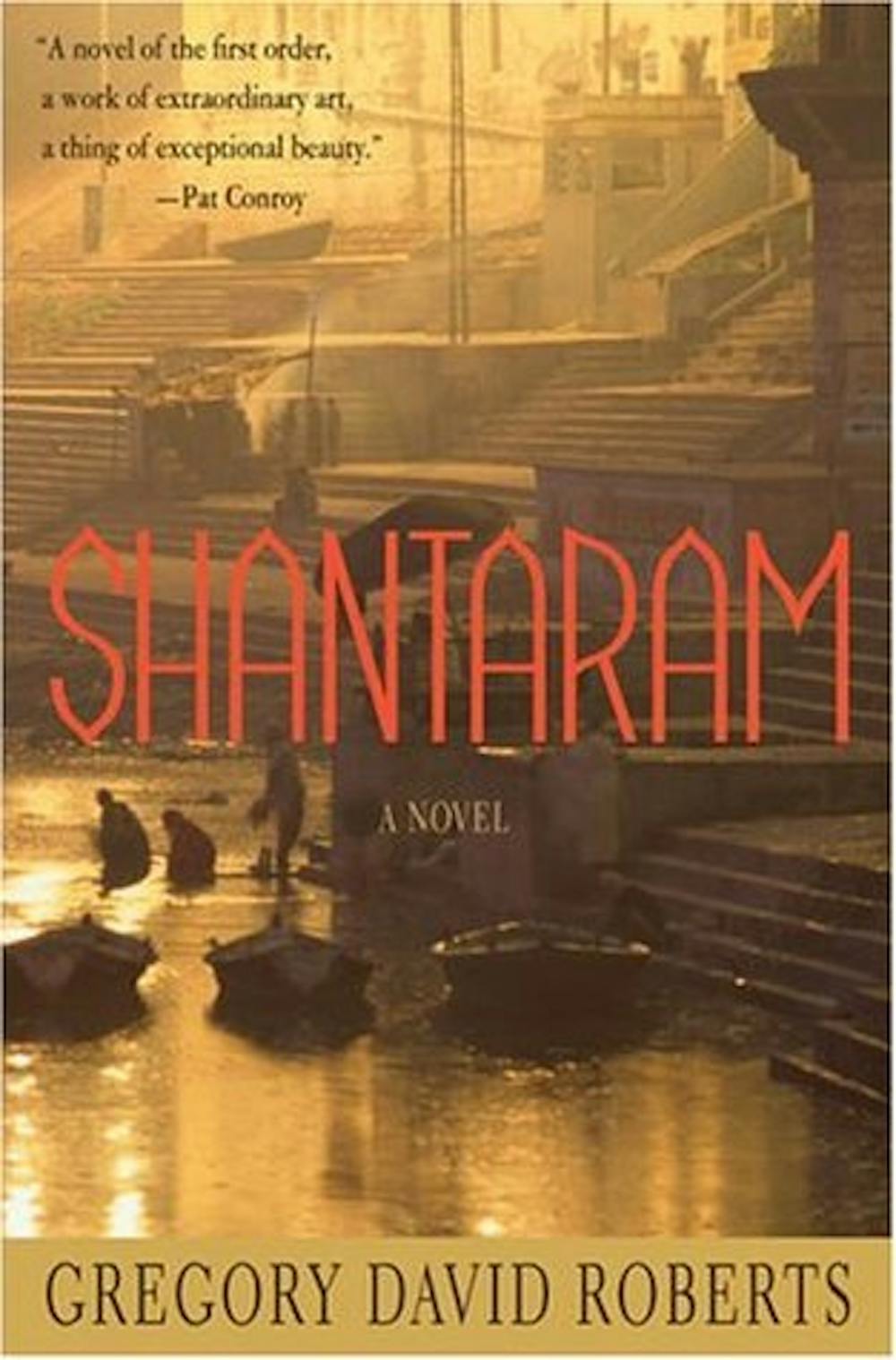
There are only two things you’re likely to encounter in India as much as Delhi belly: ubiquitous copies of Gregory David Roberts’ best-selling 2003 novel Shantaram in hostel lobbies and Swiss bakeries and, as noted in the book, constantly “being stared at with the […] almost accusatory censure of those who’ve convinced themselves they’ve found the one true path”.
Based on Roberts’ own life, Shantaram tells the story of Lin, an armed robber on the run with a false passport. Lin ends up in a Bombay slum and is adopted “like a son” by a mystic Afghan mafia boss before becoming a gun runner to Africa and a mujahedeen (guerrilla fighter) in Afghanistan.
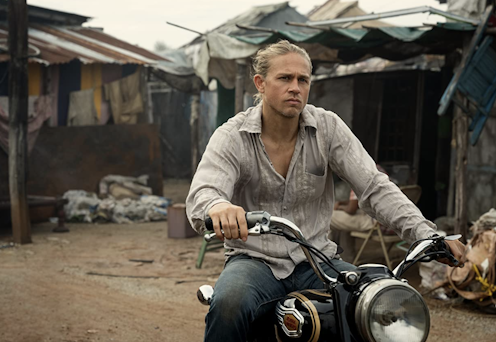
Having sold over six million copies since publication, there have been numerous attempts to adapt the book for film. It’s now a TV series made for streaming service Apple TV+ starring British actor Charlie Hunnam. Production was stop-start due to COVID, but after a long wait the series will premiere on October 14.
The cult of authenticity
Roberts’ semi-autobiographical character Lin calls himself “gora chierra, kala maan”: white on the outside, but full Hindustani on the inside. Despite this, Shantaram perpetuates the Orientalist fantasies that much of Western art does when depicting India and Indians.
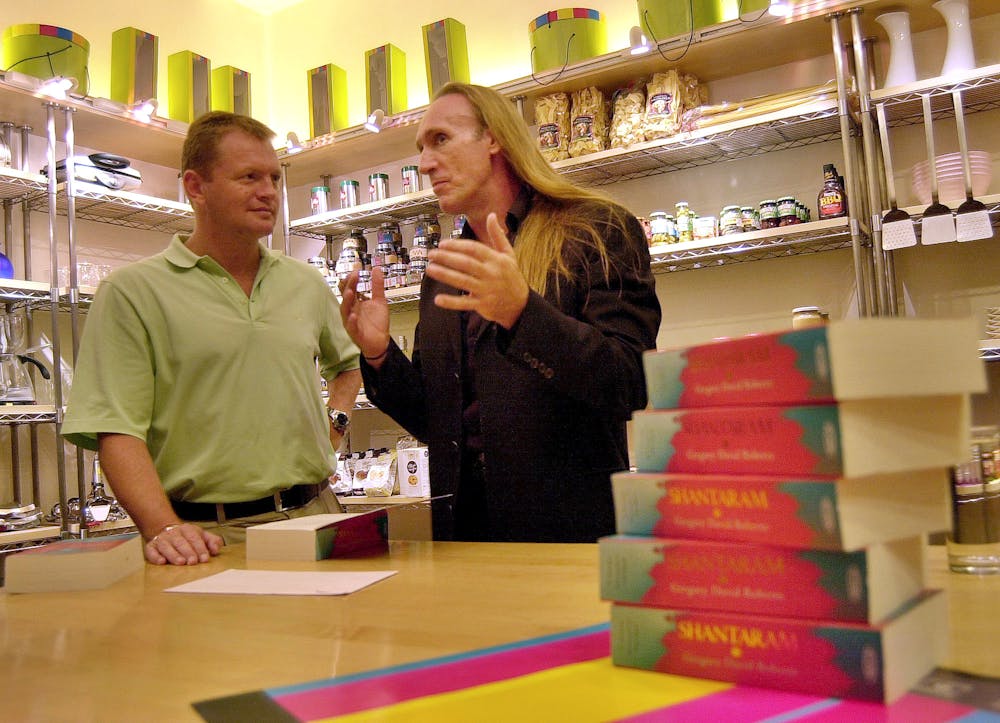 Gregory David Roberts, right, speaks with a reader during a book signing session in Bombay in 2006.
Aijaz Rahi/AAP
As reviewer Cameron Woodhead wrote of its sequel, The Mountain Shadow:
[It has] more in common with Oprah than Proust, and most readers with a shred of intellect or self-respect […] will cringe at [how] large chunks […] resemble the snake oil of the self-help industry.
According to Roberts, in the decade between Shantaram and its sequel, he “offered [his] writer’s perspective and writer’s skills to several NGOs, and worked in human rights, social justice, the environment and health issues.”
After The Mountain Shadow achieved neither the commercial success or critical acclaim of its predecessor, Roberts stepped back from public life, and embarked on what he calls “the spiritual path,” shaving his head, applying Hindu spiritual markings, foregoing shoes and donning Indian hermetic robes.
Making notes on his guru’s teachings, Roberts wrote an eponymous book, The Spiritual Path, featuring florid, cod-philosophical epigrams similar to those that choked his novels, such as “honesty is the river flowing into the sea of Trust” or “success is the full expression of personal fulfilment”.
He recorded a reggae album, Love&Faith in Jamaica (featuring collaborations with Jamaican artists), released in December 2020, and has increased his focus on music since. A plethora of releases with titles such as Good Morning Morning and Deep SurRender (music to play while your project is rendering); a playlist called Shantaram House, and featured artists on his website including Scantana, “the man with the most grammar”, suggest literature’s loss is music’s loss too.
Fixing the novel
Great literary fiction is often unfilmable because the kinetic range of the camera can’t capture the affective tone of the narrator’s voice or the author’s use of language.
But in Shantaram’s case, it’s possible being transposed to the screen and focusing on the action, rather than the cod-philosophy and over-description, might actually address the inherent vices in Roberts’ book.
As Indian reviewer Sandipan Deb wrote of The Mountain Shadow,
skim the pages rapidly, and you will get a fine thriller… Read it sincerely, and you will find a man trying so hard to be, if not the Buddha, at least a rock ‘n’ roll Jesus figure, that it is irritating. Open the book randomly, and you will find a Paulo Coelho with a snub-nosed automatic …
The new TV series is co-created, written and executive produced by showrunner Steve Lightfoot, with Bharat Nalluri directing and executive producing. Two initial episodes directed by Australian Justin Kurzel (Snowtown, Nitram) were reportedly considered too dark.
One hopes it will interrogate and subvert those persistent Orientalist, white saviour tropes, although with a trailer focusing on the white characters, who enjoy moody close ups as faceless Indians swarm in the slummy background, and with dialogue that’s as forced and wooden as the book – including Hunnam’s unconvincing Australian accent – it doesn’t promise any great improvement.
For as Deb writes,
a jailbird troubled by B-grade questions about life and the universe found India —in a very limited sense — in south and central Bombay. Then he found spirituality, with two knives hidden up the back of his shirt. And then he asks: What do you want from me, India? Mr Roberts, India doesn’t want anything from you. Write books, make money, get stoned, babble about nirvana, love the debauched expat life. India accepts you. We are not one, but we are us.
The first three episodes of Shantaram’s 12-episode first season will air on Apple TV on Friday, 14 October, 2022.
Authors: Sunil Badami, Academic Lead, Digital Transformation for Creative Industries, University of Technology Sydney
Gregory David Roberts, right, speaks with a reader during a book signing session in Bombay in 2006.
Aijaz Rahi/AAP
As reviewer Cameron Woodhead wrote of its sequel, The Mountain Shadow:
[It has] more in common with Oprah than Proust, and most readers with a shred of intellect or self-respect […] will cringe at [how] large chunks […] resemble the snake oil of the self-help industry.
According to Roberts, in the decade between Shantaram and its sequel, he “offered [his] writer’s perspective and writer’s skills to several NGOs, and worked in human rights, social justice, the environment and health issues.”
After The Mountain Shadow achieved neither the commercial success or critical acclaim of its predecessor, Roberts stepped back from public life, and embarked on what he calls “the spiritual path,” shaving his head, applying Hindu spiritual markings, foregoing shoes and donning Indian hermetic robes.
Making notes on his guru’s teachings, Roberts wrote an eponymous book, The Spiritual Path, featuring florid, cod-philosophical epigrams similar to those that choked his novels, such as “honesty is the river flowing into the sea of Trust” or “success is the full expression of personal fulfilment”.
He recorded a reggae album, Love&Faith in Jamaica (featuring collaborations with Jamaican artists), released in December 2020, and has increased his focus on music since. A plethora of releases with titles such as Good Morning Morning and Deep SurRender (music to play while your project is rendering); a playlist called Shantaram House, and featured artists on his website including Scantana, “the man with the most grammar”, suggest literature’s loss is music’s loss too.
Fixing the novel
Great literary fiction is often unfilmable because the kinetic range of the camera can’t capture the affective tone of the narrator’s voice or the author’s use of language.
But in Shantaram’s case, it’s possible being transposed to the screen and focusing on the action, rather than the cod-philosophy and over-description, might actually address the inherent vices in Roberts’ book.
As Indian reviewer Sandipan Deb wrote of The Mountain Shadow,
skim the pages rapidly, and you will get a fine thriller… Read it sincerely, and you will find a man trying so hard to be, if not the Buddha, at least a rock ‘n’ roll Jesus figure, that it is irritating. Open the book randomly, and you will find a Paulo Coelho with a snub-nosed automatic …
The new TV series is co-created, written and executive produced by showrunner Steve Lightfoot, with Bharat Nalluri directing and executive producing. Two initial episodes directed by Australian Justin Kurzel (Snowtown, Nitram) were reportedly considered too dark.
One hopes it will interrogate and subvert those persistent Orientalist, white saviour tropes, although with a trailer focusing on the white characters, who enjoy moody close ups as faceless Indians swarm in the slummy background, and with dialogue that’s as forced and wooden as the book – including Hunnam’s unconvincing Australian accent – it doesn’t promise any great improvement.
For as Deb writes,
a jailbird troubled by B-grade questions about life and the universe found India —in a very limited sense — in south and central Bombay. Then he found spirituality, with two knives hidden up the back of his shirt. And then he asks: What do you want from me, India? Mr Roberts, India doesn’t want anything from you. Write books, make money, get stoned, babble about nirvana, love the debauched expat life. India accepts you. We are not one, but we are us.
The first three episodes of Shantaram’s 12-episode first season will air on Apple TV on Friday, 14 October, 2022.
Authors: Sunil Badami, Academic Lead, Digital Transformation for Creative Industries, University of Technology SydneyRead more https://theconversation.com/shantaram-the-black-white-mans-burden-132173

















