

Here's another type of COVID test to get your head around. But is this new home kit worth the cost?
- Written by Thea van de Mortel, Professor, Nursing and Deputy Head (Learning & Teaching), School of Nursing and Midwifery, Griffith University
A new type of COVID test is set to be available from November for Australians to use at home.
It promises an alternative to rapid antigen tests (RATs), which we’re familiar with. It also promises a faster and more convenient option than PCR (polymerase chain reaction) tests performed in a lab.
The distributor is marketing the new product as a “portable PCR self-test kit” and a “game-changer” in COVID detection.
But does this new kit deliver what it promises? And is it worth the price? Here’s what we know from the limited data publicly available.
Read more: 15 things not to do when using a rapid antigen test, from storing in the freezer to sampling snot
What is the new test, exactly?
The new test is the EasyNAT COVID-19 RNA Test, which has received regulatory approval to be supplied in Australia.
It’s a type of nucleic acid test. That makes it similar in some way to lab-based PCR tests, which also detect the genetic material of SARS-CoV-2, the virus that causes COVID.
But lab-based PCR tests amplify the genetic material in a different way to this home-based test. So, strictly speaking, this new test is not a PCR test.
The new test isn’t a RAT either. RATs work by testing for viral antigens (parts of viral proteins that generate an antibody response).
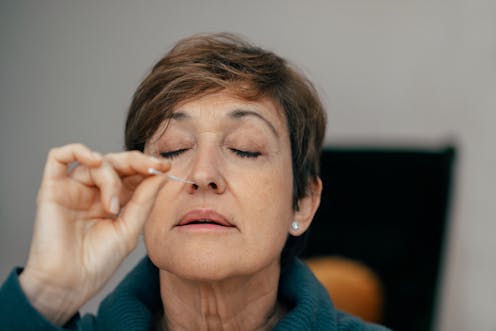
But the test does use a collection technique you will be familiar with – a nasal swab.
Read more: Can you use rapid antigen tests in children under 2 years old?
How does it work?
What’s new (to the general public) is the technology behind the test and its use to detect COVID at home.
It uses a process called isothermal cross priming amplification to copy tiny amounts of viral RNA extracted from your nasal swab. It does this many, many times so there’s enough viral RNA for the test to detect.
It does this without the multiple cycles of high and lower temperatures used to copy and amplify viral RNA in lab-based PCR testing.
Health workers are already using the technology (and the better known PCR) to detect COVID in hospitals and other health-care facilities. Here, they are known as “point of care tests” because they can provide rapid results at the bedside, rather than the swab needing to be processed in a lab.
The EasyNAT takes this further because it can be done at home. The test is said to detect all current variants of SARS-CoV-2.
By comparison, tests are currently under way to see how effective RATs available in Australia are at detecting the Omicron variant.
Do I do the test like a RAT?
Unlike RATs, this test needs to be stored in the fridge before use.
You take a nasal swab, insert it into a solution in a tube, then add one drop to a special battery operated cassette.
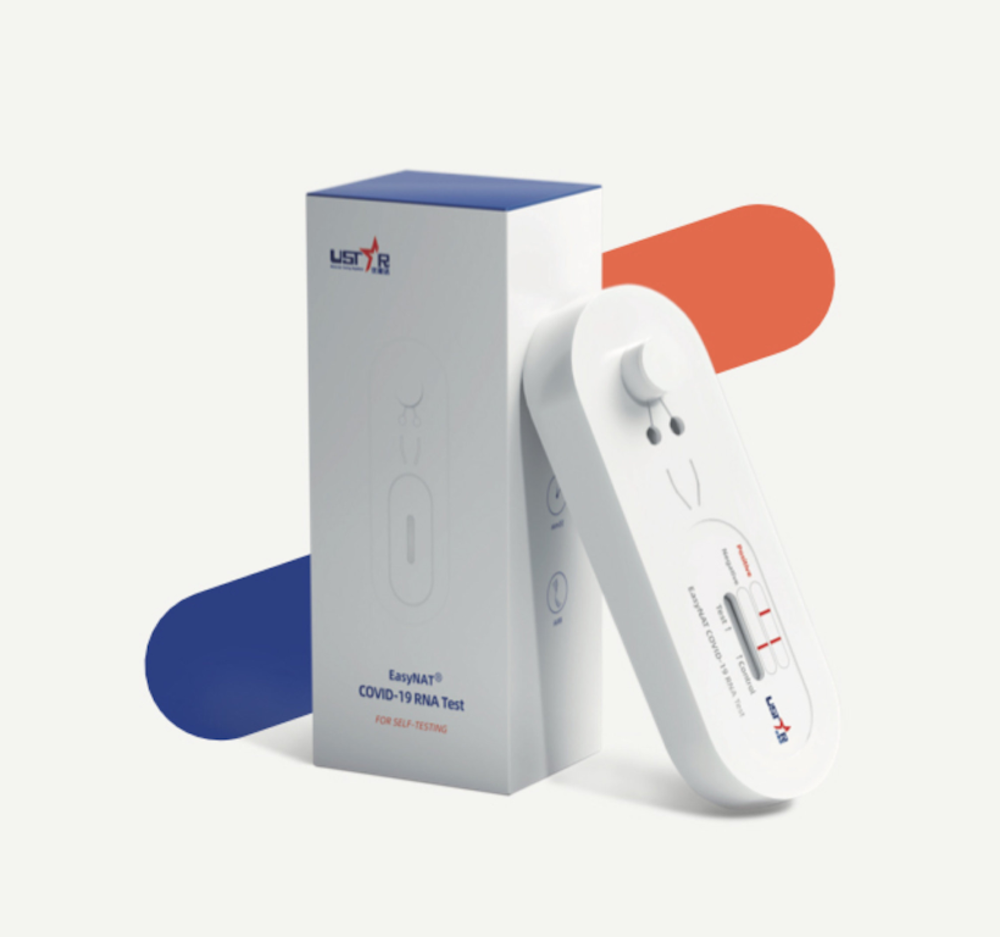
Then you add a buffer solution to the cassette, put the cap on, switch the cassette on to process the sample and wait 55 minutes. After switching the cassette off, you add a second lot of buffer solution, close the cap, and wait another 5 minutes before reading the result. The result must be read within 30 minutes of completing the test.
Results therefore take an hour – considerably quicker than waiting for the results from a PCR test processed in a lab, but much longer than a RAT where you get your results in about 15 minutes.
Read more: When RAT-testing for COVID, should you also swab your throat?
Does it work?
The Therapeutic Goods Administration (TGA) describes the test as having “very high sensitivity”. This means more than 95% positive agreement with a lab-based PCR test. This is comparable to the most sensitive RATs. But it is more sensitive than some RATs on the market (those labelled “acceptable sensitivity”, which agree with lab-based PCR tests more than 80% of the time).
The manufacturer reports a percent positive agreement with PCR of 95.4%.
Both European Union and Australian regulators have approved the test for COVID.
The manufacturer also reports a figure of 99% accuracy compared to lab PCR tests. This is a reflection of the sensitivity (correctly detecting a positive case) and specificity (not giving a false positive result). The sensitivity of the EasyNAT is 95.4% and the specificity is 99.8%.
By comparison, depending on the brand, RATs have a sensitivity of more than 80% to more than 95% and a specificity of at least 98% to 100%.
Read more: How accurate is your RAT? 3 scenarios show it's about more than looking for lines
What are the drawbacks?
Testing errors (such as incorrect swabbing technique, incorrect storage) mean the possible errors of doing a home RAT are just as likely with the EasyNAT.
A company spokesperson says the test is expected to retail for about A$55, which is considerably more expensive than a RAT (single RATs retail from $9-10, or are free for some people).
It’s unclear if a positive COVID result using this test is enough for eligible people to access oral COVID antiviral medicines, such as Paxlovid or Lagevrio, under the Pharmaceutical Benefits Scheme.
Current requirements are for someone’s COVID status be confirmed by a PCR test or a “medically verified” RAT (one supervised by a health professional).
Read more: 6 steps to making a COVID plan, before you get sick
In a nutshell
The EasyNAT costs more than a RAT and takes longer to complete. It doesn’t appear to be more sensitive or specific overall compared to the best “very high sensitivity” RATs. But it is more sensitive than some RATs on the market.
I’d like to know if the test allows you to detect COVID sooner after infection compared with a RAT (it generally takes at least a couple of days after infection before enough viral proteins accumulate to be detected on a RAT). Those data are not publicly available.
Authors: Thea van de Mortel, Professor, Nursing and Deputy Head (Learning & Teaching), School of Nursing and Midwifery, Griffith University

















