Ninety years on, what can we learn from reading Evelyn Waugh's troubling satire Black Mischief?
- Written by: Naomi Milthorpe, Senior Lecturer in English, University of Tasmania
Ninety years ago, in October 1932, the English satirist Evelyn Waugh published his third novel Black Mischief. He’d had a hit two years prior with Vile Bodies, a novel that made famous (even as it mocked) the slang and habits of the aristocratic Bright Young Things and propelled Waugh to literary stardom. The success of that novel and his later classic Brideshead Revisited (1945) meant Waugh would forever be associated with the hedonism of 1920s aesthetes and party-goers.
Waugh thought Black Mischief would be even more successful, particularly across the Atlantic. The novel wasn’t a failure, although it did not sell in the way he wanted. It did, however, ignite a scandal in English letters that reveals the values of 1930s Britain in some troubling ways.
Black Mischief is a dystopian satire like Aldous Huxley’s Brave New World, published earlier that same year. Set off the coast of northeast Africa, on the fictional island of Azania, Waugh’s novel satirises the country’s conversion from tradition to modernity.
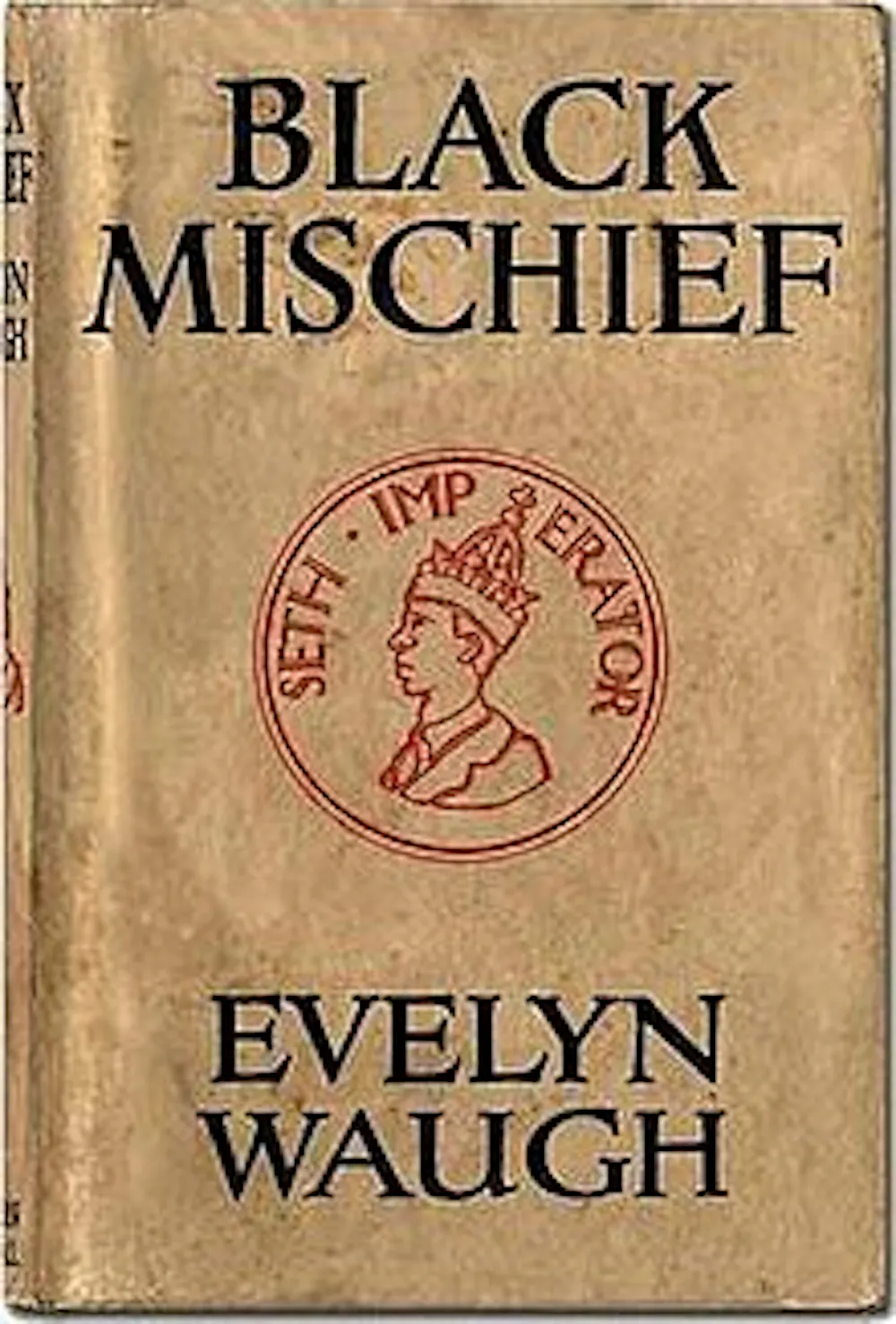
Azania’s modernisation is captained by the foolish Oxford-educated Emperor Seth and Basil Seal, an Englishman on the make, who has stolen his mother’s jewellery to finance his travel. With no qualifications and no local knowledge, Basil is appointed Minister for Modernisation by Seth, who sees Basil, accurately, as a representative of “Progress and the New Age”. Coming from the arch-Catholic Waugh, that’s a cutting insult.
Basil oversees Seth’s modernising schemes, including a city inspired by Georges-Eugène Haussmann’s remodelling of Paris, currency reform, birth control, and compulsory Esperanto. Eventually, the country collapses into civil war and Seth is killed by a rival faction. Basil escapes into the jungle and, in a grim twist, inadvertently eats his lover Prudence, who has been cooked in a cannibal stew.
Part of Waugh’s inspiration came from his travels in Abyssinia, British East Africa and the Congo in late 1930 and early 1931. He had been hired as a foreign correspondent for The Times and the Daily Express to cover Ras Tafari’s 1930 coronation as Emperor Haile Selassie of Abyssinia. Unlike the more experienced correspondents, Waugh waited to see the coronation before he wrote any stories about it. The result was that he was repeatedly scooped. He would later satirise journalistic ethics in his other African novel, Scoop (1938).
Waugh wrote about his trip in his travel book Remote People (1931), describing Abyssinia as “a tangle of modernism and barbarity”. At the time, Abyssinia (modern-day Ethiopia) was the only independent sovereign nation in Africa. European colonial powers were closely watching Selassie’s coronation.
Waugh was by turns amused and exasperated by what he saw as haphazard African attempts to modernise according to a European model of “civilisation”. But it is clear from the structure of Black Mischief, in which scenes set in England are intercut cinematically with scenes in Azania, that he also meant his English readers to draw parallels between home and abroad. As he wrote in Remote People:
Why go abroad?See England first.Just watch London knock spots off the Dark Continent.
Read more: 'Bloody Fool': Evelyn Waugh's life as a 1920s Oxford Aesthete
Deep crisis
When Waugh began writing Black Mischief in late 1931, England was in deep crisis. The 1929 financial crash and the Great Depression sparked political skirmishes over domestic and foreign economics.
At the general election of October 27, Ramsay MacDonald’s National government was elected in a landslide. MacDonald had been prime minister of the minority Labour government of 1929-31, which had been ineffective at staving off the worst effects of the crash. In 1931, MacDonald formed a coalition with Conservative MPs, including former prime minister Stanley Baldwin. This was widely seen as a betrayal of the Labour movement. When he met MacDonald in 1930, Waugh wrote in his diary that he thought him a “nasty and inadequate man”.
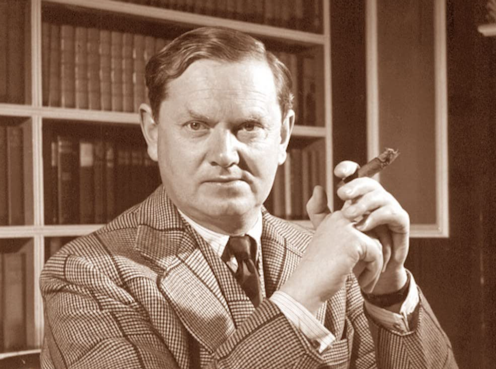
 Evelyn Waugh in 1940.
Public domain
Much campaigning in the lead-up to the 1931 general election centred around finance, including a debate over tariffs on imports. The Import Duties Act of 1932 imposed a tariff on goods not already subject to duties, effectively ending a long period of free trade in Britain. England abandoned the gold standard in late September 1931, a previously unimaginable reversal of monetary policy. Evelyn’s brother Alec Waugh wrote that it “could not mean anything but an entire reassessment of long-held values”.
For Waugh, the financial uncertainty was another sign of the disorder wrought by modernity. When Waugh introduces Basil Seal in Black Mischief, Basil has recently resigned from his seat in parliament over a “tariff issue”. Later, the Emperor Seth reveals his limited understanding of modern monetary theory when he prints (rather than mints) new currency. Such references indicate that Waugh’s satire was pointedly turned towards home.
Many of Black Mischief’s funniest scenes are set at the British Legation, whose residents are absurdly ignorant of Azanian daily life and customs. The head of the Legation is Sir Samson Courteney, father of the ironically named Prudence. Sir Samson is an old buffer who ignores diplomatic messages, preferring to play cards and take long baths. His wife Lady Courteney spends all her time in her garden, which was probably inspired by the garden at Madresfield, the country house where Waugh wrote some of the novel.
Prudence Courteney is a silly girl writing a boring modernist epic, which she calls the Panorama of Life. Waugh may have modelled Sir Samson on Sir Sidney Barton, the English Envoy Extraordinary to Abyssinia. He disliked Barton’s daughter Esmé, so he might have relished imagining her being cooked in a stew.
 Social activist Marie Stopes (1880-1958).
Wikimedia Commons
Waugh was also satirising social debates. A campaign for birth control was a major social movement in the interwar period. Its pioneer, Marie Stopes, was a strong supporter of eugenics. In Black Mischief, Seth decides that a boulevard in his rebuilt capital city will be called “Place Marie Stopes”. To make way for it, he demolishes a cathedral. Admittedly, it’s an Anglican Cathedral, so Waugh probably thought destroying it was a good idea.
Seth and Basil stage a pageant for birth control in which a group of prostitutes appear under a banner that reads “FROM STERILITY TO CULTURE”. The link between birth control and eugenics is emphasised with a reference to the concept of ectogenesis – growing embryos in an artifical environment – which had been popularised by the science writer J.B.S. Haldane in his 1923 book Daedalus. Aldous Huxley also uses the concept in Brave New World.
Halfway through the novel, Basil says that if they had been trying to modernise Azania 50 years earlier,
it would have meant constitutional monarchy, bi-cameral legislature, proportional representation, women’s suffrage, independent judicature, freedom of the press, referendums […] Just a few ideas that have ceased to be modern.
In place of democratic change, the modernisers of Azania use propaganda, money printing, and political violence. It’s unsettling that the novel was enthusiastically reprinted for German readers by the European firm Albatross in 1933. The blurb for this edition describes the novel as both satire and Utopia.
Violating standards of decency
Black Mischief was the Book Society choice for October 1932. The Book Society was an interwar subscription book club established in 1929. Members were often from non-metropolian UK or English dominions, such as Australia, and used the Book Society to access new English books that were otherwise hard to get. The result was that Waugh’s novel did quite well in the UK.
It was published simultaneously in the United States. For whatever reason, it failed to move US readers. But the novel’s financial failure in the US was only a small concern in the face of its critical savaging by the Catholic press at home.
For a reader today, the offensive parts of Black Mischief are its representations of race. This is a novel that uses racial slurs. It depicts its Oxford-educated African Emperor as a fool and a lunatic, susceptible to “the inherited terror of the jungle”. Africans are described as “black, naked, anthropophagous”.
When it was reprinted in 1962, Waugh included a series of his own illustrations, which had previously appeared only in a limited large paper edition issued to family and friends. In these, his drawings of African characters resemble the clichés of blackface minstrelsy, a staple of British music hall and US popular entertainment in the early 20th century.
The reviewers of 1932 did not have a problem with Waugh’s depiction of race. Instead, the major controversy of its publication centred on the question of his violation of standards of decency.
 Almost immediately after the novel’s release, Waugh went on another international adventure, this time to Brazil and British Guiana – a journey he would eventually fictionalise in A Handful of Dust (1934). Before he left, as his biographer Selina Hastings describes, he wrote to his friend Diana Cooper that he thought readers could enjoy Black Mischief “without any grave sacrifices of taste”.
Ernest Oldmeadow, editor of the Catholic weekly The Tablet, disagreed. He called the novel “nauseating” in its depiction of adultery and cannibalism. Oldmeadow argued that Waugh violated Catholic civility by showing Basil and Prudence’s loveless sexual affair (there’s a suggestive image of a cigar limply unfurling in a hip-bath), and Prudence’s grisly end, “stewed to pulp among peppers and aromatic roots”. He called into question Waugh’s good faith and even suggested the work was blasphemous.
For several weeks, controversy raged in The Tablet. Prominent Catholic writers sprung to Waugh’s defence in the name of artistic integrity, while Oldmeadow dug in his heels.
Waugh returned to London in May 1933, deeply insulted by Oldmeadow’s editorials. In response, he composed an Open Letter to his Eminence the Cardinal Archbishop of Westminster, a satirical diatribe that bears close resemblance to Jonathan Swift’s A Modest Proposal:
The Tablet quotes the fact that she was stewed with pepper, as being in some way a particularly lubricious process. But this is a peculiar prejudice of the Editor’s, attributable perhaps, like much of his criticism, to defective digestion. It cannot matter whether she was roasted, grilled, braised, or pickled, cut into sandwiches or devoured hot on toast as a savoury.
This Open Letter was not published in Waugh’s lifetime, but was privately circulated among friends. It later appeared in Mark Amory’s 1980 edition of Waugh’s Letters.
One of the notable aspects of the Tablet controversy was the way it centred on standards of taste and politeness. Neither side saw the novel’s problematic representation of Africans as anything worth fighting over. If it were published today, Black Mischief would have a very different reception.
Read more:
Ghoulishness, depravity and stupidity: welcome to the world of Ottessa Moshfegh's Lapvona
Types of barbarity
In his 1962 preface to the third UK edition, Waugh identified the primary theme of Black Mischief as “the conflict of civilisation, with all its attendant and deplorable ills, and barbarism”. As the phrase “attendant and deplorable” suggests, no European character or institution is set up as a positive model.
 Waugh the Tory-anarchist exposes the parallels as well as the conflicts between what he saw as two different types of barbarity: modern and traditional. For Waugh, neither European modernity nor African traditional culture was sufficient without the redemption of the Catholic faith.
Black Mischief is caustic about colonial modernity and in its mockery of European behaviours and morality, but racist in its caricatures of African people and culturally pessimistic about African self-determination. In the closing pages of the novel, Azania becomes a protectorate of the League of Nations, suggesting that Waugh saw European interference in Africa as inevitable.
Black Mischief is strangely ambivalent about this: vibrant but authentic chaos is replaced by neo-imperial regulation. This is underscored by the neutered Orientalism of Gilbert and Sullivan’s Mikado playing on a gramophone in the otherwise silent capital.
In reality, Abyssinia was invaded by fascist Italy in 1935. The war of aggression showed the ineffectiveness of the League of Nations in the years prior to World War II. In his travel book Waugh in Abyssinia (1935), Waugh sides with the Italians. In 2022, with culture wars dividing post-Brexit Britain and fascism returning in Italy, Black Mischief is discomforting to read – not for its foresight, but because very little seems to have been learned from the past.
Authors: Naomi Milthorpe, Senior Lecturer in English, University of Tasmania