

Melbourne now has chief heat officers. Here's why we need them and what they can do
- Written by: Wendy Walls, Lecturer in Landscape Architecture, The University of Melbourne
The appointment of chief heat officers in Melbourne is a vital acknowledgement of how serious urban heat is for Australia. It’s a first for the country and part of an international movement to improve how cities handle heat in a warming world.
In partnership with the US-based Adrienne Arsht-Rockefeller Foundation Resilience Center, six cities around the world now have chief heat officers dedicated to reducing heat risks.
Urban heat does more than cause discomfort for city residents. It’s a threat to their lives. The City of Melbourne’s new chief heat officers, Tiffany Crawford and Krista Milne, will oversee the work of managing the risks of extreme heat in the city.
Why do cities need heat officers?
There is growing recognition urban heat problems are not simply an external environmental impact. They are tied to the ways we live in and use urban areas.
While rising temperatures and heat waves are hazardous for cities, Australia has a cultural expectation of living in a harsh environment. As Melbourne’s first climate adaptation strategy from back in 2009 explains, Australians have a “propensity to participate in events in very hot conditions”.
Even with increasing public recognition of the threat of climate change, these kinds of background social assumptions (and of course economic agendas) set up the public and political debates about how we should respond to our warming environment.
Melbourne is a particularly challenging city to plan for heat in a changing climate. It’s known for its variable weather – “four seasons in one day” – and temperatures can flip from hot to cold in the space of ten minutes.
Alongside overall warming, Melbourne suffers from dangerous heatwaves. As the 2019 Living Melbourne Strategy summarises:
“In Melbourne, deaths begin to rise when the mean daily temperature reaches 28℃, with hospital admissions for heart attack increasing by 10.8 per cent when the mean daily temperature reaches 30℃. When the average temperature is higher than 27℃ for three consecutive days, hospital admissions increase by 37.7 per cent. This suggests that even a small reduction in temperature during a heatwave will reduce the numbers of deaths.”
So what can heat officers do?
The appointments of heat officers are a recent response to projections of a hotter climate alongside more frequent and intense heat waves. The first chief heat officer was installed in Miami-Dade County in the United States in 2021. Appointments followed in Athens, Greece; Freetown, Sierra Leone; Santiago, Chile; and Monterrey, Mexico.
In less than two years, these officers have overseen projects such as developing new ways to monitor urban heat, trialling cool pavement materials and creating refuges from the heat.
In Freetown, the chief heat officer, Eugenia Kargbo, has focused on the informal settlements and markets most exposed to increasing heat. New shading and tree plantings will help protect these economically important spaces.
In Santiago, Cristina Huidobro is sponsoring the roll-out of green roofs across state-owned buildings such as schools and hospitals. The Hospital de Maipú is being retrofitted with more than 1,000 square metres of vegetated rooftop to help keep the building cooler.
As these examples show, responses to heat must draw on both climate knowledge and local social understanding. Problems of heat in Melbourne are different to those of Sydney’s western suburbs or Darwin’s tropical intensity. Developing resilience to heat requires actions that work with the form of each city, the rules governing its spaces and how locals behave.
Read more: Requiem or renewal? This is how a tropical city like Darwin can regain its cool
For Melbourne, practical actions might include trials of urban forms that allow for mixed plantings across buildings, infrastructure and streets.
Another option is to manage traffic to take account of local climate patterns. Melbourne’s heat waves often peak in the very late afternoon as people travel home. Reducing car traffic and adding cooled trams and buses at these times will help move more people safely.
We do know what to do
We already have a huge body of science, local research and tools to help keep cool in our cities.
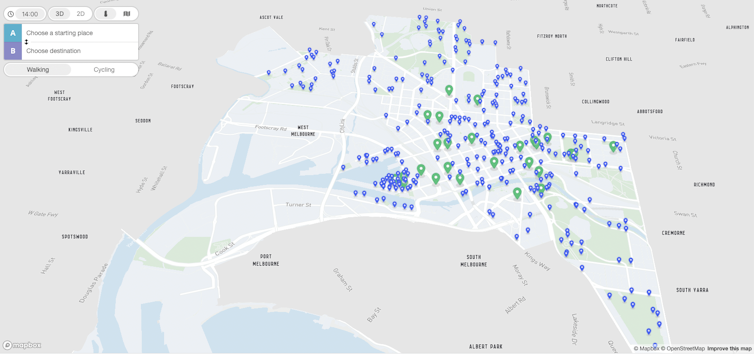
For example, the Cool Routes project allows you to plot a path through Melbourne based on live temperature data. There are also heat health alerts, cool places mapping and heat-specific support for people who are homeless.
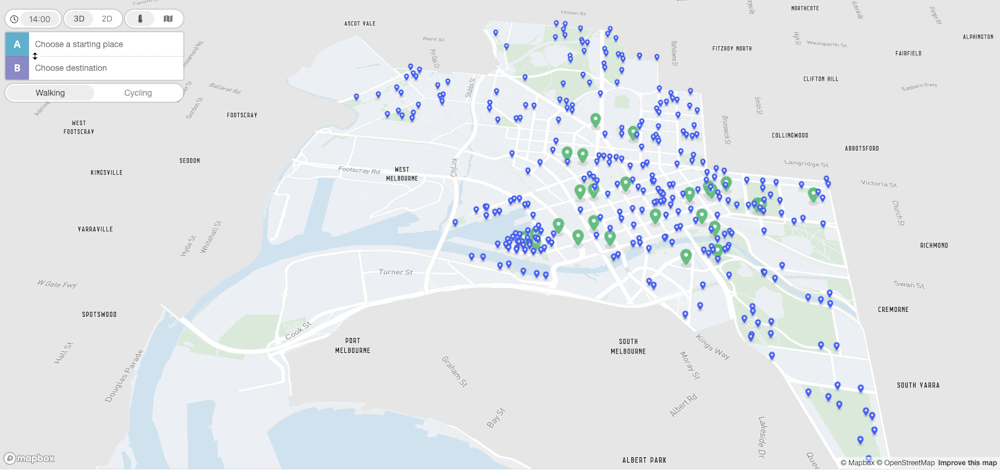
We have a world-leading Urban Forest Strategy to guide urban planning and design. Toolkits such as the Guide to Urban Cooling Strategies and the Green Factor Tool are available.
Despite this, Melbourne is still vulnerable to heat. Extreme heat increases the risk of power failure and buildings then overheat. And most of our outdoor spaces were never designed for heat in the first place.
Even with the knowledge and tools at our disposal, it is voluntary for designers and developers to use them.
There is no single solution to manage increasing heat. While trees are fantastic for natural cooling, they aren’t a cure-all.
Read more: How new design patterns can enable cities and their residents to change with climate change
Keeping cities cool is a complex task
Resilience to urban heat requires work across multiple physical scales. It involves negotiating the political and economic contests about how the city should grow.
The biggest task Melbourne’s heat officers face will be co-ordinating between partners – both within government and with the developers and private agencies that shape so much of the city. The officers have to create ties between policy, strategy, planners, designers, developers, research and tools.
They will also need to be on the ground and talk to the communities who experience heat stress. Much of our existing work on urban heat has been done from desktops and satellites. It’s time to hit the streets and start negotiating the technical, social and political worlds that determine how Australian cities respond to heat.
Authors: Wendy Walls, Lecturer in Landscape Architecture, The University of Melbourne


















