

How superblocks can free up and improve CBD space for the people of Melbourne – a step-by-step guide
- Written by: Marco Amati, Associate Professor of International Planning, Centre for Urban Research, RMIT University
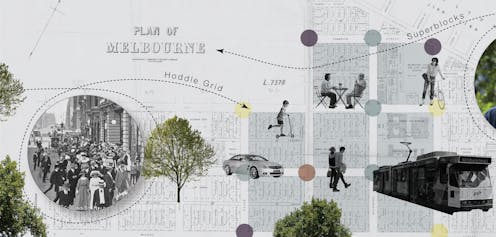
For 185 years, Melbourne’s Hoddle Grid – the ordered layout of CBD streets and blocks designed in 1837 – has dictated the flow of people and vehicles in the city centre. But how well does the grid serve 21st-century needs?
Melbourne faces three interconnected challenges that conflict with a business-as-usual, car-based grid. These are: how to end the dominance of cars; how to respond to the reality of the city centre as a residential area; and how to “reignite” post-pandemic activity in the CBD.
Superblocks are an approach, pioneered in Barcelona, to making urban areas more liveable and people-friendly.
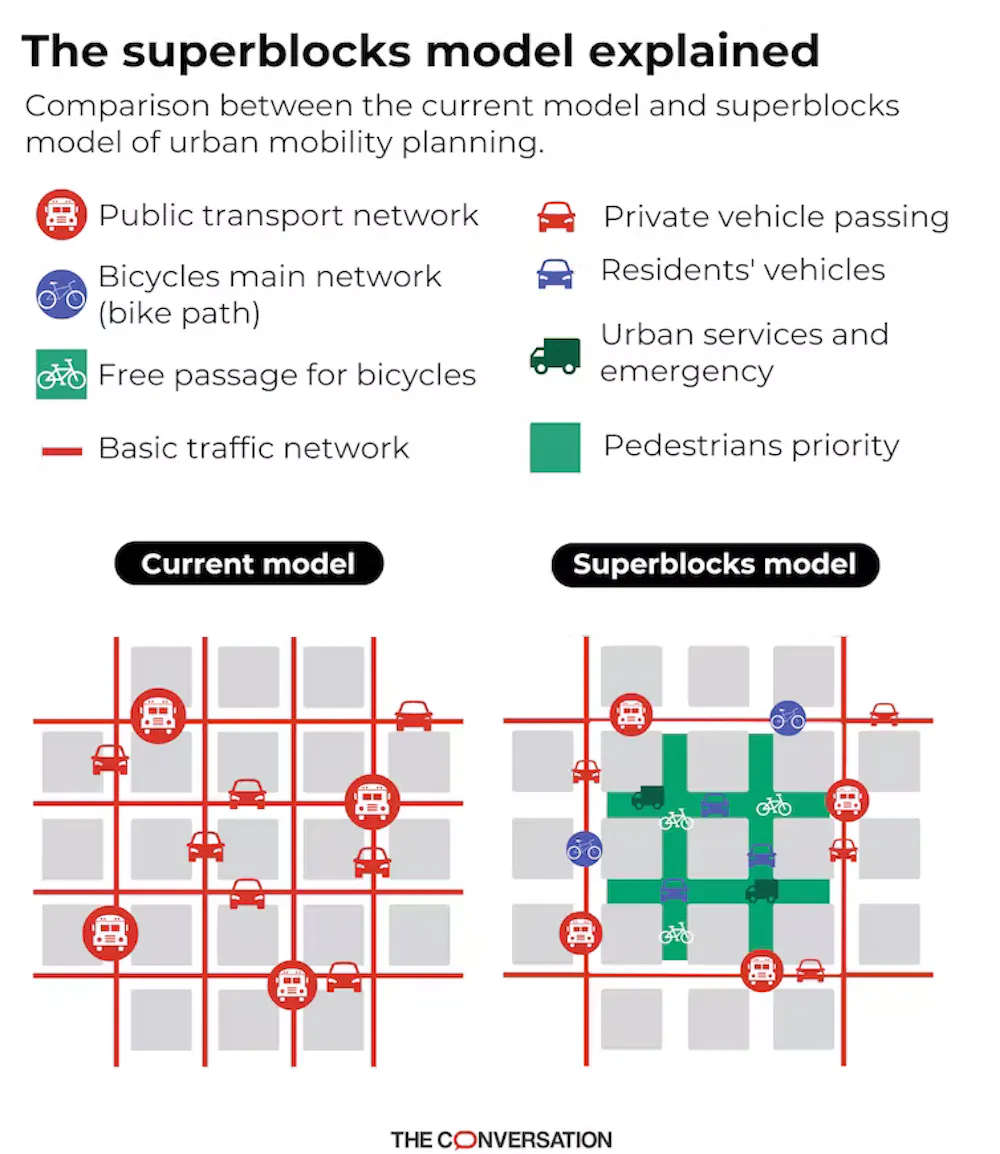
A superblock covers an area of multiple city blocks – typically nine in a 3x3 format – that excludes through traffic. In this space, cyclists, walkers and residents have priority, though cars still have low-speed access to all buildings within the area. Superblocks transform formerly car-dominated streets into public spaces that can be used for a range of activities.
We have developed a step-by-step approach to introducing superblocks to Melbourne.
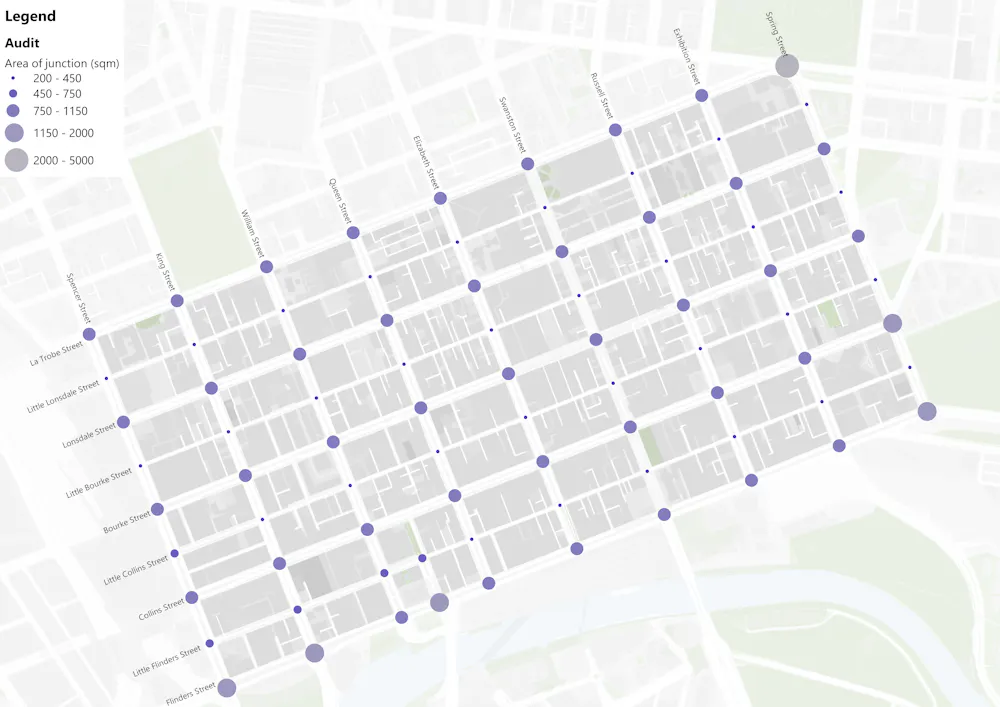 Locations of large and small junctions in the Hoddle Grid.
Map: Alexia Yacoubian and Mónica Suárez
Locations of large and small junctions in the Hoddle Grid.
Map: Alexia Yacoubian and Mónica Suárez
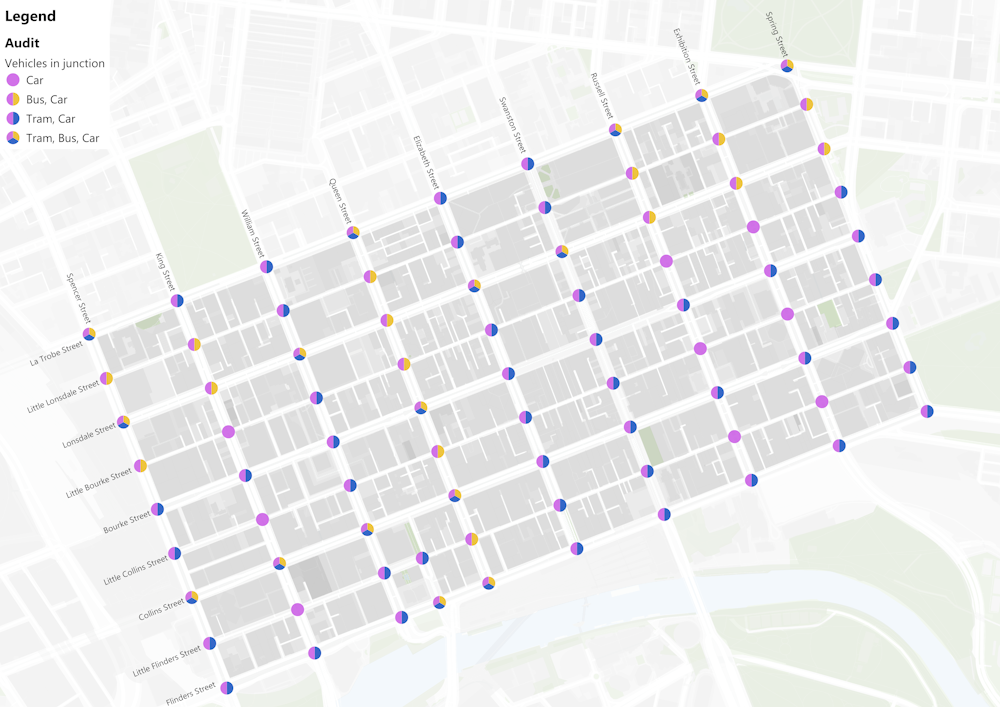 Junctions categorised by vehicle types crossing at each intersection.
Map: Alexia Yacoubian and Mónica Suárez
2. Work out what configurations are needed and where
The rectangular form, mix of large and little streets, tram lines and existing pedestrian areas all suggest departures from the “classic” 3x3 superblock that looks like a hashtag. We’re looking at including some 2x3 superblocks. All these forms should be considered to increase and improve space for pedestrians.
We propose four different options. In the following maps the green dots are junctions that have been made highly accessible for pedestrians. The more green dots, the better.
Junctions categorised by vehicle types crossing at each intersection.
Map: Alexia Yacoubian and Mónica Suárez
2. Work out what configurations are needed and where
The rectangular form, mix of large and little streets, tram lines and existing pedestrian areas all suggest departures from the “classic” 3x3 superblock that looks like a hashtag. We’re looking at including some 2x3 superblocks. All these forms should be considered to increase and improve space for pedestrians.
We propose four different options. In the following maps the green dots are junctions that have been made highly accessible for pedestrians. The more green dots, the better.
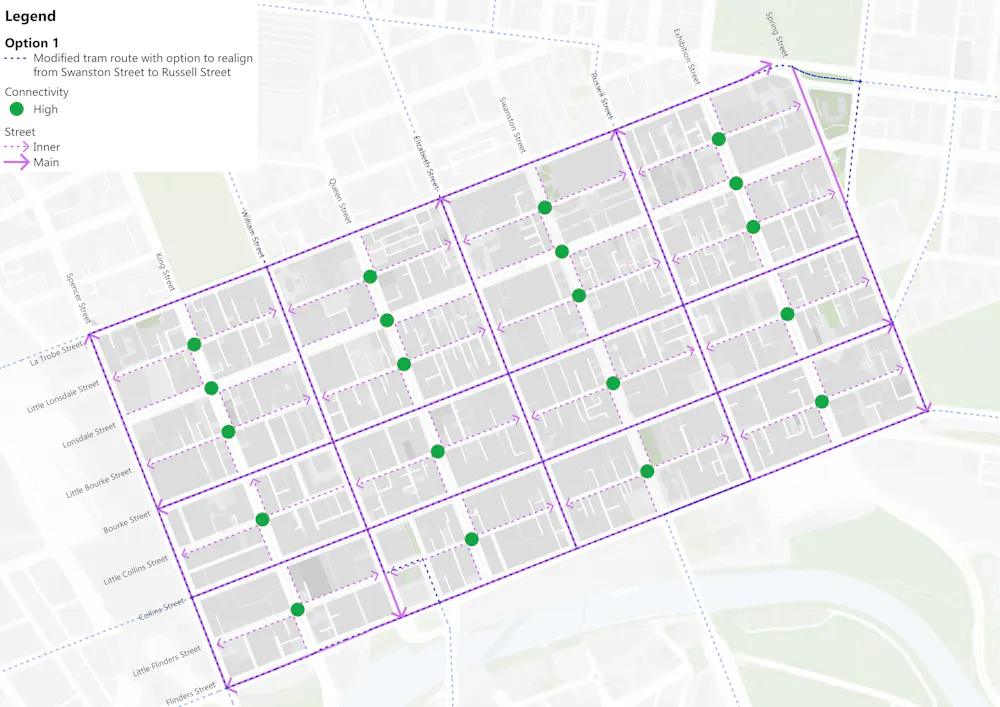 Option 1: Yields the largest number of superblocks by rerouting traffic along the roads with tramways. This involves sending traffic down Bourke Street Mall and rerouting Swanston Street trams along Russell Street.
Map: Alexia Yacoubian and Mónicá Suarez
Option 1: Yields the largest number of superblocks by rerouting traffic along the roads with tramways. This involves sending traffic down Bourke Street Mall and rerouting Swanston Street trams along Russell Street.
Map: Alexia Yacoubian and Mónicá Suarez
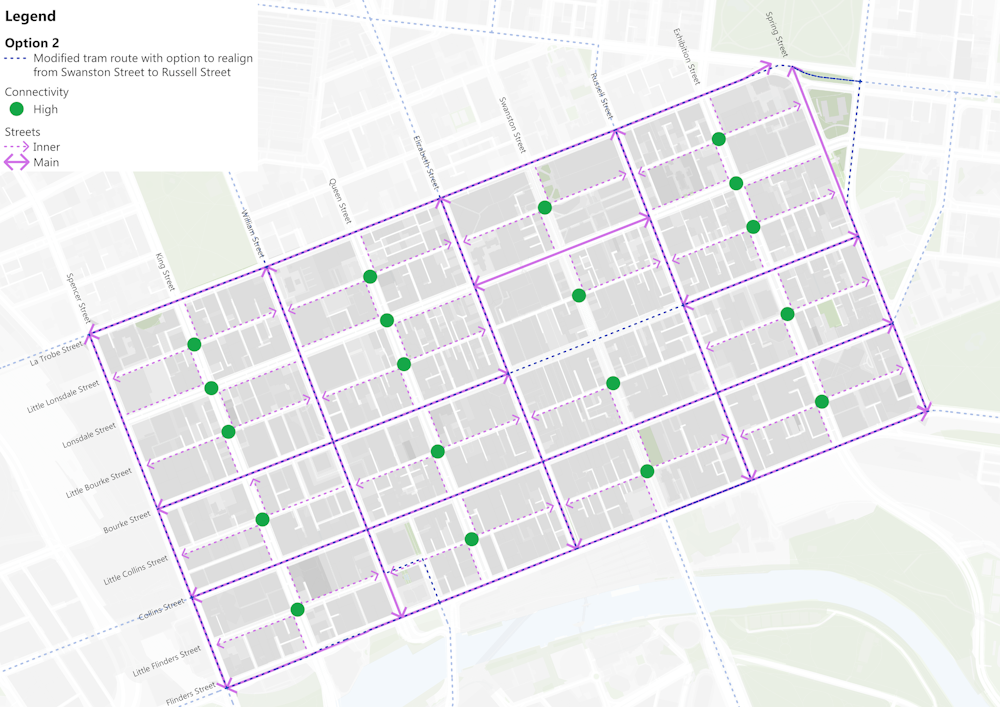 Option 2: Yields fewer green dots and maintains the Bourke Street pedestrian mall, but moves the Swanston Street tram line to Russell Street.
Map: Alexia Yacoubian and Mónicá Suarez
Option 2: Yields fewer green dots and maintains the Bourke Street pedestrian mall, but moves the Swanston Street tram line to Russell Street.
Map: Alexia Yacoubian and Mónicá Suarez
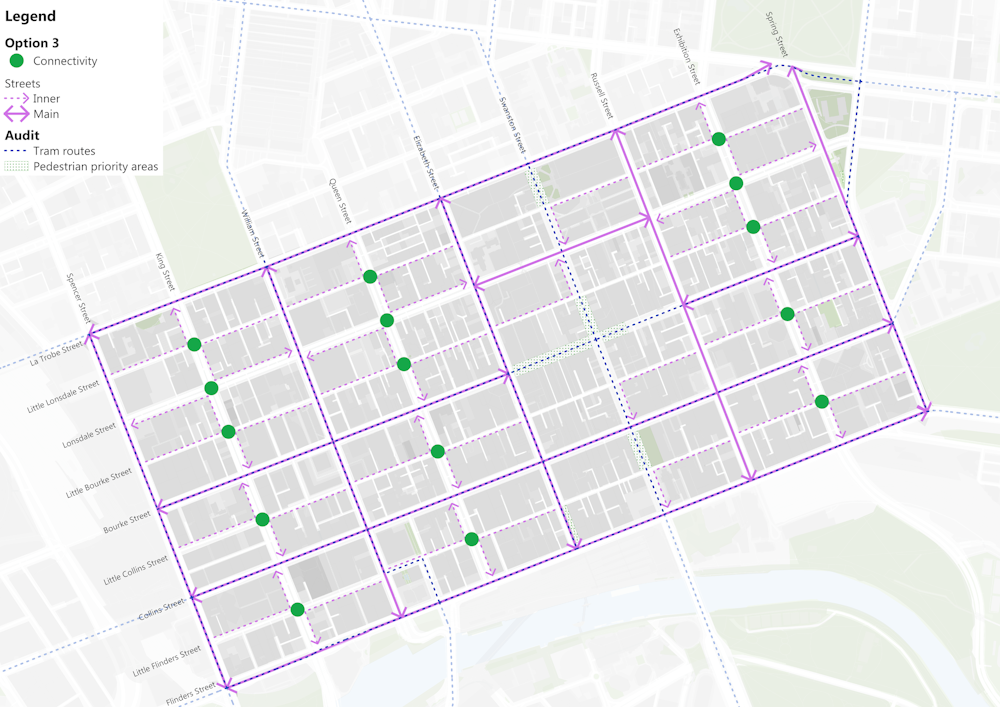 Option 3: A more conservative proposal that maintains current tram locations. However, in a superblock plan the centre junctions should not be a location for movement.
Map: Alexia Yacoubian and Mónicá Suarez
Option 3: A more conservative proposal that maintains current tram locations. However, in a superblock plan the centre junctions should not be a location for movement.
Map: Alexia Yacoubian and Mónicá Suarez
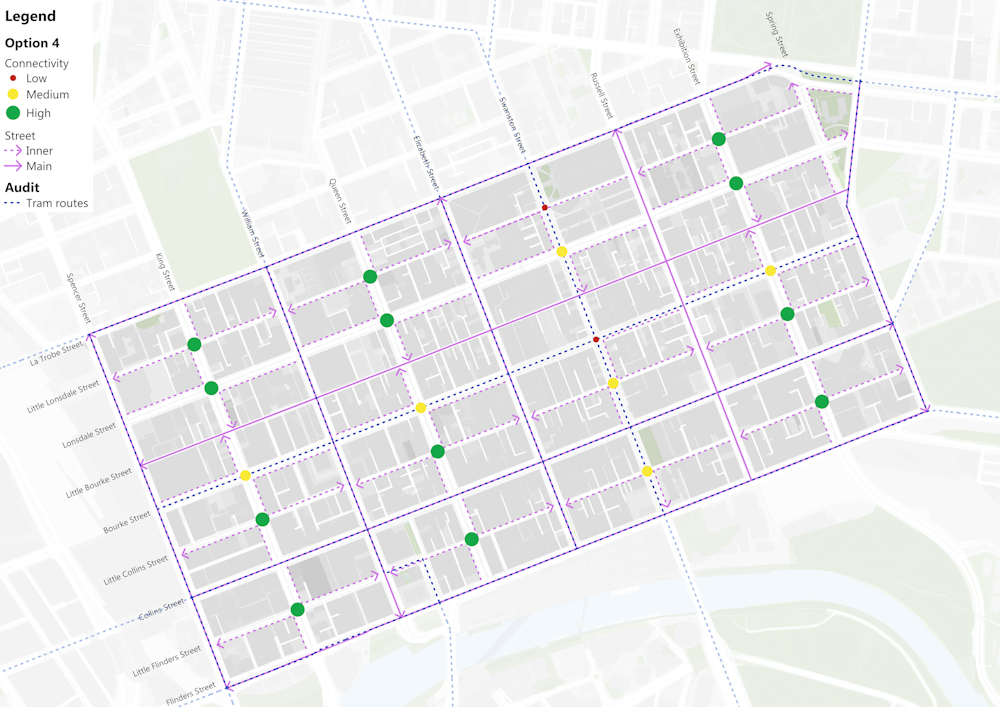 Option 4: Acknowledges that some junctions may have to include trams in the centre of the superblock.
Map: Alexia Yacoubian and Mónicá Suarez
3. Assess the success of different options
Option 1 above increases the area of footpaths from around 169,000 square metres to 385,480 square metres - an increase of around 11 MCGs.
Option 4: Acknowledges that some junctions may have to include trams in the centre of the superblock.
Map: Alexia Yacoubian and Mónicá Suarez
3. Assess the success of different options
Option 1 above increases the area of footpaths from around 169,000 square metres to 385,480 square metres - an increase of around 11 MCGs.
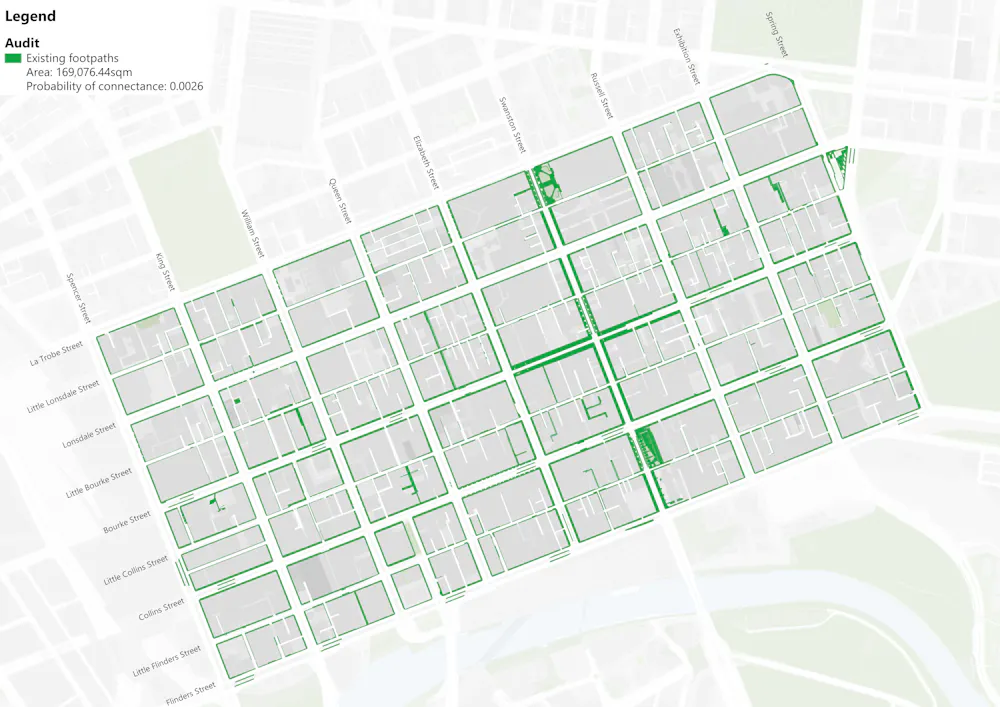 Existing footpaths in the Hoddle Grid.
Map: Alexia Yacoubian and Mónica Suárez using data from City of Melbourne
Existing footpaths in the Hoddle Grid.
Map: Alexia Yacoubian and Mónica Suárez using data from City of Melbourne
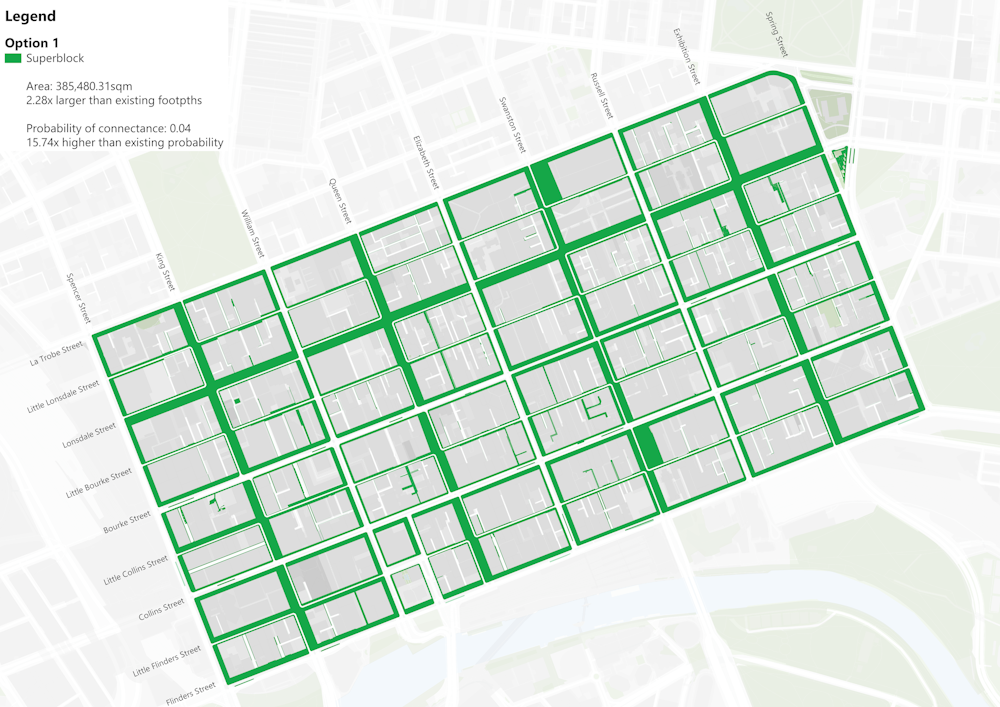 Option 1 produces a 2.3 times increase in footpath space and greater pedestrian connectivity.
Map: Alexia Yacoubian and Mónicá Suarez
Placing open spaces in junctions radically changes the pedestrian experience. Using a method from ecology, we can calculate a pedestrian connectivity index – the probability that a pedestrian can get from one point on a footpath to another in the grid without crossing a road. For the current grid, the probability is 0.2%. For the superblock model, it’s 4% – a 20-fold increase.
Even though pedestrians have more access, unlike a pedestrianisation plan, vehicle access to the buildings remains largely the same.
4. Decide how to use all this new open space
Once the questions shift from a matter of “if” to “how”, other questions come into play. What to do about car parking? We know off-street garages within 200 metres of on-street car parks could accommodate half of this parking.
How can these new spaces in junctions be used? The renderings below (by Mónica Suárez and Alexia Yacoubian using Google Street View images) provide some ideas. The first shows a “green dot” space where a car-only junction has been converted to pedestrian space. The second shows a “yellow dot” junction shared by trams and pedestrians.
Before and after: corner of Exhibition and Little Lonsdale streets
Before and after: corner of Swanston and Lonsdale streets
These are pilot ideas - e.g. the discussion should continue to how the grid interacts with surrounding streets and with Birrarung. But it could also act as a template for other cities in Australia that are similarly modern, colonial and grid-based.
Read more:
Cars have taken over our neighbourhoods. Kid-friendly superblocks are a way for residents to reclaim their streets
5. It’s a marathon not a sprint
For more than 30 years, cities around the world from Curitiba to Barcelona have in effect been saying: thank you, dear car, for all you have given us in the 20th century, but now it is time to move on.
In practice, this needs to be a gentle and caring process with many steps, learning as we go. It is as de Oliveira Andreotti might argue, low-intensity activism and a marathon rather than a sprint.
Acknowledgments: The ideas in this article were developed as part of a workshop at RMIT. Participants included Zena Cumpston, Leanne Hodyl and representatives from City of Melbourne, Department of Transport, Yarra Trams, Infrastructure Victoria, RACV, RMIT, Melbourne and Monash Universities. Any errors remain the authors’.
Authors: Marco Amati, Associate Professor of International Planning, Centre for Urban Research, RMIT University
Option 1 produces a 2.3 times increase in footpath space and greater pedestrian connectivity.
Map: Alexia Yacoubian and Mónicá Suarez
Placing open spaces in junctions radically changes the pedestrian experience. Using a method from ecology, we can calculate a pedestrian connectivity index – the probability that a pedestrian can get from one point on a footpath to another in the grid without crossing a road. For the current grid, the probability is 0.2%. For the superblock model, it’s 4% – a 20-fold increase.
Even though pedestrians have more access, unlike a pedestrianisation plan, vehicle access to the buildings remains largely the same.
4. Decide how to use all this new open space
Once the questions shift from a matter of “if” to “how”, other questions come into play. What to do about car parking? We know off-street garages within 200 metres of on-street car parks could accommodate half of this parking.
How can these new spaces in junctions be used? The renderings below (by Mónica Suárez and Alexia Yacoubian using Google Street View images) provide some ideas. The first shows a “green dot” space where a car-only junction has been converted to pedestrian space. The second shows a “yellow dot” junction shared by trams and pedestrians.
Before and after: corner of Exhibition and Little Lonsdale streets
Before and after: corner of Swanston and Lonsdale streets
These are pilot ideas - e.g. the discussion should continue to how the grid interacts with surrounding streets and with Birrarung. But it could also act as a template for other cities in Australia that are similarly modern, colonial and grid-based.
Read more:
Cars have taken over our neighbourhoods. Kid-friendly superblocks are a way for residents to reclaim their streets
5. It’s a marathon not a sprint
For more than 30 years, cities around the world from Curitiba to Barcelona have in effect been saying: thank you, dear car, for all you have given us in the 20th century, but now it is time to move on.
In practice, this needs to be a gentle and caring process with many steps, learning as we go. It is as de Oliveira Andreotti might argue, low-intensity activism and a marathon rather than a sprint.
Acknowledgments: The ideas in this article were developed as part of a workshop at RMIT. Participants included Zena Cumpston, Leanne Hodyl and representatives from City of Melbourne, Department of Transport, Yarra Trams, Infrastructure Victoria, RACV, RMIT, Melbourne and Monash Universities. Any errors remain the authors’.
Authors: Marco Amati, Associate Professor of International Planning, Centre for Urban Research, RMIT University 

















