

What mirrored ants, vivid blue butterflies and Monstera house plants can teach us about designing buildings
- Written by: Aysu Kuru, Lecturer in Architecture and Construction, University of Sydney
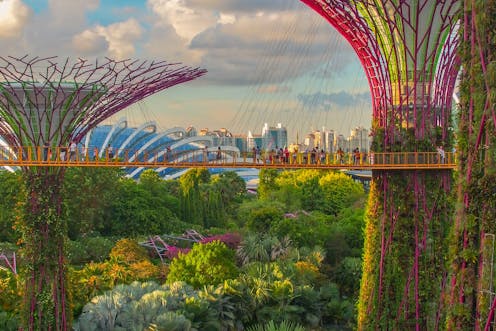
Almost all buildings today are built using similar conventional technologies and manufacturing and construction processes. These processes use a lot of energy and produce huge carbon emissions.
This is hardly sustainable. Perhaps the only way to truly construct sustainable buildings is by connecting them with nature, not isolating them from it. This is where the field of bioarchitecture emerges. It draws on principles from nature to help solve technological questions and address global challenges.
Take desert organisms, for example. How do they survive and thrive under extreme conditions?
One such desert species is the Saharan silver ant, named for its shiny mirror-like body. Its reflective body reflects and dissipates heat. It’s an adaptation we can apply in buildings as reflective walls, or to pavements that don’t heat up.
There are so many aspects of nature we can drawn on. Picture cities with shopping centres based on water lilies, stadiums resembling seashells, and lightweight bridges inspired by cells.
Water lilies can teach us how to design large buildings efficiently with smooth pedestrian circulation. Seashells can inspire the walls of large-span buildings without the need for columns. Cells can show us how to develop lightweight suspending structures.
Read more: Building a 'second nature' into our cities: wildness, art and biophilic design
Bioarchitecture works with nature, not against it
Bioarchitecture can reinvent the natural environment in the form of our built environment, to provide the ultimate and somehow obvious solutions for the threats Earth is facing.
Most industry-led and research-based approaches focus on the “technology to save us” from climate change. In contrast, bioarchitecture offers a more sustainable approach that aims to develop a positive relationship between buildings and nature.
Living organisms constantly communicate with the natural world. They move around their environment, employ chemical processes and undergo complex reactions, patterning their habitat. This means living systems constantly model and organise the environment around them. They are able to adapt and, in doing so, they change their environment too.
Can buildings do the same in cities? If buildings could grow, self-repair and adapt to climate, they might ultimately become truly sustainable.
Early examples of bioarchitecture can be found in traditional and early modern buildings. Their architects observed nature to copy its principles and design more habitable, locally made and environmentally friendly buildings. For example, Gaudi’s Sagrada Familia in Barcelona, Spain, is inspired by natural shapes that give the church its organic form.
More recent works showcase bioarchitecture that learnt from nature coupled with technology and innovation. Examples include using bio-based materials such as wood, hemp and bamboo, applying biophilia through using greenery on external walls and plants indoors to boost our connection with nature, and restoring the environment by making buildings part of it.
Considering the climate emergency, we should strengthen buildings’ coherence with nature. Bioarchitecture can do this.
Read more: Bamboo architecture: Bali's Green School inspires a global renaissance
So what can a butterfly teach us?
The blue Menelaus butterfly offers another striking example of design solutions from nature. Despite its radiant blue colour, it is not actually blue and does not have any pigments. Producing and maintaining pigments is expensive in nature, as it requires a lot of energy.
The Menelaus butterfly has an ingenious way to achieve its unique colour without pigments. Its brilliant blue shine comes from scattering light, similar to soap bubbles glimmering in rainbow colours under the sun, despite being completely transparent. The light is scattered by micro-grooves on the butterfly’s wings – so small that they can only be seen with an ultra-high-resolution microscope.
This is nature’s way to achieve high performance with cheap forms instead of costly materials. Learning from the Menelaus butterfly, we can have windows with climate-adaptable properties – changing their colour and scattering light according to the position of the sun. Butterfly wings have already inspired the development of new materials, and the next step is to use these on buildings.
In this way, we can design biobuildings that reflect excessive radiation and reduce cooling needs and glare. And the beautiful part is that this may all be done without obstructing views and without the need for shading devices or tinted windows.
Read more: Five ways that natural nanotechnology could inspire human design
And what does a pot plant have to do with buildings?

Then there is Monstera, a sought-after indoor plant that climbs up the walls. It’s also called the “Swiss cheese plant” for the holes on its leaves. Have you ever thought about how it thrives and grows like no other plant indoors?
Monstera simply needs to sustain fewer cells to maintain extra large leaves because of their holes. This enables it to capture more of the sunlight it needs to grow and spread out over a bigger area.
Now imagine if we designed hollow building structures such as columns and beams. This could help minimise the need for materials and cut carbon emissions by reducing the embodied energy that goes into making these materials.
Read more: How the wings of owls and hummingbirds inspire drones, wind turbines and other technology
Nature offers a vast design catalogue
We can look at nature as a catalogue of designs and solutions to be reimagined as bioarchitecture. So, we could have shiny silver pavements like the silver ant, metallic-coloured but transparent windows like the Menelaus butterfly, and buildings that use the minimum of materials like Monstera’s leaves.
Nature is wealthy, nature is generous. Through bioarchitecture, buildings can dive into that wealth and become a part of the generosity. Truly sustainable biobuildings can be constructed that work with nature and reverse the harm our conventional building technologies have done to the planet.
Authors: Aysu Kuru, Lecturer in Architecture and Construction, University of Sydney



















