

As Pakistan's PM, Imran Khan must embrace compromise. Can he deliver on his promises?
- Written by: Samina Yasmeen, Director of Centre for Muslim States and Societies, University of Western Australia
Once a global cricket star, Imran Khan is now poised to become Pakistan’s new prime minister. But he’s likely to find that running a country is much more difficult than winning the vote; the July election that brought him to power has also left his party short of a clear parliamentary majority.
Forced to form a coalition in parliament, Khan will have to compromise if he’s to have any hope of tackling key issues in Pakistan – myriad economic, environmental, foreign policy and social welfare challenges – while trying to deliver on his vision for “naya Pakistan” (new Pakistan).
Read more: Imran Khan hopes to transform Pakistan but he'll have far less power than past leaders
Rise to power
Khan formed his political party, Pakistan Tehreek-e-Insaf (PTI), in 1996 and persevered for years to muster support for his vision for “naya Pakistan”. His electoral success is also partly explained by his popularity as the cricket captain who won the World Cup for Pakistan in 1992.
In a country that feverishly loves cricket, Khan creatively used “cricket-speak” in his campaigning and employed a cricket bat as his electoral symbol. But his success has predominantly resulted from pre-polling orchestration and support from the military, which provided him space for electioneering while denying similar opportunities for other contestants. In other words, he has learnt the art of politics.
Khan’s chief rival was the Pakistan Muslim League (PML-N), led by former Prime Minister Nawaz Sharif, whose administration was toppled over corruption allegations. When the nation’s top court declared him ineligible to hold public office - a move Sharif decried as “judicial martial law” - his party was left weakened. Khan’s party, the PTI, reaped the benefits.
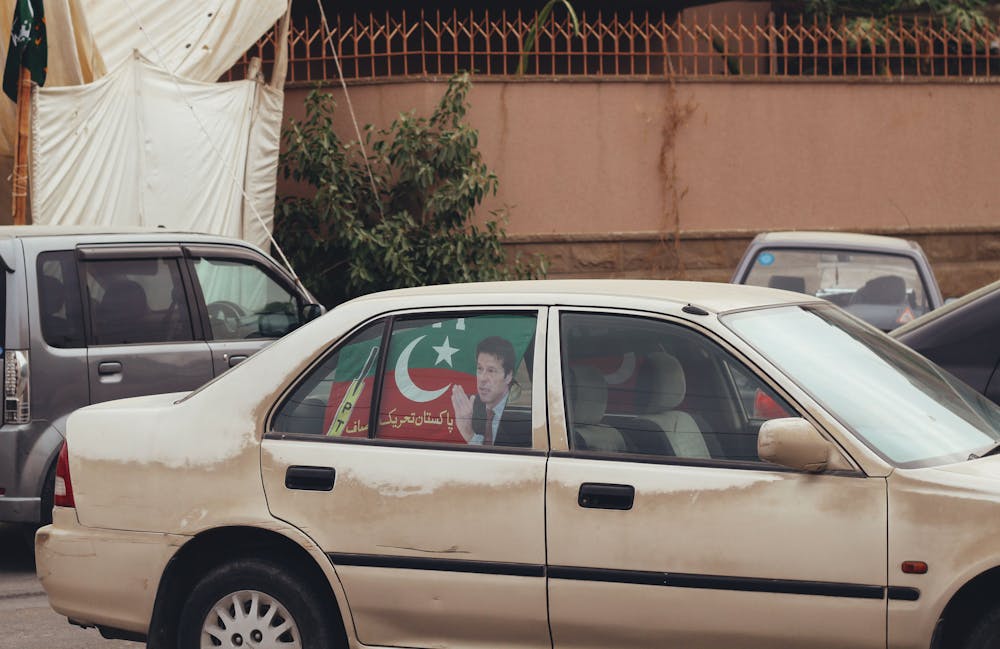 Khan used the cricket bat symbol in his election material.
Aine Moorad / Shutterstock.com
Khan used the cricket bat symbol in his election material.
Aine Moorad / Shutterstock.com
Following the July vote, the PTI secured 116 of the 270 seats contested in the National Assembly, with rival parties PML-N and Pakistan Peoples Party (PPP) securing only 64 and 43 seats, respectively.
Falling short of a clear majority, Khan’s PTI party has opted for coalition politics. It has joined forces with independently elected representatives and a wide variety of political parties, including the Grand Democratic Alliance (GDA), the Muttahida Quami Movement (MQM) and the Balochistan Awami Party (BAP).
The coalition is also poised to form three of the four provincial governments: Khyber Pakhtunkhwa (KPK), Balochistan and Punjab. Of these, Punjab is the jewel in the crown, with half of the country’s 208 million people, and where the PML-N has lost its traditional power base to the PTI. But ensuring the sustainability of coalition government at provincial level remains a challenge, especially as local tensions intersect with the eternal strain between central and regional governments.
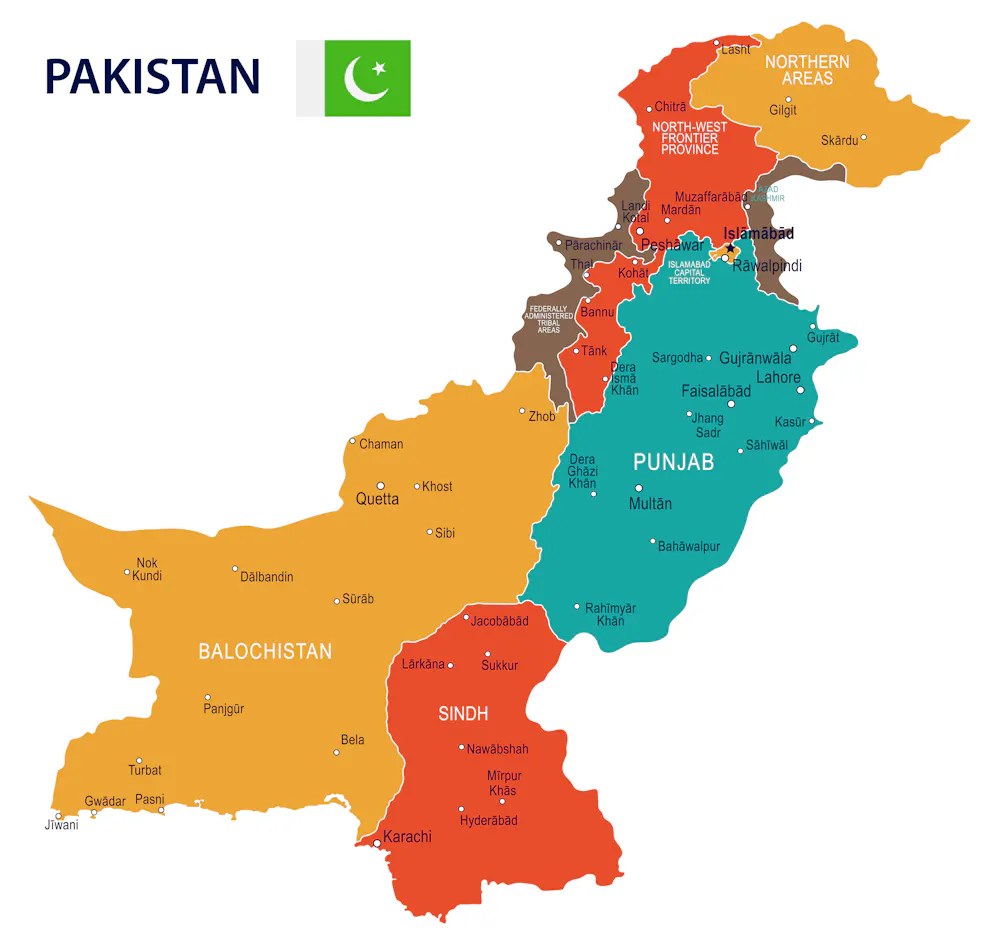 The coalition is also poised to form three of the four provincial governments: Khyber Pakhtunkhwa (KPK), Balochistan and Punjab.
Shutterstock
The coalition is also poised to form three of the four provincial governments: Khyber Pakhtunkhwa (KPK), Balochistan and Punjab.
Shutterstock
Foriegn policy woes and domestic tensions
In the foreign policy arena, Pakistan faces mounting US pressure and has been placed on the “grey list” of the Financial Action Task Force (FATF), an inter-governmental body aimed at combating money laundering and terrorist financing.
The military has increasingly sought to control Pakistan’s foreign policy, especially its relationships with India, Afghanistan, the US, Iran and the Gulf States. We shouldn’t expect huge change on that front. Judging by the PTI manifesto and Khan’s first post-election address, the new government will continue to operate within the parameters established by the military.
Khan’s PTI party faces domestic economic woes, too. Pakistan’s foreign exchange reserves have dwindled from US$17.5 billion in April to US$9.66 billion in June. Economic growth has slowed, the rupee has been devalued and Pakistan is seeking a US$12 billion bailout package from the International Monetary Fund.
Can Khan deliver?
Khan acknowledges these challenges, and has proffered solutions. He’s talked about learning from China the art of rapidly lifting people out of poverty and promised to cut government spending.
But the capacity of the government to deliver on these promises cannot be guaranteed. Traditionally, Pakistan’s regional and national leaders have used their local influence to sustain their respective power bases at the cost of ordinary citizens. Khan’s PTI party has engaged a number of these “electables” for its electoral success, but such people are unlikely to embrace change beyond a certain level.
The biggest challenge remains the tide of rising expectations in Pakistan. Khan says his vision of “naya Pakistan” means combating corruption and nepotism, promoting merit-based decisions at all levels, increasing accountability and boosting access to education and health services.
Such aspirations are noble, but he will need more than five years to achieve all this in a country in which the powerful are privileged and the powerless usually ignored.
This is not to suggest that nothing can or will change in Pakistan.
But change may be so slow that young people (who make up 64% of the population) could grow increasingly disillusioned.
Pakistan’s political history may repeat itself. Former prime minister Zulfiqar Ali Bhutto (who was also the father of another Pakistani leader, Benazir Bhutto) similarly heightened expectations among the poor in the 1960s with a suite of promises. His inability to deliver on them pushed the country towards 11 years of military rule.
Read more: Imran Khan's battles have only just begun, after Pakistan’s 'dirtiest election'
The growing power of Pakistan’s religious groups is an even bigger challenge. Traditional Islamist parties have not fared well in the elections. But one such party, Tehreek-e-Labbaik Pakistan (TLP), secured 2.2 million votes, in contrast to the 6.8 million votes for the left-leaning Pakistan Peoples Party (PPP), led by Benazir Bhutto’s son Bilawal.
If PTI fails to deliver on Khan’s promise of a “new Pakistan”, the TLP or other militant outfits could entice more young people to join their cause.
After the celebrations for Khan’s victory are over, we must be realistic about the likelihood for rapid change in Pakistan.
Authors: Samina Yasmeen, Director of Centre for Muslim States and Societies, University of Western Australia



















