

Google AI


Modern Australian

To clean up Australia's power grid, we're going to need many thousands more skilled workers – and fast

  • Written by: Jay Rutovitz, Research Director, Institute for Sustainable Futures, University of Technology Sydney
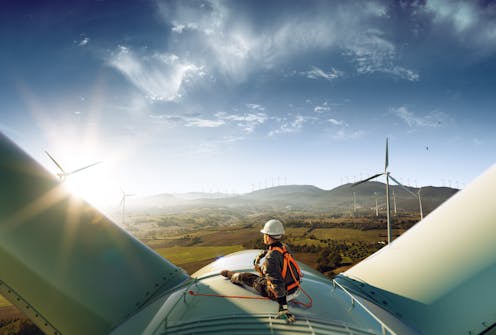
To clean up Australia's power grid, we're going to need many thousands more skilled workers – and fast

To get Australia’s grid 82% powered by renewables by 2030 is a huge increase. At present, the electricity powering eastern and southern states is around 33% renewable.

To get there means a lot of work. Over the next seven years, it would be equivalent to installing dozens of large wind turbines every month, and tens of thousands of solar panels every day.

And work needs workers. To make this happen, our modelling shows 15,000 more workers are needed by 2025 – less than three years away. That’s amid a skills shortage, an infrastructure boom and unemployment rates at the lowest level in decades.

So how to do it? We need to train more skilled workers and give them more security. Renewable projects have tended to operate on boom-bust cycles when it comes to jobs. But to get where we need to be, we need to shift to a long-term boom mentality. We’re going to need people doing these jobs for decades to come.
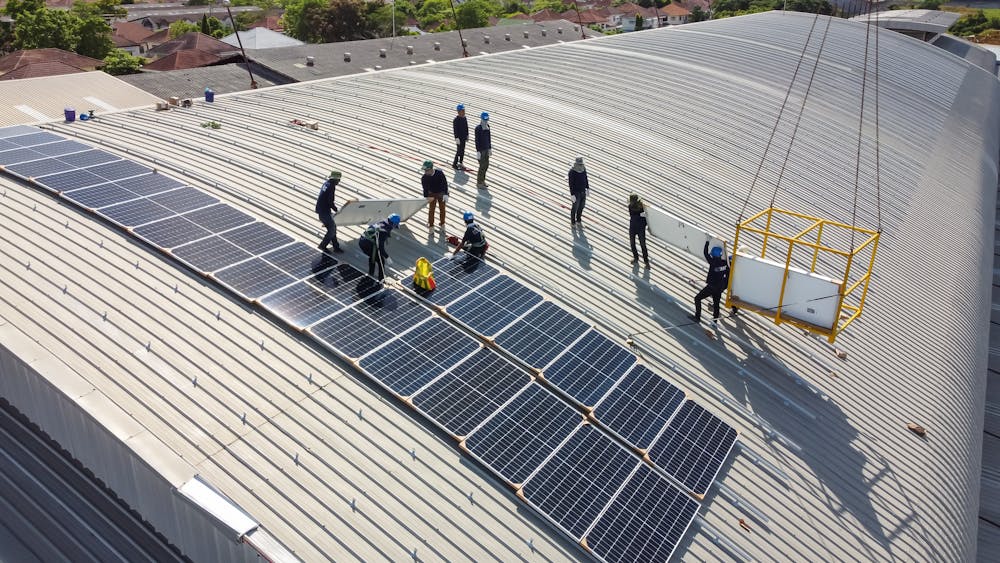
Solar panel installation
The big renewable build will only work if we have enough workers. Shutterstock

How big is this issue?

Big. Getting to 82% renewables and fast means we need to greatly scale up the electricity sector workforce in generation, storage and transmission line construction.

We estimate the current workforce is around 41,000, including 12,000 working in coal and gas power stations or supplying those power stations with fuel. This is only an estimate, as updated figures won’t be available until the federal government delivers its promised energy employment report.

Read more: Wind turbines off the coast could help Australia become an energy superpower, research finds

Australia’s energy market operator, AEMO, publishes regularly updated pathways to a clean-energy future. Now we have federal backing for accelerated timelines, the most likely outcome is the so-called “step change scenario”. This scenario envisages nine times more wind and solar by 2050, to boost capacity to 141 gigawatts, and four times more rooftop solar.

Under this scenario, 15,000 more workers must be ready and able to build and operate renewables and storage, or build transmission lines, by 2025.

The problem is, these workers don’t exist at present. Many existing skilled workers are already paid well by major infrastructure projects, such as metro rail projects in Melbourne and Sydney and regional projects such as inland rail. What’s more, unemployment rates are the lowest in decades, and peak demand for labour to build wind and solar projects is set to outstrip the entire current workforce in some regional areas where the renewable projects will be concentrated.

To add to the challenge, skilled workers tend to live in major population centres – but clean energy projects are virtually all in the regions. So the clean energy sector must compete with big infrastructure projects in the cities, which pay more and don’t involve travel. You can see the challenge. If we don’t get this right, the clean energy transition just won’t happen.

The common answer to workforce shortages is to train more workers. But here, too, there are challenges. Our skilled training sector has long been in the doldrums, with demand spread thin across far-flung regions and policy uncertainty leaving many gaps in capacity.

15,000 new skilled workers are just the start

We modelled the workforce needed to achieve three of the AEMO scenarios: the step change, the hydrogen superpower and the slow change. We also modelled an offshore wind scenario, using AEMO’s modified step change “sensitivity” which takes into account Victoria’s ambitious target for offshore wind.

Under the step change scenario, we found the demand for skilled jobs will increase 37,000 from 2023 and peak at 81,000 in 2049.

Jobs in generation, transmission construction and storage under different scenarios for the National Electricity Market.

But if Australia becomes a major exporter of renewable energy in the form of green hydrogen or green ammonia, as backers like iron ore billionaire Twiggy Forrest are hoping, that’s a different story. It would require up to twice the workers of the step-change scenario in the 2030s, and up to triple in the 2040s.

That’s a staggering peak demand of 237,000 jobs, with an average demand of 110,000. To get there, we would need 34,000 extra workers within three years.

Where will the jobs be? New South Wales will be the leading state in most scenarios, with a demand for over 20,000 skilled workers annually until 2050 under the step-change scenario. Across NSW, Queensland and Victoria, the job split by technologies is very similar in this scenario: 37% of jobs in solar, 27–30% for wind, and 17–22% in batteries. The pattern is similar in the offshore wind and slow-change scenarios.


What about the hydrogen superpower scenario? This would change things dramatically. Here, the highest demand for renewable jobs would be in Queensland, South Australia and Tasmania. Compared to the step-change scenario, Queensland would add over 100,000 jobs, while jobs in South Australia would more than treble and Tasmania quadruple from 2,200 to 9,400. Relatively modest growth is projected for NSW and Victoria – 4,000 new jobs in both states compared to the step change. Electricity sector jobs in the Step Change scenario by technology in the National Electricity Market. We can’t just leave it to the market Coordinated action is needed to plan and implement skills, training and workforce development. Here, state and territory governments can build on the recent creation of Renewable Energy Zones – essentially, renewable rich areas where transmission lines exist or will be built – to boost collaboration between industry and government on training strategies and programs. Workforce planning should be brought into overall energy system planning, to help reduce the employment boom-bust cycle. Most electricity planning favours “just in time” construction, where infrastructure is built as it is needed. That means demand for labour is volatile. The NSW government has created an electricity infrastructure jobs advocate and created EnergyCo to co-ordinate the development of the renewable energy zones and maximise local benefits. Given current shortages of workers, it’s vital governments take action now. Acting early would help future-proof our clean energy workforce and maximise benefits for regional areas. Even better, we could help boost numbers of workers from under-represented groups such as women and First Nations communities. Read more: How can Aboriginal communities be part of the NSW renewable energy transition? Authors: Jay Rutovitz, Research Director, Institute for Sustainable Futures, University of Technology Sydney

Read more https://theconversation.com/to-clean-up-australias-power-grid-were-going-to-need-many-thousands-more-skilled-workers-and-fast-195906

Pool and Deck Design: How to Plan the Perfect Outdoor Living Space for Your Sydney Home

For many Australians, the backyard is where life happens. Summer barbecues, weekend swims and long evenings outdoors are all part of the lifestyle, ...

Is Solar Pool Heating Worth It? What Sydney Homeowners Should Know

There's nothing quite like a backyard pool on a hot Sydney day. But once autumn rolls in, many pools sit unused for months because the water is simp...

Planning a Luxury House Move: A Week-by-Week Timeline for Prestige Sydney Homes

Selling or buying a prestige home is a major milestone. Whether it's a waterfront residence in Birchgrove, a grand Federation home in Haberfield or ...

Downsizing or Upgrading Your Caravan? Here's How to Sell It Without the Hassle

Selling a caravan can feel like a major task, especially when you are unsure about its value, paperwork, or how to find a buyer. Whether you are dow...

The Best Overseas Adventure Holidays for Australians Who Love the Outdoors

Australia offers no shortage of incredible outdoor experiences, but sometimes the best way to satisfy your sense of adventure is to head overseas. A...

Cape Town Wine Shuttle: Winelands Tasting & Tours

Embark on an unforgettable journey through the picturesque Cape Winelands, where world-class wines and breathtaking scenery await. Our Cape Town Win...

Why Giant Rats Tail Grass Keeps Coming Back After Spraying

Giant Rats Tail Grass (GRT) is one of the most frustrating pasture weeds for farmers and lifestyle property owners. You spray an infested area, see th...

When Custom Cardboard Boxes Make Sense for Your Business

Custom cardboard boxes can be useful when a standard carton does not fit a product, packing method or presentation requirement particularly well. A ...

Virtual Livestock Fencing and GPS Tracking: Improving Visibility Across Cattle Properties

What Virtual Livestock Fencing Means for Modern Cattle Management Managing cattle across extensive properties requires more than knowing where anim...

Sydney Pawnbrokers Explained: How Hocking Your Car Actually Works

Sometimes you need cash, and you need it soon. If you own a car, you may already have a way to get it. That's what people mean when they say they've...

Moving Interstate from the Gold Coast to Brisbane (or Back)? What Removalists Wish You Knew First

Have you talked to anyone who’s done the move? They say the same thing: the drive up the M1 is the easy part. It's everything around it that catches...

Why the Spring School Holidays Are a Great Time to Visit Coffs Harbour

The spring school holidays are a good time to spend a few days on the Coffs Coast. The weather is starting to warm up, there is plenty to do outdoor...

What to Do When an Older Car Is No Longer Worth Keeping in Melbourne

Ever looked at another repair quote and wondered whether your old car is still worth the trouble? It is a common turning point for Melbourne motoris...

Your Baby's First Year: A Local Guide to Feeding, Sleep, and When to Get Extra Support

Ask ten parents in a Brisbane mothers' group how their baby is feeding or sleeping, and expect ten different answers.  Someone's baby sleeps throug...

Kitchen and Laundry Makeover Ideas That Don't Require a Full Renovation

Full kitchen renos are expensive — and most people don't actually need one.  They need the kitchen to stop looking like it's stuck in 2009, or they...

How Technology Is Reshaping the Modern Australian Commercial Kitchen

The commercial kitchen has always been shaped by technology. Refrigeration changed how ingredients could be stored, modern ventilation transformed k...

The Number on a Roller Blind Fabric That Nobody Explains

Somewhere in the fabric book, next to the colour name, there is a percentage. Three per cent. Five per cent. Ten per cent. Nobody explains it, most c...

What’s Trending in Men’s Jewellery This Father’s Day!

Finding a Father’s Day gift that feels personal, stylish and genuinely wearable is not always easy. While socks and novelty mugs have traditionally ...















