

here's how AI can help protect the oceans
- Written by: Philipp Bayer, Adjunct Research Fellow, UWA Oceans Institute, The University of Western Australia
You’ve seen the art AI image generators can create, and you may have played with natural language AI chatbots. You’ve benefited from artificial intelligence tools recommending you music and suggesting your next streaming show.
But AI can do much more. Humans are excellent at spotting patterns. It’s why we see faces on Mars or in the clouds. But in some areas, AI is even better. Give one of these tools a million photographs and ask it to spot telltale signs – and it can. AI can enable research at scales previously impossible.
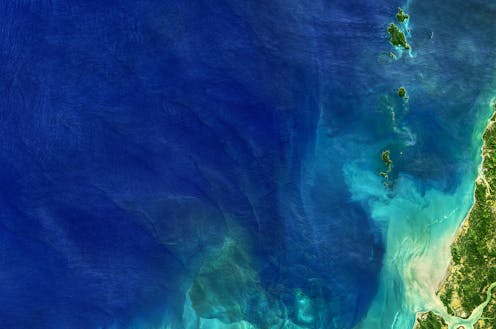
We’ve used AI’s exceptional pattern recognition to trawl through satellite images and map the tonnes of plastic pollution threatening our seas – in real time. Already, this technique has found more than 4,000 unreported informal dumps next to rivers. This is useful, given just ten rivers contribute nearly all the plastic entering our oceans.
This is just the start. So far, AI has shown promise in our projects mapping seagrass meadows from space and finding unknown reefs likely to harbour heat-resilient coral. Soon, we hope we’ll be able to put AI on the job to find out exactly what fish live where – without ever seeing them.
Is AI really a gamechanger for science?
Yes. Think of the vast volumes of data scientists have gathered in recent decades. Until now, trawling through the data has been painstaking and at times tedious. That’s because while detecting patterns is something humans do well, we’re slower.
AI mines large data sets, which can be anything from photos to numbers. You train it so it knows what you’re looking for. Then the software tool gets to work, detecting patterns – and importantly, offering up predictions about how these patterns arise.
Read more: How shoring up drones with artificial intelligence helps surf lifesavers spot sharks at the beach
These methods are especially powerful for messy and complex biological data. For example, the AI tool AlphaFold has totally revolutionised the slow process of understanding how proteins fold themselves into origami-like shapes inside cells. Previously, it might have taken months or years to figure out a single protein structure. This year, AlphaFold announced predicted structures for 200 million proteins.
What can AI offer ecology?
We’ve found AI useful at finding unknown reefs with corals primed to survive despite warming waters. That’s vital, given the oceans have taken up almost all of the heat trapped by the trillion tonnes of greenhouse gases we’ve put in the atmosphere.
And we’ve found AI can usefully identify specific environmental conditions under which reefs will survive as the oceans heat up. Our research suggests hundreds of reefs among the thousands in the Great Barrier Reef may be home to corals which have higher heat tolerance than normal. Now we know this, we can protect these reefs – and turn to them for potential use to restore dying reefs elsewhere.
 Finding naturally heat-resilient corals could help us safeguard reef ecosystems.
Shutterstock
Finding naturally heat-resilient corals could help us safeguard reef ecosystems.
Shutterstock
This idea of “super reefs” isn’t new. Other researchers have focused on protecting 50 coral reefs globally in the hope of safeguarding these ecosystems against the expected mass coral death as water temperatures rise. What we have added was the discovery that AI can help find these heat-resilient corals. Without AI, it would have been like trying to find a needle in a haystack.
Spotting plastic waste from space would have been almost impossible before AI image detection programs became available. How does it work? Essentially, photos taken by European Space Agency satellites are scanned by AI to spot hidden plastic dumps. Then we refine it over time, to see if these sites are getting bigger – and if they’re close to rivers or lakes, which could carry plastics into the seas and add to the millions of tonnes of turtle-choking, fish-killing plastics already swilling around.
The goal is to find the sites at highest risk of adding to ocean plastics. Once we know this, enforcement agencies in each of the 112 countries we’ve mapped can respond to the most urgent problems first. So far we’ve found more than 4,000 sites, with around one in five within 200 metres of a waterway. When we looked at Indonesia in detail, we found double the number of publicly listed dump sites.
 You could trawl through millions of satellite images looking for hidden plastic waste dumps - or you could train an AI tool and let the software do the work.
ESA/Shutterstock
You could trawl through millions of satellite images looking for hidden plastic waste dumps - or you could train an AI tool and let the software do the work.
ESA/Shutterstock
AI is also proving itself as a labour-saver. One part of science often hidden to the general public is the sheer number of manual, repetitive tasks. For instance, if you want to figure out why some baby coral polyps survive heat or more acid water while others die, you have to measure colour, growth and survival rates over time. We’ve found AI can do this work, precisely and fast.
Of course, AI is not magic. It is a tool, and all tools have pitfalls. One problem is placing too much trust in AI outputs, believing them true because the algorithm has seen more data than we have. But this is dangerous, as the confidently wrong answers given by the new ChatGPT AI demonstrate.
Ecology isn’t free from biases either. That means we have to carefully evaluate the data we use to train the AI. Plus, we have to remain vigilant and manually evaluate AI predictions to figure out if they fit with our reality. AI is a valuable assistant for ecologists – not a replacement.
 Automatic weather buoys already exist. It won’t be long until we can build AI water sampling drones to tell us about life underneath.
Shutterstock
Automatic weather buoys already exist. It won’t be long until we can build AI water sampling drones to tell us about life underneath.
Shutterstock
What’s next?
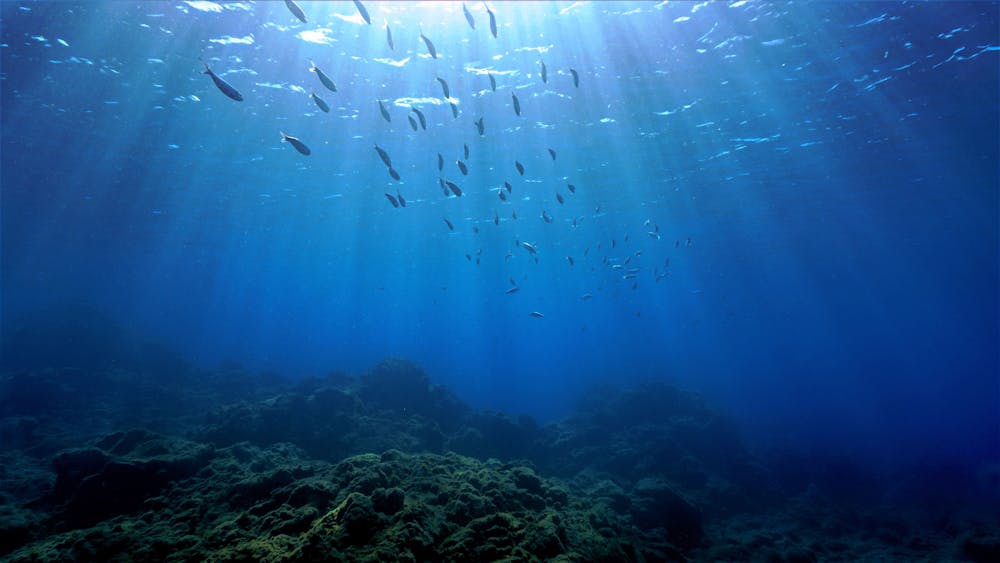
Imagine having autonomous floating or underwater drones sampling seawater, with AI neural networks looking for fish DNA. It sounds like sci-fi, but it’s now entirely possible. Drone technology has matured. AI tools have arrived. And we no longer need to catch fish to know what lives in the seas. All you need are tiny traces of environmental DNA marine species leave behind in water. Similarly, we could track coral reef ecosystem health in near real time.
This will let us take the pulse of these ecosystems at a time when our oceans are under unprecedented pressure from industrial fishing, marine heatwaves and acidification from climate change, and plastic pollution. The more we know, the better we can respond.
Read more: AI can tackle the climate emergency – if developed responsibly
Authors: Philipp Bayer, Adjunct Research Fellow, UWA Oceans Institute, The University of Western Australia

















