

The University of Adelaide and UniSA merger talks are back on but other Australian unis are unlikely to follow
- Written by: Gavin Moodie, Adjunct Professor, Department of Leadership, Higher and Adult Education, OISE, University of Toronto
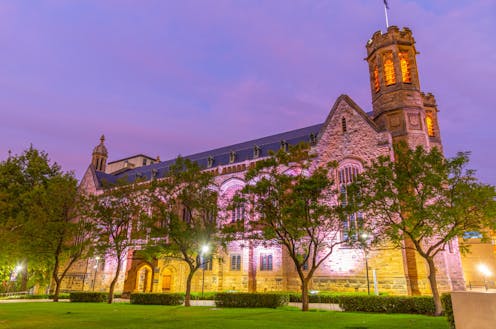
A merger between the universities of Adelaide and South Australia has been talked about for years.
The idea is now officially back on the table, with both universities agreeing to work on a feasibility study.
The proposed new university would be called Adelaide University and open in 2026, with the aim of becoming the biggest Australian university for domestic students.
What will this mean for the university landscape in Australia?
The 3 South Australian universities
There are three public universities in South Australia: the University of Adelaide, University of South Australia and Flinders University.
All three are the result of Australia-wide mergers of universities and colleges of advanced education in the 1990s as part of the “Dawkins revolution,” led by former federal education minister John Dawkins.
The idea of more merges has remained popular amongst some policymakers. There have been proposals to amalgamate Flinders University with earlier versions of the University of South Australia. There was also talk of Flinders “returning to mother” as a campus of the University of Adelaide.
Proposals to merge the universities of Adelaide and South Australia were seriously considered in 2012 and 2018. Then, one of the main aims was to form a very big university. This was despite the fact both universities were then around or just below the median size for Australian universities, of almost 23,000 equivalent full-time students and bigger than the average United Kingdom and United States university.
Since then, the University of South Australia has grown to 25,767 and the University of Adelaide to 23,162 full-time equivalent students.
A ‘vanity project’?
As Australian National University higher education expert Andrew Norton notes, South Australia has a history of “higher ed vanity projects”.
In the 2000s, the state government subsidised the US Carnegie Mellon University, UK Cranfield University and University College London to establish campuses in Adelaide. The dream was to establish Adelaide as a “university city”. In 2004, then foreign minister Alexander Downer (and South Australian) said he wanted Adelaide to become the “Boston of Australia”, as “one of the education centres of the Asia-Pacific region”.
That dream was never realised. Now just Carnegie Mellon University retains its Adelaide campus, with 34 equivalent full-time students reported in official figures in 2020.
Read more: Size isn't everything when it comes to the proposed UniSA-University of Adelaide merger
Why is the merger back on the table now?
The current merger proposal was spurred on by the new Labor state government. One of its election policies was a commission to consider whether a merger would be in the state’s interests. The policy says,
The harsh truth is that each of our universities alone are too small and too undercapitalised to make it into the list of top international universities.
The policy argues a top ranked university would be more attractive to students. This is true for international students, who are attracted to universities’ prestige and the liveliness of the city in which they are based. Most of the prominent international league tables rank universities by volume rather than the intensity of their research, favouring bigger universities.
So, the merged university would be ranked higher in most international league tables and likely attract more international students. In turn, this would expand the state’s economy and develop Adelaide as another type of university city.
Is this really a good idea?
But a merger is not without risks. Each university has a distinct history and orientation and amalgamating them would substantially reduce the diversity of institutions in the state.
The University of Adelaide was the third Australian university, established in 1874, and has a very strong tradition of research intensity and scholarly and cultural enrichment.
The University of South Australia was established in 1991 from a combination of colleges and technical institutes, some of which also originate from the late 19th century. Its strong traditions are in technical and applied studies and research.
A merger would also reduce competition and choice for students. Of the 41 undergraduate study areas on the University of South Australia’s website, 13 are also offered by the University of Adelaide. These choices are likely to be reduced following a merger.
Flinders University declined an invitation to join the current merger, and will presumably present itself as a boutique alternative to its neighbouring behemoth.
What will this mean for other states?
The other most obvious candidate for a merger is the ACT. Here, the Australian National University is of reasonable size of aboout 17,300 equivalent full-time students, but the University of Canberra has (for an Australian university) a modest 11,500 equivalent full-time students.
There was a proposal to merge these universities in 1990s. But the universities had different ambitions. The ANU is one the most research-intensive universities in Australia, while the University of Canberra has had a strong commitment to professional education.
Read more: The universities accord could see the most significant changes to Australian unis in a generation
The other obvious candidate is Western Australia, where Curtin University has 35,000 equivalent full-time students, but the other public universities are from 17,000 to 20,000 equivalent full-time students. However, the state government has other, bigger options for economic development, such as mining.
Twelve of the 13 smallest universities in Australia have very distinctive missions or locations which makes amalgamation either very unlikely to be accepted by their governing body or unlikely to yield any benefits without closing an important regional campus.
For example, the University of Notre Dame Australia (9,700) is a private, Catholic university, Charles Darwin University (8,000) is based in the Northern Territory and the University of Divinity (700) works in partnership with churches and religious orders.
So the Adelaide University merger seems unlikely to be followed in other states. But if it happens in South Australia, it will make a distinctive university, whose formation and development would be interesting to watch.
Authors: Gavin Moodie, Adjunct Professor, Department of Leadership, Higher and Adult Education, OISE, University of Toronto


















