

In Voices of Us, Tim Dunlop considers the outsiders re-energising politics – and takes aim at dumbed-down media and do-nothing politicians
- Written by: Mark Kenny, Professor, Australian Studies Institute, Australian National University

Did Bill Shorten lose the unlosable election in 2019 because he was too frank about franking credits? Was John Howard’s defeat in 2007 a voter reaction against WorkChoices?
Post-election commentary tends to work backwards from who won, casting the decisions of the vanquished as causal. If Labor had lost the 2022 election, its conspicuous campaign strategy of staying low and forcing attention on an unpopular Coalition government would have been tagged as a fatal mistake.
In hindsight, the small target looks wise, if only because Labor secured its majority. But it was a close-run thing with Labor’s primary vote below 33%.
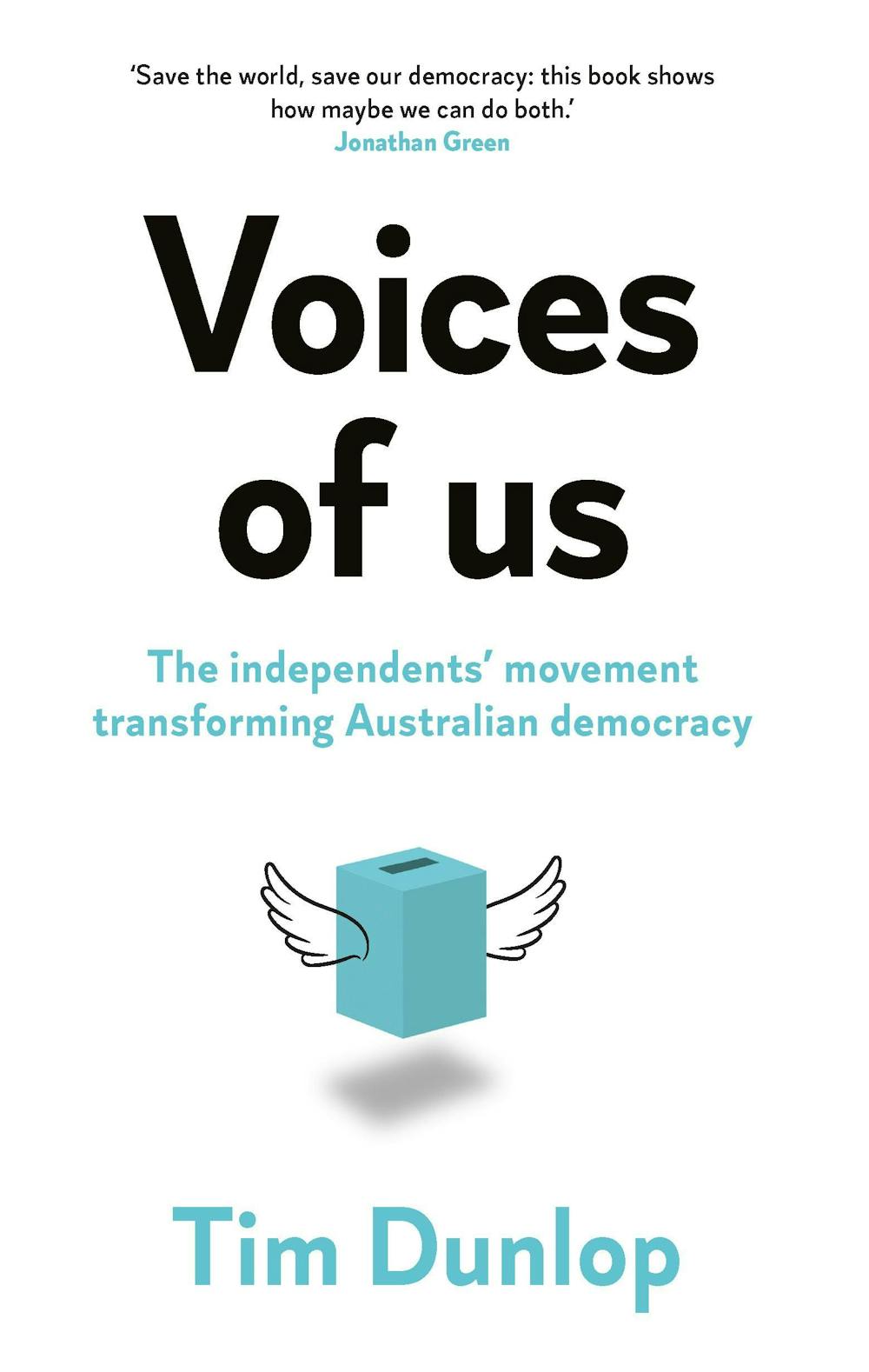
Voices of Us: The Independents’ Movement Transforming Australian Democracy – Tim Dunlop (NewSouth).
That Tim Dunlop’s new book Voices of Us exhibits this tendency in places hardly makes it unique.
Besides, Dunlop would argue, even though the small-target strategy delivered, it was typical of a systemic predilection for political manoeuvring ahead of policy discussion – a symptom of a shallow political-class discourse that valorises the tactical over the substantive in the exclusive interests of that class, which includes the media.
Dunlop, a perceptive social and political observer, has attempted to explain what was different about the 2022 election and how some voters got active, many of them for the first time. Nine independents and four Greens washed into the House of Representatives, shaking orthodox political party dominance from its hundred-year torpor.
Certainly, candidates from outside the major party blocs had run before, but never had they attracted such nationwide attention, and rarely had any won. Dunlop positions what some have called the “teal wave” as a reaction to the kind of shallow, focus-group-tested political representation described above.

Transforming democracy
Self-evidently, 2022 was different, as the result showed. But how different, ironically, turns on something as yet unknowable: how permanent.
“It wasn’t a revolution – much of the old order remained in place,” Dunlop writes, “but it nonetheless represented a significant realignment of power, one that provided a platform for further democratic reform.”
Of course, that remains to be seen, but my hunch is that his book’s subtitle will prove prescient. Consider the arithmetic. Peter Dutton’s task of dragging the Coalition up to the magic number of 76 seats for a majority in the 151-seat House of Representatives, looks next to impossible without recovering the once “blue ribbon” seats lost to centrists in 2022.
It is open to the hard-line Dutton to seek new gains directly from Labor in the outer-suburbs, as he has hinted. But that approach would probably see a further populist positioning of the Liberal Party to the right. In other words, it would make reconnecting with voters who went “independent” in 2022 even harder. The loss of more inner-urban electorates could follow.
The safer approach of trying to unseat the teals in seats like Mackellar (NSW), Wentworth (NSW), Goldstein (Vic) and Kooyong (Vic), will require Liberal candidates to look more like the teals in style and substance. That means adopting more progressive positions on policies like affirmative action quotas, climate change, health, housing and social issues.
That shift alone would have an impact on politics. It would force a Liberal party that has become increasingly beholden to right-wing media in recent decades back towards the centre.
These are among the tantalising prospects for rejuvenating our politics out of the 2022 result – or, as Dunlop puts it, “transforming Australian democracy”.
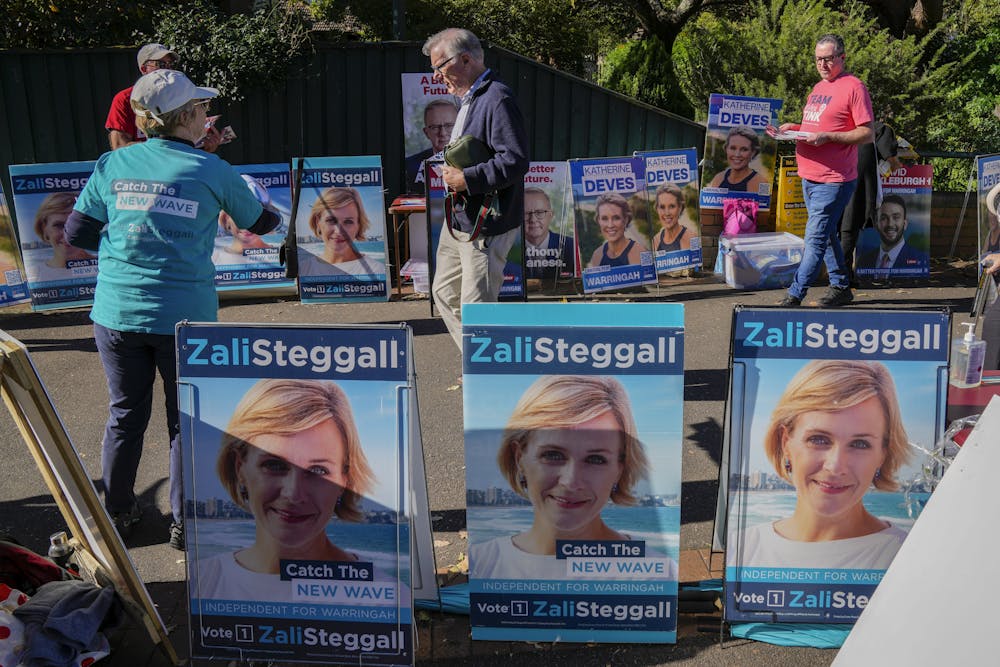 A volunteer hands out how-to-vote cards for independent candidate Zali Steggall in her electorate of Warringah, May 17, 2022.
Mark Baker/AP
A volunteer hands out how-to-vote cards for independent candidate Zali Steggall in her electorate of Warringah, May 17, 2022.
Mark Baker/AP
Read more: Networks and money: the inside story of how the teals won Australia's six richest electorates
Local politics
Dunlop lays bare the systemic, situational, and attitudinal factors at play. He considers the ways in which a new kitchen-table politics of “listening” and representation could replace tribal loyalties and the “limited guest lists of the mainstream media”.
Much of the impetus was local, but the common issues being pressed were national, and even global. Critically, community support – which is to say local support – for dumping the governing Liberal MP generally preceded the drafting of the candidate. In other words, the campaigns were issues driven, rather than personality derived.
Once drafted, the candidates were, in most cases, able to combine significant local enthusiasm with external campaign funding. They also benefited from campaigning techniques shared by “like” candidates running in other electorates.
It helped that, for the most part, the candidates embraced a concise and easily communicated set of common principles: faster action on climate change, a better deal for women in politics and power, and the establishment of a powerful integrity body to address corruption in federal politics and arrest declining trust.
Moreover, the candidates were very similar in some important ways. Almost all were women. Almost all were mid-career professionals, tertiary educated, middle-class and well-off. While all were good communicators, they were also political clean skins, putting their hands up for parliamentary slots for the first time.
Nick Bryant captured the zeitgeist in a recent piece for the Nine newspapers:
What made the success of the teal independents so eye-catching and innovative was the trend-lines they personify: the feminisation of politics; the greening of politics; and the revitalisation of the old adage, which seemed to fall out of fashion in an era of presidential-style Australian election campaigns, that all politics is local.
The arrival of the independents on the cross bench en masse was arguably the story of the 2022 poll, even though it was a change-of-government election. The more so because they had become so controversial ahead of the poll. Shallow media analysis had characterised them as “anti-Liberal groupies” (as John Howard branded them), an undeclared party, and privileged political ingenues – essentially, short-term aberrations in an otherwise smooth and stable democracy.
Of course, as Dunlop notes, the “Voices Of” movement (as he has chosen to identify the candidates) were not evidence of systemic dysfunction. Far from it:
The singular achievement of the Voices Of movement has been its reassertion of the democratic right of citizens to participate in their own governance, opening the possibilities of reform outside the confines of what the “major” parties would normally tolerate.
For Dunlop, the preconditions for the “Voices of” candidates were almost the polar-opposite of “the image portrayed in the media of an angry, divided nation disengaged from politics”. He describes a precocious new optimism gripping re-energised voters as they came to believe the system itself – and therefore the country – needed rescuing from the people running it. Voters, Dunlop tells us, saw that the machinery was still capable of delivering change. It just needed the kind of critical mass that parties typically delivered:
What we were disengaged from […] was the political class itself: the politicians, and media, the journalists and commentators, the business leaders and the other insiders who wield power in our island nation.
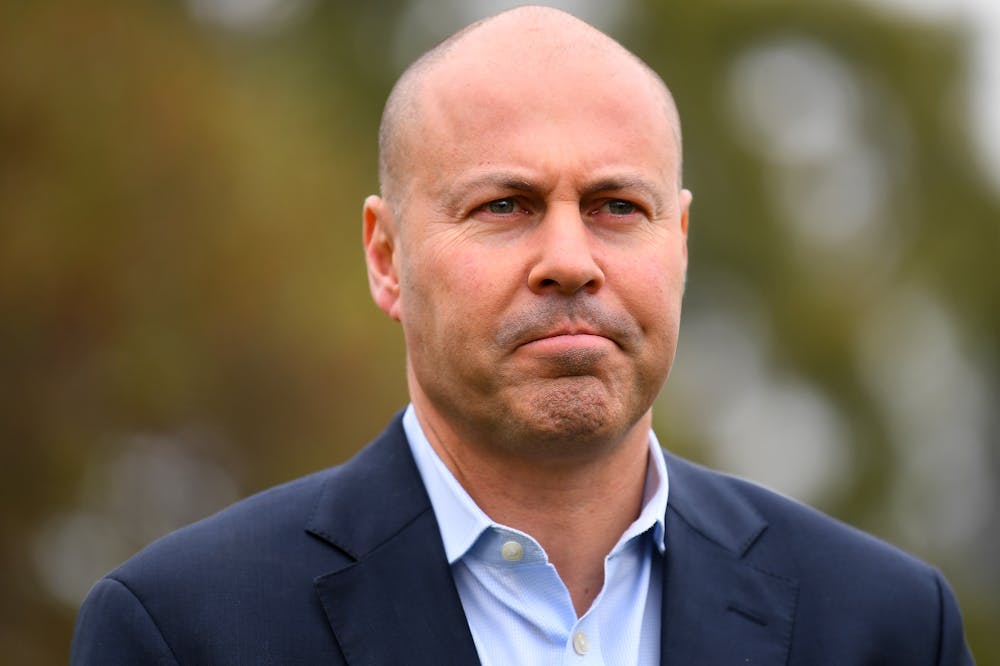 Former federal treasurer Josh Frydenberg following his loss to Monique Ryan in Kooyong, May 22 2022.
James Ross/AAP
Former federal treasurer Josh Frydenberg following his loss to Monique Ryan in Kooyong, May 22 2022.
James Ross/AAP
Media culpa
This audacious yet attractive argument turns the right-wing populist trope of outsiderism on its head.
In this dynamic, the “outsiders” were the urban, economic and cultural insiders. Their beef was not being left behind, but rather a sense of alarm that moral leadership and core enlightenment values were being forsaken by poll-driven, lowest-common-denominator politics and imagination-challenged politicians, who would happily trade planetary health for another term in office.
The outsiders then, in Dunlop’s figuring, are the ordinary citizens who had been taken for granted, assumed to be fixed in one silo or the other. “In all these ways, the 2022 federal election was a contest of outsiders against insiders,” he argues, “and against all odds, the outsiders won.”
This is a book as critical of media as it is of do-nothing politicians. But more importantly, it needles at the unhealthy interdependence between these supposedly separate realms.
Writing about the campaign period, Dunlop describes how voters in leafy South Melbourne were frustrated by performative journalism and hackneyed press-gallery narratives, such as whether Anthony Albanese was “unprepared for office and gaffe-prone”.
Pushing a “dysfunction” narrative, conservative media persisted with the pseudo-important question of who independent candidates would support to form government in a hung parliament. The intention of such probing was twofold. It was designed to stoke fears of chaos and instability arising from the election of non-major party candidates, and it was to adduce an answer which proved correct the “closet greenie” critique of the independents.
That such idiotic questions relied on an unlikely triple hypothetical seemed to bother few press gallery journalists, who probed away manfully as if it were the prime challenge facing the country.
 There is much to like about this forcefully argued book. Dunlop’s convincing contention is that mainstream media have helped dumb down and hollow out politics, reducing complex issues into flat binaries – often to serve political biases.
But if there is a hint of overreach, it is where he tries too hard to make the case for the Greens’ frustration of Labor’s climate change policy in 2009-10. He unfurls the familiar Greens Party explanation that the Rudd government’s Carbon Pollution Reduction Scheme (CPRS) was not strong enough – the result of too much fossil fuel lobbying and weak targets.
What gets left out in such pleas is the rapid fall of dominoes from that point. Malcolm Turnbull was rolled by a virulently anti-climate Tony Abbott as the Coalition shifted markedly rightward. Labor panicked, dumping Rudd as PM, which led to a series of norm-trashing leadership meltdowns. A decade of climate denial followed, culminating in Scott Morrison’s pointless right-wing government.
Dunlop’s answer in 2022 seems to be that Labor should immediately go beyond its promised 43% emissions cut by 2030, “knowing full well the media would tip a bucket on them”, because the “Voices of” proposed doing so:
How ridiculous was it that they, and the media, would rather honour a promise to a flawed policy than negotiate with other members of parliament for a better outcome?
The attractions of such a proposition are obvious – until, that is, you remember that trust was also on the ballot.
Yet this is a perennial debate. Dunlop believes in this new community model of politics, and with good reason. Intellectually and morally, the crossbench class of 2022 – with the re-elected MPs like Zali Steggall, Helen Haines, Andrew Wilkie and Rebekah Sharkie – is leagues ahead of previous independents, and frankly above most MPs in the House.
Put simply, the model works and democracy has been transformed. Dunlop’s book shows us how it was done, and importantly, why it remains necessary.
Authors: Mark Kenny, Professor, Australian Studies Institute, Australian National University
There is much to like about this forcefully argued book. Dunlop’s convincing contention is that mainstream media have helped dumb down and hollow out politics, reducing complex issues into flat binaries – often to serve political biases.
But if there is a hint of overreach, it is where he tries too hard to make the case for the Greens’ frustration of Labor’s climate change policy in 2009-10. He unfurls the familiar Greens Party explanation that the Rudd government’s Carbon Pollution Reduction Scheme (CPRS) was not strong enough – the result of too much fossil fuel lobbying and weak targets.
What gets left out in such pleas is the rapid fall of dominoes from that point. Malcolm Turnbull was rolled by a virulently anti-climate Tony Abbott as the Coalition shifted markedly rightward. Labor panicked, dumping Rudd as PM, which led to a series of norm-trashing leadership meltdowns. A decade of climate denial followed, culminating in Scott Morrison’s pointless right-wing government.
Dunlop’s answer in 2022 seems to be that Labor should immediately go beyond its promised 43% emissions cut by 2030, “knowing full well the media would tip a bucket on them”, because the “Voices of” proposed doing so:
How ridiculous was it that they, and the media, would rather honour a promise to a flawed policy than negotiate with other members of parliament for a better outcome?
The attractions of such a proposition are obvious – until, that is, you remember that trust was also on the ballot.
Yet this is a perennial debate. Dunlop believes in this new community model of politics, and with good reason. Intellectually and morally, the crossbench class of 2022 – with the re-elected MPs like Zali Steggall, Helen Haines, Andrew Wilkie and Rebekah Sharkie – is leagues ahead of previous independents, and frankly above most MPs in the House.
Put simply, the model works and democracy has been transformed. Dunlop’s book shows us how it was done, and importantly, why it remains necessary.
Authors: Mark Kenny, Professor, Australian Studies Institute, Australian National University 

















