

4 facts about seagulls that will make you love these relentless chip thieves
- Written by: Grainne Cleary, Researcher, School of Life and Environmental Sciences, Deakin University
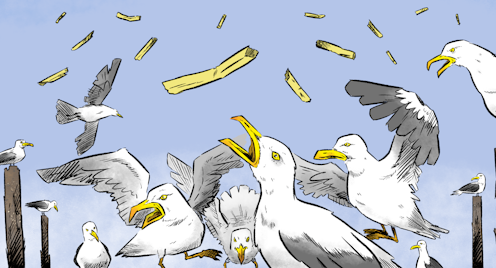
Whether they’re stealing your chips or screeching at your picnic table, seagulls are a hallmark of Australian summers. But how much do you really know about them?
In Australia, the most common species of seagull is the silver gull (Larus novaehollandiae), which is found throughout the continent. People in southern Australia may have also seen its larger, dark-winged cousin, the Pacific gull (Larus pacificus).
And in fierce competition with the Pacific gull is the kelp gull (Larus dominicanus), which established itself in Australia in the 1940s and is found in all states.
Here are four fascinating facts about seagulls that might make you see them a little differently.

1. Seagulls thrive in cities
Gulls are part of “Laridae” family of seabirds and are found worldwide. While they’re synonymous with the sea, they can also thrive inland, particularly in urban areas.
Life in urban areas can be hard for birds. Without natural habitat, birds must learn to live among human-made infrastructure. However, gulls have adapted well to our highly modified landscape.
For example, research has found gulls are highly tolerant to urban disturbances, such as loud traffic and industrial noise as well as pedestrian and vehicle traffic. They have even adapted their nesting behaviour to use, for instance, ovals and flat roofs on buildings.
Gulls have a large brain relative to their body. Research suggests birds with larger brains can more successfully adapt to changing habitats and colonise new environments.
 Seagulls thrive in cities.
Shutterstock
Seagulls thrive in cities.
Shutterstock
An interesting study last year tested the intelligence of ring-billed gulls, which are predominately found in Canada and northern United States.
Researchers attached a piece of sausage to a string, and placed it inside a clear box. Some 75% of the 138 gulls tested attempted to solve the task by pulling the string to bring the food closer, and 25% were successful.
This study shows gulls are curious and try to solve problems - both skills that serve them well in the urban jungle.
Read more: Seagulls, songbirds and parrots: what new research tells us about their cognitive ability
2. They are expert food thieves
Gulls are opportunistic feeders, meaning they will try almost any food they encounter. They’re renowned for stealing food from other gulls and even from us, a behaviour called “kleptoparasitism”.
A 2019 study showed herring gulls, found along the shores of western Europe and the UK, are aware of the direction of the human gaze. The herring gulls in the study more quickly snatched up food placed near a person, when the person was looking away from the gull.
Other research looked at how herring gulls interacted with food after they watched a person handle it. It found the gulls were much more likely to peck at food a human had handled, rather than food that hadn’t been touched.
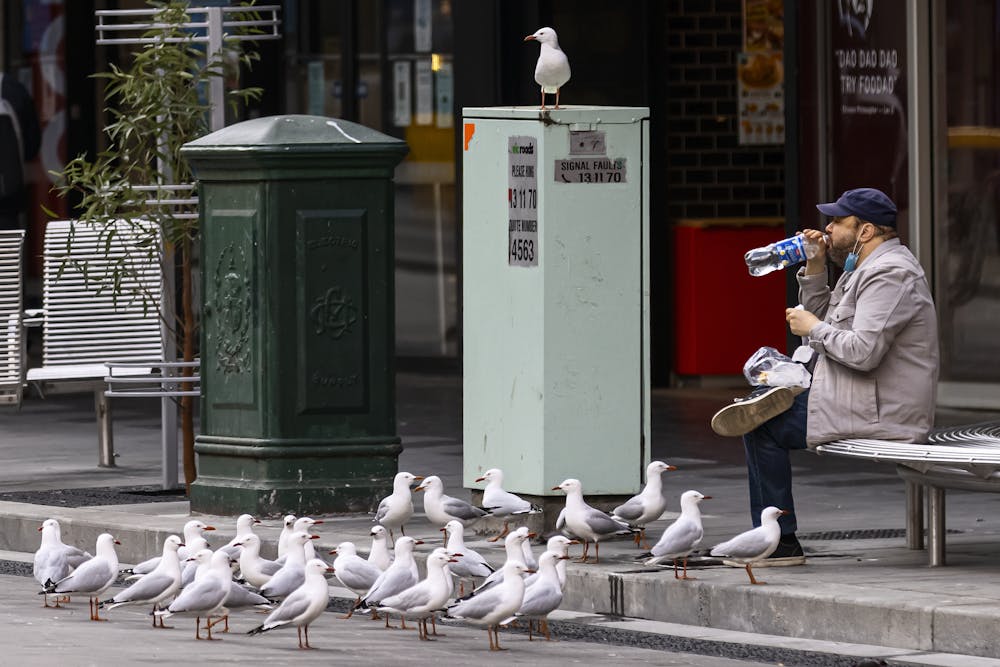 Seagulls are more likely to eat food they’ve seen a human handle.
AP Image/Daniel Pockett
Seagulls are more likely to eat food they’ve seen a human handle.
AP Image/Daniel Pockett
Silver gulls in Australia have a diverse range of natural prey. This includes cnidarians (such as jellyfish), squids, insects, fish, frogs, small birds such as sparrows and wrens, plants and, when possible, small rodents.
Gulls, especially silver gulls, are also expert scavengers, and often exploit landfills. A study from 1993 recorded 6,000 silver gulls per hour leaving a single urban landfill site in Wollongong in Australia.
A more recent study in 2012 found a kelp gull breeding colony in the De La Guardia Islands of Patagonia, Chile, is sustained by food from an inland rubbish tip.
Seagulls snatching a sandwich in the UK | BBC.Read more: Why you should have more sympathy for seagulls – and how to stop them stealing your chips
3. They can nest almost anywhere, anytime
When conditions are right and food is plentiful, gulls can breed all year around. Peak breeding season for silver gulls is roughly between August and November and they lay one to four eggs.
Seagulls are traditionally found sleeping and nesting on flat beaches. Some gull species, including Australia’s silver gull, may create “nest scrapes” – shallow depressions in the the ground lined with, for instance, leaves and other vegetation.
Silver gulls prefer to nest in islands. But as urban development encroaches into their habitat, seagulls have adapted to roost and nest in a range of places. Their simple nest design means they can nest in grass cricket pitches, ovals, car parks, low shrubs between rocks and even flat roofs.
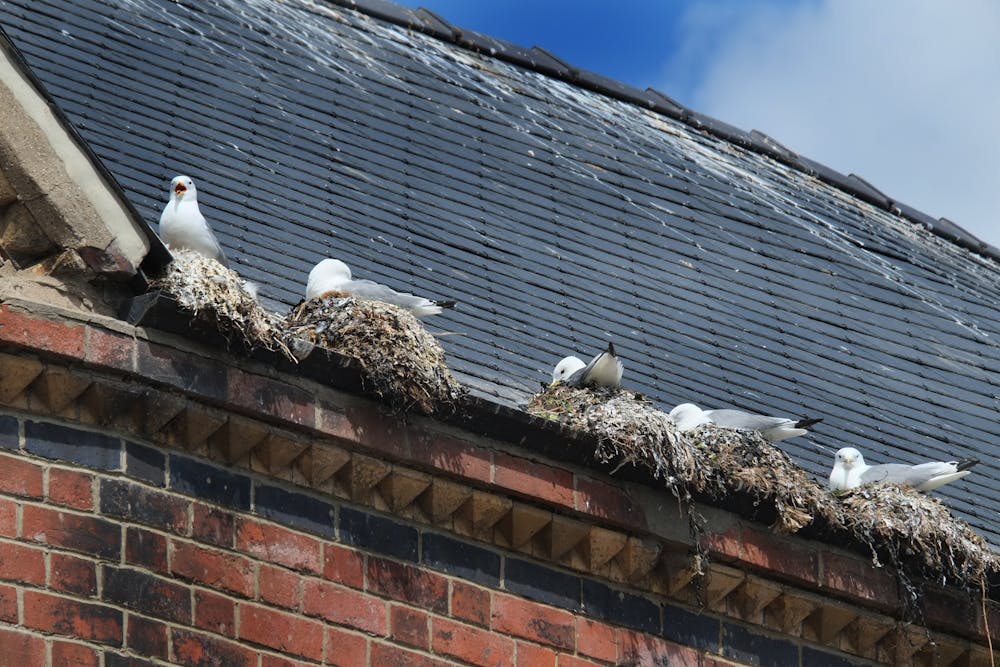 Seagulls nesting in a gutter in the UK.
Shutterstock
Seagulls nesting in a gutter in the UK.
Shutterstock
The downside for ground-nesting birds such as gulls is that they’re especially vulnerable to human disturbances, such as lawnmowers, pedestrians and their dogs, and even footy games.
Still, gulls seem to make it work. The abundance of human food seems to benefit breeding birds – a Tasmanian study on silver gulls in 2008 found urban males were heavier and had greater body condition then non-urban male gulls. Interestingly no difference were detected between females.
Further research is need to see how successful urban silver gulls are at breeding and raising young on human food.
4. They use teamwork to harass enemies
Cats (both pet and feral) are a downside to urban life for gulls. Foxes and wild dogs can also pose a significant threat.
This is where team works come in. When silver gulls detect a predator, they work together using aerial group defence tactics to drive away the threat.
Black-headed gulls mobbing a crane.One anti-predator strategy is called social mobbing. This is where a group of gulls unite to harass a potential enemy – such as a cat or fox – by flying towards it and making alarm calls, until it goes away.
Some gulls might even vomit or defecate on the predator, with startling accuracy.
Authors: Grainne Cleary, Researcher, School of Life and Environmental Sciences, Deakin University


















