

The sky isn't just blue – airglow makes it green, yellow and red too
- Written by: Michael J. I. Brown, Associate Professor in Astronomy, Monash University
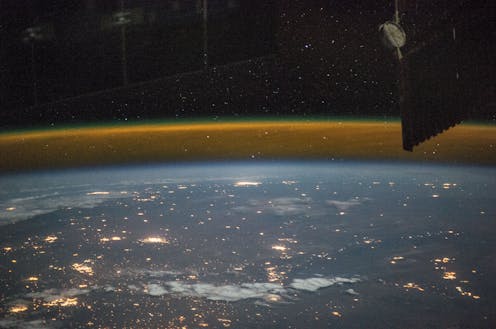
Look up on a clear sunny day and you will see a blue sky. But is this the true colour of the sky? Or is it the only colour of the sky?
The answers are a little complicated, but they involve the nature of light, atoms and molecules and some quirky parts of Earth’s atmosphere. And big lasers too – for science!
Blue skies?
So first things first: when we see a blue sky on a sunny day, what are we seeing? Are we seeing blue nitrogen or blue oxygen? The simple answer is no. Instead the blue light we see is scattered sunlight.
The Sun produces a broad spectrum of visible light, which we see as white but it includes all the colours of the rainbow. When sunlight passes through the air, atoms and molecules in the atmosphere scatter blue light in all directions, far more than red light. This is called Rayleigh scattering, and results in a white Sun and blue skies on clear days.
At sunset we can see this effect dialled up, because sunlight has to pass through more air to reach us. When the Sun is close to the horizon, almost all the blue light is scattered (or absorbed by dust), so we end up with a red Sun with bluer colours surrounding it.
But if all we are seeing is scattered sunlight, what is the true colour of the sky? Perhaps we can get an answer at night.
Read more: Curious Kids: Why is the sky blue and where does it start?
The colour of dark skies
If you look at the night sky, it is obviously dark, but it isn’t perfectly black. Yes, there are the stars, but the night sky itself glows. This isn’t light pollution, but the atmosphere glowing naturally.
On a dark moonless night in the countryside, away from city lights, you can see the trees and hills silhouetted against the sky.
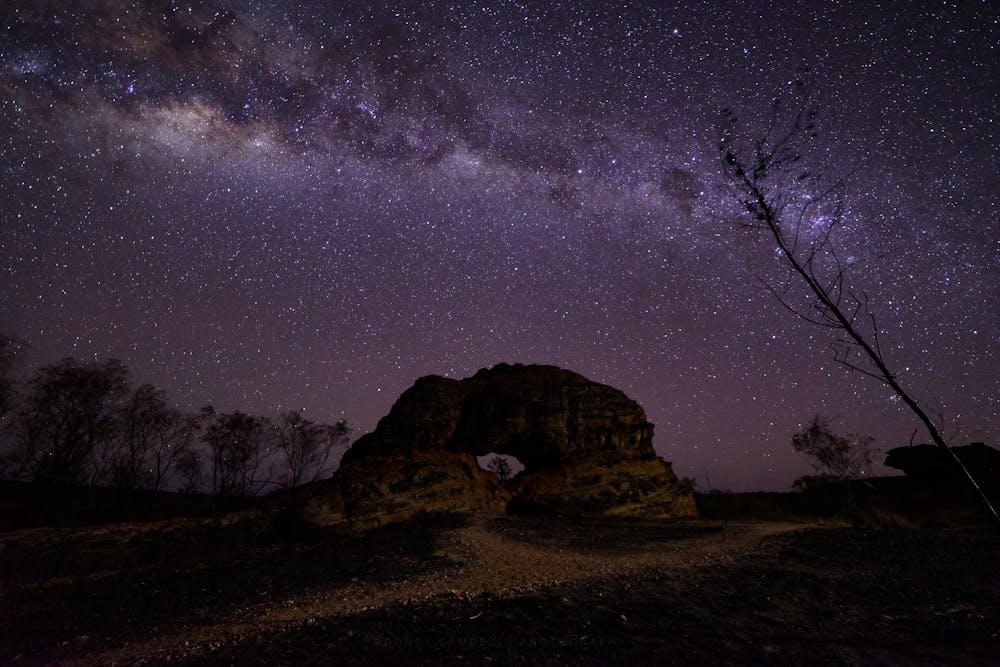
This glow, called airglow, is produced by atoms and molecules in the atmosphere. In visible light, oxygen produces green and red light, hydroxyl (OH) molecules produce red light, and sodium produces a sickly yellow. Nitrogen, while far more abundant in the air than sodium, does not contribute much to airglow.
Read more: Beautiful green 'airglow' spotted by aurora hunters – but what is it?
The distinct colours of airglow are the result of atoms and molecules releasing particular amounts of energy (quanta) in the form of light. For example, at high altitudes ultraviolet light can split oxygen molecules (O₂) into pairs of oxygen atoms, and when these atoms later recombine into oxygen molecules they produce a distinct green light.
You can see airglow at dark sites, such as the European Southern Observatory in Chile.Yellow light, shooting stars and sharp images
Sodium atoms make up a minuscule fraction of our atmosphere, but they make up a big part of airglow, and have a very unusual origin – shooting stars.
You can see shooting stars on any clear dark night, if you’re willing to wait. They are teensy tiny meteors, produced by grains of dust heating up and vaporising in the upper atmosphere as they travel at over 11 kilometres per second.
As shooting stars blaze across the sky, at roughly 100 kilometres altitude, they leave behind a trail of atoms and molecules. Sometimes you can see shooting stars with distinct colours, resulting from the atoms and molecules they contain. Very bright shooting stars can even leave visible smoke trails. And among those atoms and molecules is a smattering of sodium.
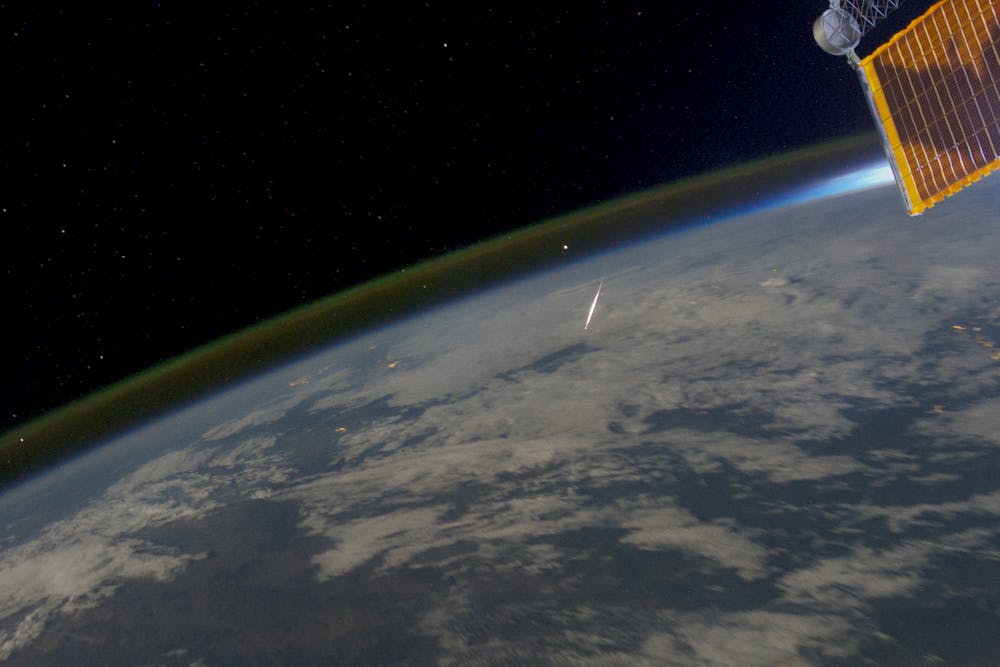 A shooting star and airglow seen from the International Space Station.
NASA
A shooting star and airglow seen from the International Space Station.
NASA
This high layer of sodium atoms is actually useful to astronomers. Our atmosphere is perpetually in motion, it’s turbulent, and it blurs images of planets, stars and galaxies. Think of the shimmering you see when you look along a long road on a summer’s afternoon.
To compensate for the turbulence, astronomers take quick images of bright stars and measure how the stars’ images are distorted. A special deformable mirror can be adjusted to remove the distortion, producing images that can be sharper than the ones from space telescopes. (Although space telescopes still have the advantage of not peering through airglow.)
This technique – called “adaptive optics” – is powerful, but there’s a big problem. There are not enough natural bright stars for adaptive optics to work over the whole sky. So astronomers make their own artificial stars in the night sky, called “laser guide stars”.
Those sodium atoms are high above the turbulent atmosphere, and we can make them glow brightly by firing a power laser at them tuned to the distinct yellow of sodium. The resulting artificial star can then be used for adaptive optics. The shooting star you see at night helps us see the Universe with sharper vision.
So the sky isn’t blue, at least not always. It is a glow-in-the-dark night sky too, coloured a mix of green, yellow and red. Its colours result from scattered sunlight, oxygen, and sodium from shooting stars. And with a little bit of physics, and some big lasers, we can make artificial yellow stars to get sharp images of our cosmos.
Sodium laser guide stars at ESO’s Very Large Telescope in Chile.Authors: Michael J. I. Brown, Associate Professor in Astronomy, Monash University
Read more https://theconversation.com/the-sky-isnt-just-blue-airglow-makes-it-green-yellow-and-red-too-196386


















