

how women broke down the boys' club barriers to surf lifesaving in NZ
- Written by: Katie Pickles, Professor of History, University of Canterbury
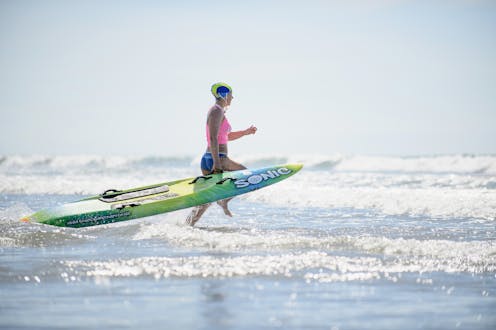
Hanging out at the beach, body surfing, boogie boarding or just cooling off in frothy waves under a hot sun are all part of a typical Kiwi summer.
But with an extensive coastline, plenty of hazardous surf and a poor water safety record, swimming between red and yellow flags under the watchful gaze of surf lifesavers is a reassuring part of the experience. Over the years, brave and capable lifeguards have saved thousands of lives.
And these days you’re just as likely to be saved by a female guard as a male one. Girls and women now expect to be able to participate and compete in surf lifesaving. But it wasn’t always that way. Until relatively recently, patrolling the beach and waves was pretty much a male domain.
In many ways, the story of how surf lifesaving cast off its Edwardian-age origins of masculine grit and strength mirrors social progress in New Zealand in general. And it involves tenacious and talented women who braved the waters to open the way for others.
Locked out of the changing room
Surf lifesaving landed on New Zealand’s shores in 1910, having crossed the Tasman from Australia where it was already taking hold. The volunteer club movement included both rescue work and sport. It quickly adopted a masculine culture that involved patrols of men drilling, training and competing.
Strength and fitness were considered prerequisites for rescuing bathers in trouble. Swimming out in a belt attached to a rope, throwing out and reeling in ropes, and rowing boats weren’t seen as women’s jobs.
Historians Caroline Daley and Charlotte Macdonald have examined the separation of women and men into different sports, and traced the development of an early lifesaving mythology: tanned muscular men, with women cast in a feminine supporting role, providing afternoon teas at the surf club or sunbathing on the sand. Saving lives was men’s work.
Read more: Why football needs a gender revolution
In reality, women always wanted to be actively involved and were buoyed by growing feminist attitudes and awareness in wider society. By the 1920s, women’s teams were forming at various clubs around the country. There were even some separate women’s clubs.
Researcher Elena Simatos examined the records of the Canterbury Surf Life Saving Association (CSLSA) from 1917-1990 to see if women had been “locked out of the changing room”. Despite the growing involvement of women, it seems there was clearly still prejudice against them.
In 1928, for example, the “Ladies” Sumner team was granted permission to compete for surf medallions and in club lifesaving events. But soon after, the CSLSA discussed the “question of the desirability of lady members entering into surf competitions” and banned women in Canterbury from competing.
Experiences varied according to the beliefs of individual members and the culture of each club. Overall, though, change came slowly through the steady chipping away at a dominant culture steeped in a tradition of exclusively male strength.
Women hit the waves
Emergency regulations during the second world war allowed women to patrol beaches while the men were away fighting. But the change was reluctant and fleeting. There were concerns about the “physical strain” on women in surf races, with limits placed on the most challenging races.
But the post-war years saw some gains. Histories of surf lifesaving by Douglas Booth, Bob Harvey, Tony Murdoch and Christine Thomas have shown how the dominant culture continued to be eroded, with women’s clubs acting as incubators of female participation. Women were allowed to become summer beach patrollers and be paid for their work.
The first of New Zealand’s paid women patrollers was probably Daphne McCurdy (née Dasler), who received NZ$40 a week during the 1969-1970 summer season at Waimairi and North Beach in Christchurch.
McCurdy came from a family of swimmers, surfers and surf lifesavers and grew up near the North Beach Surf Life Saving Club. By 1969, she told me, she had gained the skills and tenacity for the job:
At the time of my appointment I had been active in surf lifesaving four-man, six-man and surf-race teams for more than a decade, was known for my ability to successfully pull a belt in rough seas, could ride a paddleboard if required and had trained most of my club’s boat crew members who had been recruited from the local football clubs. On the day of my appointment I was second in the surf swim test. I was the only female.
Swimming with the feminist tide in the 1970s, other paid women beach patrollers followed McCurdy. More girls and women entered competitions, and there were some mixed competitive teams around the country. More awards were also given – with titles such as “Lady Surf Life Saver of the Year”.
‘Amazons of the sea’
And yet, while women such as Jan Pinkerton and Christine Thomas gradually assumed leadership roles, surf lifesaving was still far from a gender-equity workplace. As author Sandra Coney noted in her 1985 article Amazons of the Sea for feminist magazine Broadsheet, there were only two women, Kate Sheriff and Muriel Brown, on the honours board of the Auckland Surf Life Saving Association.
Family background and connection, Coney argued, were still important for women like Sue Donaldson of Muriwai. Like Daphne McCurdy, she’d first become a lifeguard at Christchurch’s North Beach. Also like McCurdy, her father, brother and sister were lifeguards.
Nonetheless, women were making inroads, and the cultural reputation of surf lifesaving in New Zealand was always better than Australia’s. Historian Caroline Ford has written of “rampant misogyny” on Sydney beaches, where it took until 1980 for the Australian Surf Life Saving Association to allow women to become active surf lifesavers.
Still, Coney uncovered plenty of evidence of a macho, drink-fuelled local culture, involving “chunder miles where increasingly blotto clubbies stagger from jug to jug before disgorging a full frontal puke”. “Other typical boyish pranks [included] publicly stripping men of their togs and hoisting women’s knickers on the club flagpole.”
Read more: Why surfing is an antidote to the relentless march of capitalism
In it together
Did new technology shake up old prejudices and promote equality for all on the waves? On the contrary, Coney reported that “men have colonised the beaches”, keeping women away from new equipment that compensated for sheer physical strength.
In the 1950s and 1960s at Piha beach near Auckland, Coney’s sister Helen Watson couldn’t join the surf lifesaving club or use “all the interesting equipment – the skis, boards and boat”, and was “excluded from taking part in competitions”.
New lifesaving equipment was nabbed by the men. As Bryony Coutanche said of the heavily male-dominated board riding scene: “I was told to ‘get off, this is my wave’. The men are awful and when you’re learning it’s hard.”
By 2017, half of New Zealand’s surf lifeguards were women, but they made up only 28% of rescue boat drivers. A recent survey found girls and women still faced some barriers to participation.
Still, if surf lifesaving has never radically led the way for gender equality, its culture has changed with the times. A Wahine on Water program sets out to redress the remaining gender imbalance, providing mentors and training opportunities. And Surf Life Saving New Zealand has made it a mission to include all peoples and cultures within the organisation.
Lifesaving is heroic work that often shows people at their most humane and caring. So it’s good to see an inclusive culture being built for those welcome guards who watch over us while we relax and enjoy summer at the beach.
This article benefits from research by Elena Simatos in her 2016 University of Canterbury History BA (Hons) research essay, “Locked out of the changing room? A gendered history of surf lifesaving in Canterbury 1917-1990”, which was supervised by the author.
Authors: Katie Pickles, Professor of History, University of Canterbury


















