

From hapless parody to knight crusader – how far-right nationalism hijacked the real Don Quixote
- Written by: Roberto Suazo, Research Assistant , University of Otago
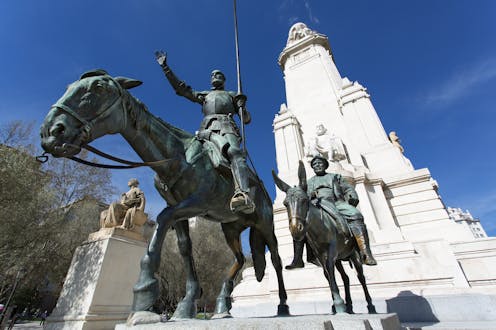
It’s said that Don Quixote and his faithful squire Sancho Panza were riding their horses in the dark night when they heard the sound of dogs barking. Trying to console the frightened Sancho, Don Quixote uttered what may be the most quoted line attributed to him: “Let the dogs bark, Sancho, it’s a sign that we are on track.”
Today, the phrase is used to express the notion that if someone criticises (barks at) you, it’s a sign you are on the rise. Dogs bark at the moon, don’t they?
Unfortunately, the quote doesn’t appear anywhere in Miguel de Cervantes’ famous 17th century novel Don Quixote. But that hasn’t stopped it appearing all over the Internet. Not long ago, for instance, I came across the “barking dogs” phrase in some Facebook motivational meme depicting Don Quixote as a knight crusader galloping on an alabaster-white horse.
Anyone who reads the novel will know Cervantes’ hero is first and foremost a parody of a knight. The novel tells the adventures of Alonso Quijano, a skinny old man maddened by his inordinate taste for reading chivalric romances. Determined to become a knight errant himself, he changes his name to Don Quixote de la Mancha.
In a rusty suit of armour with a helmet patched with cardboard, riding an old nag (in his imagination a noble steed he names Rocinante), he sallies forth to right the wrongs of the world. His quest will inevitably prove as futile as tilting at windmills under the illusion they’re giants. Far from resembling an epic crusader, Don Quixote is a bizarre, laughable character.
The dreadful and never-imagined (at least, certainly not by Cervantes) portrait of Don Quixote as a crusader is the kind of mistake that sets scholars’ teeth on edge. Being a scholar myself, I wondered whether I should bark at this apocryphal Quixote riding through cyberspace, or just let him pass.
But that image, sloppily posted on the web, actually comes from somewhere other than mere literary ignorance. From the early 20th century onward, Don Quixote has suffered a paradoxical fate, wrapped in a crusader’s cloak by nationalist propaganda. And this misrepresentation seems to be growing in the 21st century, threatening to obscure Cervantes’ real message.
A national myth
The closing of the 19th century saw the gloomy twilight of the Spanish empire. The loss of its last colonial possessions dealt a severe blow to the national spirit. Around this time, the novelist, poet and philosopher Miguel Unamuno wrote an influential essay where he imagined a holy crusade to rescue Don Quixote’s grave.
For Unamuno, Cervantes’ hero was a nostalgic reminder of Spain’s heyday in the 15th to 16th centuries – the days of the “Reconquista”, or Christian reconquest of the Iberian Peninsula from the Moors, and the beginning of Spanish imperial history in America. Tellingly, Unamuno placed Don Quixote alongside Columbus and Magellan – heroes, in his opinion, led by “a generous and big dream: the dream of glory”.
Read more: Guide to the classics: Don Quixote, the world's first modern novel – and one of the best
Don Quixote thus underwent an odd metamorphosis, from a fallible antihero to an epic ideological hero, from a comic literary character to a national myth. The grotesque old man, his brain dried up and shrivelled from too much reading, became a clever crusader knight, inviting identification and admiration.
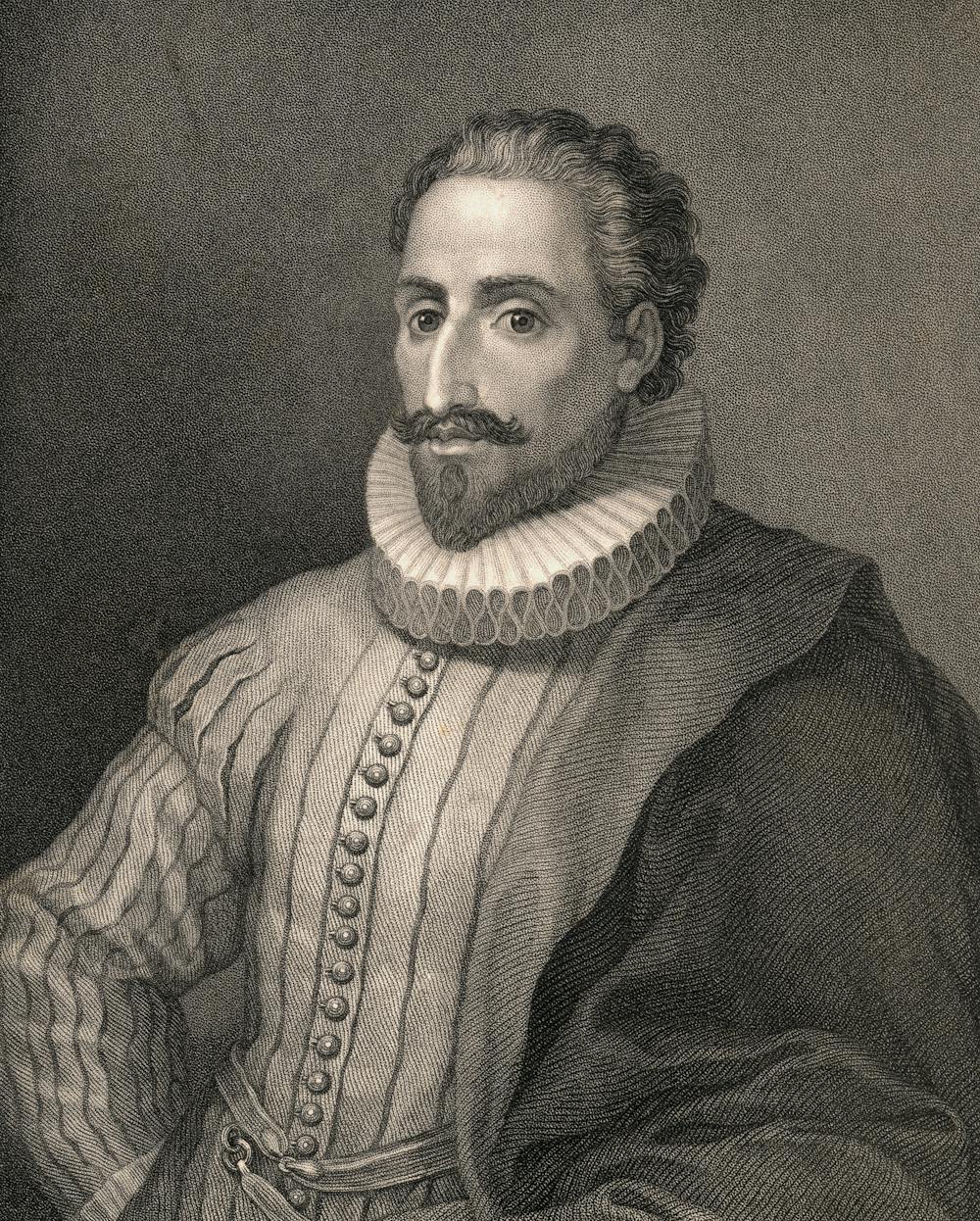
During the Spanish civil war, the image of crusaders against the “communist and atheist rule” was invoked with ardour by the nationalist cause. After the fall of the republic in 1939, the newly enthroned dictator Francisco Franco flooded the squares with statues of the author of Don Quixote.
With Spain still strewn with war victims, Francoist propaganda recalled the author’s left hand being mutilated from fighting against the Muslims. What better model of Spaniard than the great writer who was crippled in the service of his nation! Thus, Cervantes himself was turned into a crusader knight and a national hero.
More recently, leaders of the far-right Spanish party Vox have compared its political agenda with Don Quixote’s quest. During a visit to a field of windmills, former party general secretary Javier Ortega Smith declared: “Those are the giants we have to fight against in politics: climate fundamentalism, gender ideology, historical lies, Agenda 2030, absurd animalism […]”
The true Don Quixote was an infamous dreamer, consistently misreading reality and seeing imaginary enemies. That’s probably the only trait he shares with his current nationalist eulogists. But Vox’s identification with Don Quixote is an irony we can’t afford to take too lightly. While reality always defeats Cervantes’ hero, it doesn’t seem to prevent people from tilting at windmills with nationalist rhetoric.
Don Quixote in Arabic
In its rise to popularity, Vox has encouraged crusades against various “enemies of the nation”, such as the pro-independence campaign in Catalonia and contemporary feminist movements. African immigrants and Muslims are also regular targets.
Santiago Abascal, president of the party, has explicitly called for “a new Reconquista” of Spain to stop the so-called invaders from the south. When asked about it, Abascal said “there was no danger of Islamophobia in Spain: the real danger was Islamophilia.”
Islamophobic and xenophobic views, as well as the use of crusader tropes, are unfortunately familiar among today’s Western nationalisms. Misleading content on the web revolves around the image of medieval Europe as a land populated by white crusaders and nobles. Promoted by white supremacists around the world, this notion of a mythical “West” is even more indefensible in Spanish culture.
Read more: Vox: how to understand the peculiarities of Spain’s hard-right movement
From the 8th century to the late 15th century, Muslims, Christians and Jews dwelt side by side in Al-Andalus, the Arabic term for medieval Iberia. This centuries-old relationship, often called “convivencia” or coexistence by historians, left indelible marks on Spanish culture.
In stark contrast to modern nationalist and xenophobic sentiments, Cervantes showed a great deal of respect for the Muslims. And his famous novel doesn’t conceal Spain’s history of racial hybridity and cross-cultural fertilisation – evidenced by an often overlooked aspect of the story.
In the novel, we read that Don Quixote’s adventures were originally narrated by the fictional Muslim historian Cide Hamete Benengeli. Cervantes playfully declares that, while taking a stroll, he just stumbled on some folders full of papers written in Arabic. Cervantes’ appreciation of Spain’s multicultural legacies is clearly reflected in these words of praise for Don Quixote and his Arabic ancestry:
Blessings on Cide Hamete Benengeli, who wrote the history of your great deeds, and double blessings on the inquisitive man who had it translated from Arabic into our vernacular Castilian, for the universal entertainment of all people.
Read more: What Don Quixote has to say to Spain about today's immigrant crisis
There are many wrongs in nationalist appropriations of Don Quixote. To right them is not for the sake of literature alone. In a world where facts seem to have less influence over what people believe and how they behave, the real Don Quixote is at risk of being forgotten.
Meanwhile, the flamboyant crusader-usurper rides on through cyberspace, declaring to be above all criticism and boldly saying, “Let the dogs bark…”. We should know by now that there are people, gullible or mad, who are willing to follow him, perhaps with horrifying and deadly consequences.
To bark louder is crucial, then, since it might yet help stop those delusional expeditions.
Authors: Roberto Suazo, Research Assistant , University of Otago


















