

Long before Silicon Valley, scholars in ancient Iraq created an intellectual hub that revolutionised science
- Written by: Terhi Nurmikko-Fuller, Senior Lecturer in Digital Humanities, Australian National University
Time and again, collaboration has proven to be a key driver of scientific and technological innovation. So it follows that some of the greatest advances have come from intellectual hubs set up for this very purpose.
Today Silicon Valley is synonymous with this idea – but it’s just one in a long line of institutions that paved the way before it. One such example came from Baghdad, Iraq, during the Islamic Golden Age in the fourth Islamic century (tenth century AD).
It was around this time, when Europe was living through its so-called “Dark Ages”, the House of Wisdom (Bayt-al Hikmah) was born. It was here that many great works from Persia, China, India and Greece were collected and translated into Arabic, including works by Aristotle and Euclid.

This culturally and linguistically diverse environment gave rise to innovations that would have lasting legacies in fields including algebra, geography, astronomy, medicine and engineering.
Automata with talent
During its tenure of some three-and-a-half centuries, the House of Wisdom was populated by a number of multitalented thinkers.
Among these were the Banu Musa brothers – three ninth-century Persian scholars who lived in Baghdad. The brothers formed a multidisciplinary team: one was a mathematician, one an astronomer and one an engineer.
They translated works from other languages into Arabic, sponsored other translators and invested money in buying rare manuscripts. They were also involved in politics and the development of urban infrastructure, and were even musically talented.
But arguably their most tangible contribution was to automated machines, or automata. One of their works published in 850 AD, The Book of Ingenious Devices, translated as The Book of Tricks, describes machines that served as precursors to modern robots.
These automata included mechanical musical instruments and a self-playing steam-powered robotic flute player. Vrije University of Amsterdam’s Teun Koetsier considers this mechanical musician to be the world’s first programmable machine.
Brilliant polymaths
Another scholar of the House of Wisdom at the time was Mohammad ibn Musa al-Khwarizmi, whose name inspired a term we use regularly: “algorithm”.
In fact, his is a two-fold legacy, as the term “algebra” also derives from the title of one of his books, Kitab al-Jebr, or The Book of Completion.
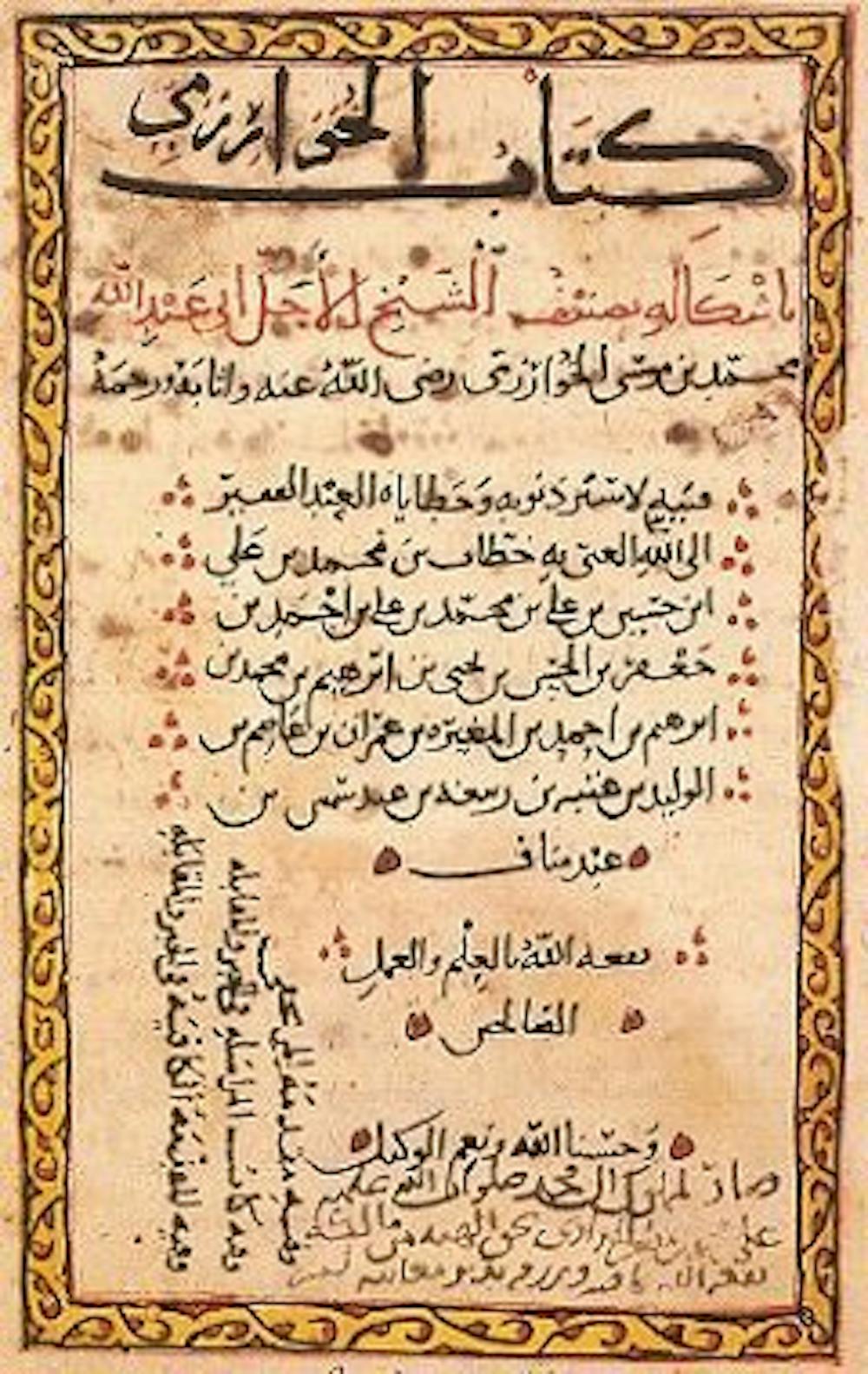 A page from al-Khwarizmi’s Kitab al-Jabr, written around 820 AD.
Wikimedia Commons
A page from al-Khwarizmi’s Kitab al-Jabr, written around 820 AD.
Wikimedia Commons
This was one of the (if not the) world’s first publications of algebraic rules. He also made important contributions to geography and astronomy.
Al-Khwarizmi worked closely with al-Kindi, also known by his Latinised name Alkindus.
Al-Kindi was an Abbasid polymath. He was a citizen of the Abbasid Empire, which spanned the Arabic-speaking world from what’s now Pakistan to Tunisia, and from the Black Sea to the Indian Ocean. He was a mathematician, student of cryptanalysis, and pioneer in music theory who combined Aristotelian philosophy with Islamic theology.
Al-Kindi is credited with introducing Indian numbers to his colleagues and peers in the Arab-speaking world. Together with al-Khwarizmi, he developed the Arabic numerals that we all use today (i.e. numbers 0-9).
He also authored the oldest known book on cryptanalysis, and is known to have used statistical inference (a type of data analysis). Statistician Lyle Broemeling describes this as one of the earliest known examples of both these methods.
Al-Kindi’s personal library was so magnificent the Banu Musa brothers apparently conspired, in their jealousy, to have him beaten, evicted from the House of Wisdom, and his library confiscated and given to them.
Gone without a trace
After centuries of fostering intellectual thought and technical development, The House of Wisdom was destroyed by the Mongols during the Siege of Baghdad in 1258 – leaving next to no traces.
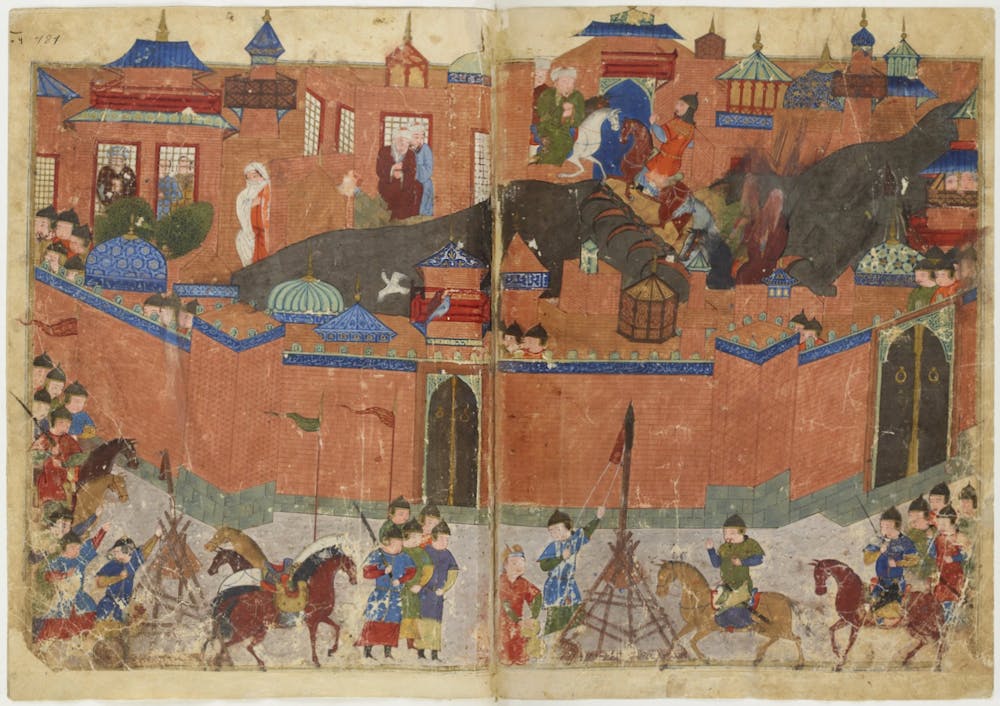 This painting by Persian historian Rashid-al-Din Hamadani formed part of a manuscript made in Iran around 1430 AD. It shows the 1258 siege of Baghdad by the Mongols, headed by Genghis Khan’s grandson Hulagu Khan.
Bibliothèque nationale de France. Département des Manuscrits. Supplément Persan 1113
This painting by Persian historian Rashid-al-Din Hamadani formed part of a manuscript made in Iran around 1430 AD. It shows the 1258 siege of Baghdad by the Mongols, headed by Genghis Khan’s grandson Hulagu Khan.
Bibliothèque nationale de France. Département des Manuscrits. Supplément Persan 1113
This absence of archaeological evidence has even led some scholars to doubt its very existence, or to suggest it existed not so much as a place, but as a state of mind.
In his book Greek Thought, Arabic Culture, Dimitri Gutas suggests the House of Wisdom could, at best, be romanticised as an “idealised national archive”. But this view is challenged by Islamic Studies expert Hossain Kamaly in the review of the volume.
However, even Gutas agrees that between 800 AD and 1000 AD there was a large-scale translation movement in the Middle East that led to a comprehensive and systematic translation of Greek non-literary works into Arabic. Translators were held in high esteem, and social prestige was awarded not only to them, but also to the elite who helped fund their activities.
As renowned science communicator and theoretical physicist Jim al-Khalili summarises in his book Pathfinders:
[T]here was indeed an establishment known as the House of Wisdom […] expanded dramatically in scope from a mere palace library […] that became a centre for original scientific scholarship.
In other words, the House of Wisdom could have been a small space, but one that enabled a culture of interdisciplinary knowledge acquisition in a rich and dynamic environment. Its legacy and contribution to modern research are clear.
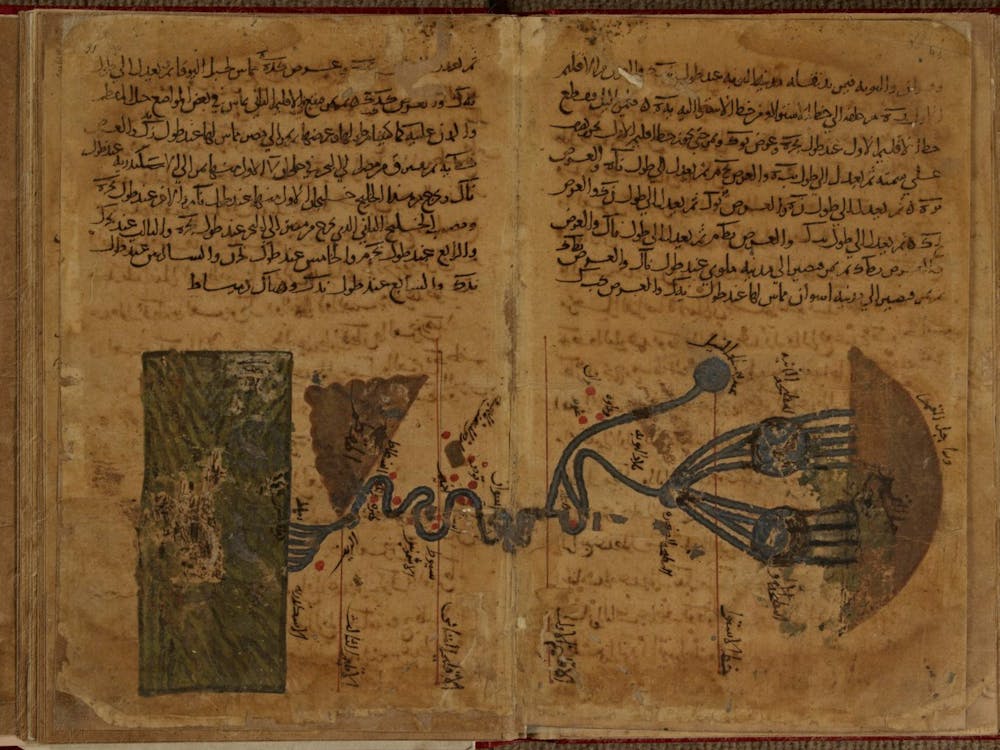 In his book Kitab Surat-al-ard, Al-Khwarizmi depicts what is considered one of the earliest maps of the River Nile (11th century).
Wiki Commons
In his book Kitab Surat-al-ard, Al-Khwarizmi depicts what is considered one of the earliest maps of the River Nile (11th century).
Wiki Commons
Lessons for today
While there’s much we don’t know about the House of Wisdom, one thing seems clear: it was driven by an appreciation of the rich ideas that can emerge in a dynamic, multidisciplinary environment.
In this regard, it begins to sound less like Silicon Valley, which has shown itself to be focused squarely on commercial gain and is known for attracting unscrupulous behaviour.
On closer inspection, The House of Wisdom sounds more like a collaborative environment that could be achieved in higher education.
One key to its success was consistent financial backing from various caliphs, who were the political and religious leaders of Islamic states, known as caliphates. In other words, the scholars were focused on just that – scholarship – rather than applying for funding.
Also, all manners of gathering knowledge were equally respected, rewarded and encouraged, which led to social stability and prosperity.
What would it take to create a space like this today? A complete re-evaluation of the way higher education is managed, funded, judged and taught?
Or maybe we should simply ask: are our disciplinary divides, which position the sciences and humanities as antithetical, holding back innovation?
For the scholars in Baghdad in the fourth Islamic century, these pursuits were opposite but equal sides of the same coin. Perhaps we’d benefit by taking a page from their book.
Read more: 3 reasons to study science communication beyond the West
Authors: Terhi Nurmikko-Fuller, Senior Lecturer in Digital Humanities, Australian National University




















