Modern Australian
Times Advertising

reform a fuel tax credit scheme with no real rationale

  • Written by Marion Terrill, Transport and Cities Program Director, Grattan Institute
reform a fuel tax credit scheme with no real rationale

Revising the generous fuel tax credits given to businesses should be a priority for the Albanese government, because keeping them would conflict with two other pressing priorities: reducing carbon emissions and repairing the budget.

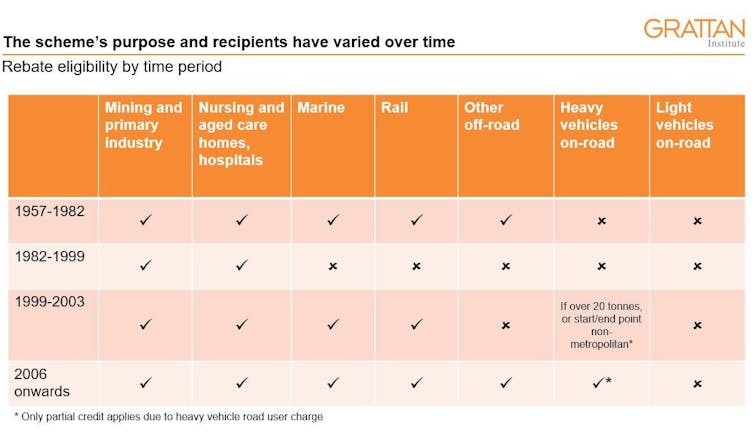
Fuel tax exemptions have existed for as long as the federal government has taxed fuel, starting in 1957. With the rationale for the tax being to pay for building and maintaining roads, initially all off-road users were exempt.

But the earmarking of all fuel tax revenue for spending on roads ended in 1959 – more than 60 years ago. With the tax becoming a general revenue-raiser, the rationale for exemptions or tax credits has shifted with the disposition of the government of the day.

The settings inherited by the Albanese government now cost the budget almost $8 billion a year.

CC BY As long ago as 1991, the Australian National Audit Office recommended the credit scheme “clarify its purpose and objectives”. Yet those objectives remain unclear today. Who benefits most? Previous governments have argued exemptions and tax credits support regional industries, and people living in regional areas. In 1999, when the credit was extended to marine, rail, and some trucks and buses, the then-deputy prime minister (and National Party leader) John Anderson said the goal was to reduce transport costs, particularly for “those people living in regional, rural and remote areas”. In 2006, when expanding the credit to include all off-road users and on-road vehicles weighing over 4.5 tonnes, the then-assistant treasurer Peter Dutton said: “This is good news for business, and regional Australia in particular.” But if the aim of the policy is to support regional areas, fuel tax credits are a poorly targeted way to do so. Read more: We pay billions to subsidise Australia’s fossil fuel industry. This makes absolutely no economic sense In the five industries that receive almost 90% of the value of credits, more than 60% of businesses, and 67% of employees, are in major cities. There is no evidence fuel tax credits particularly benefit regional areas, or that they are more effective than other policies in doing so. It is hard to avoid the conclusion that fuel tax credits are mostly a gift to the mining and agricultural industries – the only non-care industries that have always received an exemption from paying taxes on fuel, and the major recipients of fuel tax credits today. Business in the mining, transport and agriculture industries are biggest recipients of fuel tax credits. CC BY-SA Budgetary needs have prompted changes Changes to fuel tax credits have also aligned with the budgetary needs of the government of the day. In 1982, when government debt as a share of GDP was rising steadily, the Fraser government narrowed the scheme to just mining, primary industries and care industries. Many businesses previously exempt – including in rail, marine, construction and manufacturing – were forced to pay fuel taxes. In 2006, the Howard government broadened the scheme during the mining boom when budget surpluses meant no net debt for the first time in 30 years. Despite the straightened fiscal position the government now faces, the credit scheme remains unchanged. Out of step with net zero and budget repair The Albanese government has several growing spending obligations, particularly in health, aged care, disability care and interest expenses on its debt. After stripping out the effects of temporary factors such as high commodity prices, there remains a stubborn gap between government receipts and spending of about $40 billion a year. In a new report published by Grattan Institute, Fuelling budget repair: How to reform fuel taxes for business, we argue fuel tax credits should be removed for on-road users, and roughly halved for off-road users. This would save about $4 billion a year. It would also reflect the environmental and health costs of diesel use. Read more: Australia's government gives more support to fossil fuel research than is apparent Giving businesses tax credits on for consuming fuel without having to pay for or reduce their carbon emissions is sharply at odds with the government’s goal of net zero emissions by 2050. Diesel combustion currently accounts for 17% of Australia’s emissions. In 2020, the top five industry recipients of fuel tax credits directly produced more than half of Australia’s emissions. That share is expected to reach 64% by 2030. As well as helping repair the budget, reducing fuel tax credits would signal to businesses that they need to consider emissions in their investment decisions, minimising the costs to future consumers, taxpayers and shareholders. Authors: Marion Terrill, Transport and Cities Program Director, Grattan Institute

Read more https://theconversation.com/how-to-save-4-billion-a-year-reform-a-fuel-tax-credit-scheme-with-no-real-rationale-198999

Preparing Your Air Conditioner for Summer: What Most Homeowners Overlook

As temperatures rise, many homeowners switch on their air conditioning for the first time in months — only to find it’s not performing the way i...

What Actually Adds Value to Properties in Newcastle

Newcastle has seen steady growth over the past few years, with more buyers looking beyond Sydney for lifestyle, space, and long-term value. As dema...

What is Design and Build in Construction?

Imagine you’re about to start a new construction project, maybe it’s a custom home or a commercial building. You’ve got the idea, the land, an...

Commercial roof leak detection: why early action protects your building

Water ingress is one of the most disruptive and costly issues facing commercial properties. For property managers and facilities teams, even a minor...

Custom Photo Frames: Turning Everyday Moments into Lasting Displays

Photos capture moments, but how you display them determines how they’re experienced every day. A meaningful photograph deserves more than a generi...

Managed IT Services: A Smarter, More Predictable Way to Run Your Business Technology

If you’ve ever had your systems go down in the middle of a busy day, you’ll know how quickly things can unravel. Phones stop ringing, emails sto...

Landscaping Geelong — Coastal Elegance Meets Practical Design

A Landscape Shaped by Location Geelong occupies a unique position within Victoria’s broader landscape. It carries the energy of a growing city, y...

Electric Adjustable Beds: A Simpler Way To Sleep Better

Sleep should feel natural. It should come easily, without discomfort, without constant repositioning, and without waking up feeling sore. But for ma...

Healthy Snacking Sorted: Premium Beef Jerky

In today's fast-paced world, finding a snack that's both satisfying and genuinely good for you can feel like a mission. Many readily available optio...

What to Know Before Getting Dental Implants: A Guide for First-Time Patients

Dental implants Perth patients often look for a long-term solution for missing teeth without the hassle of dentures or bridges. If you are thinking ...

Why Protective Packaging Matters More Than Ever In Modern Shipping

In today’s fast-paced world of logistics and eCommerce, ensuring that products reach customers safely is a top priority. This is where a bubble wrap...

Pest Control Albury: Protecting Your Property From Hidden Damage And Health Risks

Pests rarely announce their arrival. They creep into spaces quietly, turning small, unnoticed corners into breeding grounds for bigger problems. Tha...

Why Root Canal Treatment Melbourne Is Essential For Saving Natural Teeth

Tooth pain has a way of demanding attention at the worst possible time. When the discomfort becomes persistent and intense, it often signals an infe...

How Bird Flight Diverters Help Protect Wildlife Around Power Infrastructure

Power infrastructure plays an essential role in modern life, but it can also create risks for wildlife, particularly birds moving through establishe...

What Businesses Should Look for in a Commercial Coffee Partner

Choosing a commercial coffee partner is not the same as choosing a machine. It is a broader decision that affects beverage quality, staff efficiency...

3PL Logistics Australia Driving Smarter Supply Chains And Faster Deliveries

In a world where customers expect speed almost as much as quality, logistics has become the silent heartbeat of every successful business. Behind th...

Why Professional Electrical Services Are Essential For Modern Properties

Electricity powers almost every aspect of daily life, from lighting and appliances to complex systems in homes and businesses. This makes choosing a...

What Not to Pack When Moving: The Essential Guide to Smart Packing

Moving house is one of those all-encompassing events in life and most people focus their energy on deciding what to pack. But knowing what not to pa...