

debunking 4 myths that stand in the way of cutting emissions
- Written by: Christiaan De Beukelaer, Senior Lecturer in Culture & Climate, The University of Melbourne
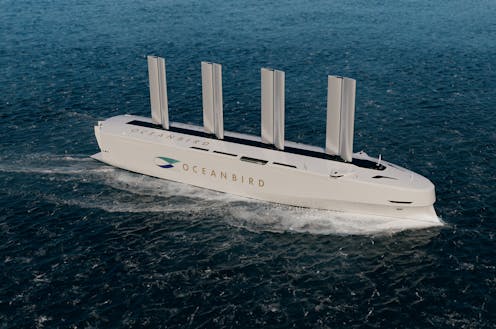
Sailing cargo ships are making a genuine comeback.
Japanese bulk carrier MOL is operating a wind-assisted ship. American food giant Cargill is working with Olympic sailor Ben Ainslie to deploy WindWings on its routes. Swedish shipping company Wallenius is aiming for Oceanbird to cut emissions by up to 90%. The French start-up Zephyr & Borée has built the Canopée, which will transport parts of European Space Agency’s Ariane 6 rocket this year.
I researched the decarbonisation of the shipping industry. While doing fieldwork aboard the Avontuur, a wind-propelled cargo ship, I even got stuck at sea for five months – because of the pandemic, not because the winds failed.
Commercial carriers are due to set sail with WindWings this year.Read more: Shipping must accelerate its decarbonisation efforts – and now it has the opportunity to do so
Sailing towards zero emissions
Like every other sector, the shipping industry needs to decarbonise in line with the Paris Agreement, but its emissions continue to grow. In 2018 the International Maritime Organization (IMO) set a first-ever target of halving shipping emissions between 2008 and 2050.
It was an important, but inadequate, first step. Climate Action Tracker calculates that halving emissions is not nearly enough to keep global warming below 1.5℃.
And yet the scientific consensus is that 1.5℃ is the real upper limit we can risk. Beyond that, dangerous tipping points could spell even more frequent disasters.
Luckily, the IMO will revise its strategy this July. I and many others expect far more ambition – because zero shipping emissions by 2050 is a necessity to keep the 1.5℃ limit credible. That gives us less than three decades to clean up an industry whose ships have an average life of 25 years. The 2050 timeline conceals that our carbon budget will likely run out far more quickly – requiring urgent action for all sectors, including shipping.
The Oceanbird project aims to reduce a ship’s emissions by up to 90%.Research has confirmed the potential of wind propulsion.
The maths is simple. Shipping accounts for one billion tonnes of carbon dioxide a year, almost 3% of global greenhouse gas emissions. If wind propulsion saves fossil fuels today, the dwindling carbon budget stretches a little further. This, in turn, buys more time to develop alternative fuels, which most ships will need to some extent. Once these fuels are widely available, we’ll need less of them because the wind can provide anything from 10% to 90% of the power a ship needs.
Some commentators aren’t easily convinced, but I found most objections to wind-propelled shipping are based on four myths that can be easily debunked.
Myth 1. Wind ships are a thing of the past, for good reason
Wind ships may remind us of 19th-century tea clippers and, worse, of the slave trade and colonial exploitation. But returning to wind propulsion doesn’t mean going back in time.
New wind-powered ships use a blend of new and old technology to harness the wind where it is most common: at sea. This reduces the need for fossil fuels and for new alternative fuels that will require investment and space for new landside infrastructure, both to generate electricity and to transform this power into fuel.
Even if research into sailing cargo ships all but stopped in the late 19th century, engineering, materials science, yacht racing and aerospace design have yielded major innovations that are being used for cargo ships.
Read more: Sail GP: how do supercharged racing yachts go so fast? An engineer explains
Myth 2. The wind is unreliable, so ships won’t arrive on time
The wind may seem fickle when standing on the beach. But at sea the trade winds that powered globalisation have remained stable. Indeed, the most common trade routes are still well-served by the prevailing winds.
Weather forecasting has also improved massively since the last days of sail. And weather routing software helps find the best course to take better than anyone could in the 19th century.
While the wind may not be as predictable as a steady flow of heavy fuel oil, technological advances have taken a lot of uncertainty out of sailing. The wind is also free and unaffected by fluctuating oil prices.
Myth 3. Sails cannot work on all types of ships
It’s true not all types of ships would work with sails, rotors or kites mounted on their decks. This can be due to the type of ship, as the largest container ships can’t easily accommodate sails, for example. It can also be because of where or how vessels operate – the windless waters of the doldrums and tight ferry schedules do pose challenges.
However, the argument that wind propulsion isn’t viable because some ships can’t use it is like claiming that commuting by bike is not a realistic option because not everyone can do so.
Meanwhile, the race between Veer Voyage and Windcoop to build the first wind-powered container ship is on. So, perhaps such ships can use sails, after all.
Myth 4. If it makes so much sense, we’d already be doing it
The 1970s oil crisis drove an upswing of interest in wind propulsion. Conferences in Delft (1980) and Manila (1985) heralded a new dawn for wind ships. But as oil prices dropped, interest waned.
Wind has had a hard time competing with cheap heavy fuel oil – the toxic sludge that refineries have no other use for. Wind propulsion has remained a niche part of the sector because shipping companies don’t have to pay the real environmental and societal costs of burning fossil fuels.
But a global carbon price is likely to be applied soon to international shipping (the European Union’s Emissions Trading Scheme already includes shipping). This creates a financial incentive for non-polluting means of propulsion.
What are we waiting for?
The added complexity of using wind propulsion and weather routing software is a small trade-off to decarbonise shipping.
The International Windship Association reports that more than 20 commercial cargo ships already use “wind-assist” technologies that are retrofitted on existing vessels. The first purpose-built modern sailing cargo ship, Canopée, will start operations this year.
While shipping is a conservative industry, with few companies willing to be first movers, many more wind-propelled vessels will be launched in the next years.
For shipping companies, the biggest risk now isn’t making a daring investment – it’s not investing in a sustainable future at all.
Christiaan De Beukelaer’s new book, Trade Winds: A Voyage to a Sustainable Future for Shipping, is out now.
Authors: Christiaan De Beukelaer, Senior Lecturer in Culture & Climate, The University of Melbourne



















