

How the push to end tobacco advertising in the 1970s could be used to curb gambling ads today
- Written by: Carolyn Holbrook, Senior Lecturer in History, Deakin University
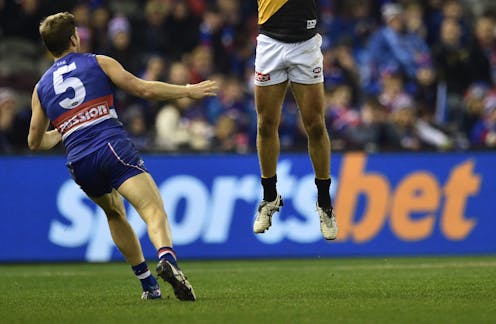
If you think you are seeing a lot more gambling ads on television and online platforms, you are not imagining it. They are so common that high-profile AFL players have refused to participate in sponsored gambling.
Online gambling companies are ploughing huge amounts of money into advertising, and for good reason. The ads work. While fewer people are gambling overall, online gambling is a booming industry.
There are uncanny parallels between the public health challenges posed by gambling advertising today and tobacco advertising 50 years ago. In 1970, a tobacco ad ran on Australian television every eight to 14 minutes. These ads portrayed smoking as cool and adult, and often relied on celebrity endorsements. They worked, driving a new generation of youth into smoking amid predictions of a dramatic increase in the future cancer burden.
Like the tobacco industry in earlier decades, online gambling advertising targets young people. Advertisements that use laconic, blokey humour and carefully selected celebrities like former American basketball superstar Shaquille O’Neal and American actor Mark Wahlberg are skilfully designed to appeal to 18-to-24-year-old men. Young women also represent a growing customer base.
Worryingly, research has shown children as young as 11 are susceptible to the marketing and sales tactics of betting agencies, and that 75% of 8-to-16-year-olds think gambling is just a normal or common part of sport.
As with Commonwealth governments in the 1960s when faced with tobacco advertising, today’s politicians have tinkered around the edges of gambling advertising reform, but shied away from decisive action.
In 2018, the Turnbull government banned gambling ads before 8.30pm on live sports events. But gambling companies easily circumvent these laws. They simply flood the half-time break and post-match coverage with ads. They have even breached the law.
Streaming services remain completely unregulated, and ads are ubiquitous on platforms like YouTube, TikTok and Instagram.
Gambling companies, like tobacco companies before them, proclaim their own efforts at self-regulation by providing embedded warnings that champion “responsible gambling”.
Yet phrases used in their ads, such as “bet responsibly, no matter who you bet with”, have no demonstrable effect on dangerous gambling behaviours. Punters simply ignore warnings against excessive or problem gambling. They buy into the responsible gambling trope and believe they have control.
As with the link between smoking and lung cancer, the harms associated with gambling are well established. Apart from the massive financial losses – an estimated $25 billion in 2018-19 – there are cascading physical and mental health impacts. These include suicide, incapacity to work or study, damage to close relationships and, in some cases, a resort to criminal behaviour.
In 1970, a large majority of the Australian public (74%) disliked cigarette ads and wanted them banned. The figure is similar for gambling advertising today. In a 2022 survey, 71% agreed these ads should be banned.
In the face of such a compelling case for action, why won’t governments act? Back in the 1970s, the tobacco industry and the television and radio stations on which they advertised (to the tune of $125 million a year in today’s money) were powerful lobby groups that reached into the heart of government.
While health experts and organisations like the Anti-Cancer Council of Victoria (now Cancer Council of Victoria) advocated for reform, tobacco growers, cigarette companies, the media and those politicians beholden to these interests pushed back.
In a familiar pattern, the online gambling industry exerts its influence increasingly in the political arena. Sportsbet, for example, donated $313,424 to political parties in 2022, spreading its contributions between the Coalition and the ALP.
It donated $19,000 in 2022 to the election campaign of the now Communications Minister Michelle Rowland, whose portfolio includes advertising regulation. Given that gambling companies provide a significant and expanding source of revenue for both conventional and new media companies, they form a powerful coalition of self-interest.
Read more: From TV to TikTok, young people are exposed to gambling promotions everywhere
So, how did the anti-tobacco lobby burst through a similar impasse 50 years ago? And can we transfer these lessons to the present?
The Victorian Anti-Cancer Council, then led by Dr Nigel Gray, and other cancer control bodies led a sustained program of non-partisan, evidence-based advocacy to government about the health effects of smoking, and the links between advertising and youth smoking uptake.
But the act that finally embarrassed the government into action was a series of 26 anti-tobacco ads starring celebrity actors Warren Mitchell and Miriam Karlin from the UK and Australian Fred Parslow. Conceived by Gray, his director of public education, David Hill, and advertising creative John Bevins, the ads lampooned tobacco advertising with satire.
For instance, they contrasted the illusion of the international jet-setting lifestyle portrayed in the adverts with the realities of lung cancer and repulsive coughing. An important feature of the campaign was the inclusion of one “straight” educational advertisement on the dangers of smoking and the effect of tobacco ads on youth by the first Australian of the Year, esteemed Nobel Prize-winning scientist Sir Frank McFarlane Burnet.
The television channels played into Gray’s plan by refusing to air the Anti-Cancer Council ads. The print media picked up the story of Burnet being denied a chance to speak to the public. The Coalition government was criticised for failing to intervene despite public support for limiting or banning tobacco advertising, and the evidence from Denmark, the US and the UK, presented by Gray, showing that banning tobacco advertising reduced youth smoking.
Embarrassed, the government forced the TV stations to air the anti-tobacco ads in July 1971, creating even more media scrutiny. The public attention brought by this debacle finally pressured the McMahon government into introducing some limits on tobacco advertising.
When Gough Whitlam won the 1972 election, Labor legislated a phased ban on tobacco advertising. Despite internal debate within the Liberal Party, the subsequent Fraser government maintained it and implemented a total ban on tobacco advertising on television and radio by 1977 — a major win for tobacco control and public health.
The media environment has clearly changed markedly since the 1970s. But the success of the highly creative 1971 anti-tobacco campaign offers some inspiration for taking on gambling, which is among the major public health issues of our time.
Gray recognised that merely providing honest information about smoking was not enough. The tobacco control effort had to galvanise public dissatisfaction and motivate media action through evidence-driven, high-profile advocacy. A similar approach could be a way of forcing government to take action against the powerful interest groups supporting pervasive gambling advertising today.
Authors: Carolyn Holbrook, Senior Lecturer in History, Deakin University


















