

We used DNA from Beethoven's hair to shed light on his poor health – and stumbled upon a family secret
- Written by: Robert Attenborough, Honorary Senior Lecturer in Bioanthropology, Australian National University
Many astonishingly creative people have lived lives cut tragically short by illness. Johannes Vermeer, Wolfgang Amadeus Mozart, Jane Austen, Franz Schubert and Emily Brontë are some famous examples.
Ludwig van Beethoven’s life was not quite as short; he was 56 when he died in 1827. Yet it was short enough to tantalise us as to what more he might have achieved, had he had better health.
For much of his adult life, Beethoven was frequently tormented by pain and poor health – not to mention hearing loss. He gave anguished thought to these afflictions, especially his hearing loss, and hoped they would one day be understood and the explanation made public.
At times he despaired and contemplated suicide; at times he stopped composing altogether.
Entire books have been written on Beethoven’s health, based on records from the time. However, my colleagues and I approached the topic from a different perspective. We asked what clues Beethoven’s genome – his DNA – might provide.

We found some answers, and some surprises, as we explain in new research published in Current Biology.
Planting the seed
Our multinational collaboration began with Tristan Begg – a Beethoven enthusiast and student of biological anthropology, then at the University of California Santa Cruz.
While volunteering at the Ira F. Brilliant Center for Beethoven Studies at San José State University, Begg encountered the centre’s director at the time, historical musicologist William Meredith.
The seed of the project was sown then, but it took eight years and the input of several other specialists to develop it to the point of being published. All the complex multidisciplinary collaborations notwithstanding, the only person who has worked full-time on the project is Begg himself, now in his final PhD year at the University of Cambridge.
Where did the DNA come from?
It’s very challenging to extract and analyse DNA from the remains of a dead person (or other animal) – much more so than from living tissues. Nonetheless, huge technical advances have transformed the field of ancient DNA studies.
Generally, the best DNA sources from human remains include teeth and the petrous bone in the skull, but none of Beethoven’s bones or teeth were available to us.
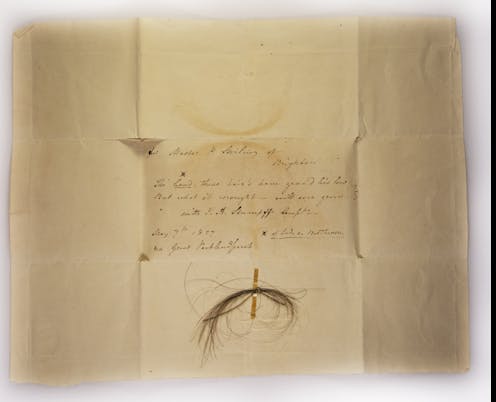
What was available was hair. In Beethoven’s day, it was common to collect locks from famous people or loved ones. Dozens of locks attributed to Beethoven are held in public and private collections.
However, hair without roots is a less tractable source of DNA. This DNA tends to exist in short and sometimes degraded sequences. These have to be painstakingly pieced together, using specialised computer software, to construct as much of a complete genome sequence as possible.
How do we know the locks are Beethoven’s?
Our project used samples from eight independently sourced locks attributed to Beethoven. Of these, five yielded DNA from the same male individual, with degrees of damage consistent with origins in the early 19th century.
Working with the ancestry firm FamilyTreeDNA, we traced the ancestry for this person to western-central Europe. We are confident it is Beethoven, since two of the locks exist alongside uninterrupted provenance records going as far back as the 1820s.
Three more locks, genetically identical with the other two, also had good (although not completely uninterrupted) provenance records.
The combination of excellently documented provenances with perfect genetic agreement between five independently sourced samples made it very difficult to doubt these hair samples came from Beethoven.
That left three locks of hair. Two of these were clearly genetically different from the other five: one is a woman’s. We don’t know how these came to be attributed to Beethoven.
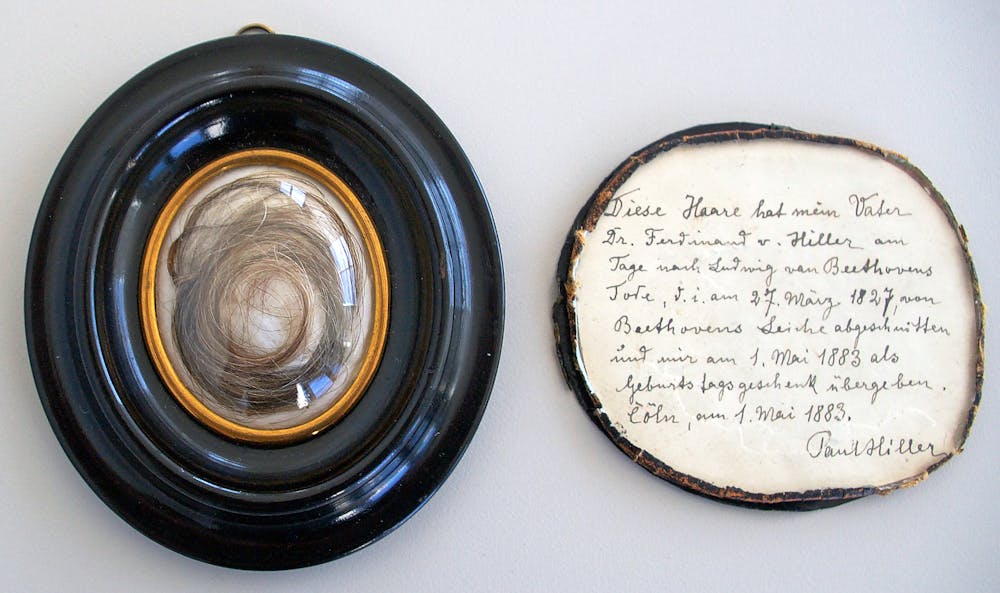 Our results showed the Hiller lock, previously attributed to Beethoven, actually came from a woman.
Ira F. Brilliant Center for Beethoven Studies, San Jose State University / William Meredith, Author provided
Our results showed the Hiller lock, previously attributed to Beethoven, actually came from a woman.
Ira F. Brilliant Center for Beethoven Studies, San Jose State University / William Meredith, Author provided
One of the misattributions is significant in itself, because it was the basis of earlier research that concluded Beethoven had been subject to lead poisoning. Our findings show this conclusion no longer stands.
The eighth lock yielded too little DNA to be declared authentic or otherwise.
What we learnt about Beethoven’s health
We didn’t expect to find a genetic basis for Beethoven’s most widely known health problem – his hearing loss – and this was borne out. Beethoven had adult-onset hearing loss, which is only rarely attributable to primarily genetic causes.
He was, however, beset for many years by other health problems – particularly gastrointestinal problems (pain and diarrhoea) and liver disease.
Working with the Bonn University medical genetics team, we didn’t find Beethoven to be especially genetically susceptible to any particular gastrointestinal condition, such as inflammatory bowel disease, irritable bowel syndrome, coeliac disease or lactose intolerance (as some have hypothesised). Our main discoveries related to liver disease.
We already knew through documentation that Beethoven had attacks of jaundice. Begg’s work has now shown Beethoven had two copies of a particular variant of the PNPLA3 gene, which is linked to liver cirrhosis. He also had single copies of two variants of a gene that causes haemochromatosis, a condition that damages the liver.
Quite remarkably, the analyses also revealed Beethoven was infected with the hepatitis B virus in the final months of his life (and perhaps before). Hepatitis B infection may have been common in Europe at the time, but details on this are scant.
What’s more, alcohol consumption may have exacerbated Beethoven’s liver disease risk. There has been controversy regarding the extent and nature of his alcohol consumption, which is referred to – but not quantified – in surviving records.
Begg reviewed the records carefully and concluded Beethoven’s alcohol consumption was likely unexceptional for the time and place, but may have still been at levels now considered harmful.
Revelations from the Beethoven family
There was one more surprise in store for us. As part of our work, we sought to link Beethoven’s genome with those of living members of the Beethoven lineage. To do this we focused on the Y chromosome, which is inherited in the male line only (following a similar pattern to surnames in most European traditions).
Five men with the surname Beethoven contributed their DNA samples. They were not closely related to each other, and were living in present-day Belgium where the surname originates. They all essentially shared the same Y chromosome, which could be put down to descent from a common male ancestor: Aert van Beethoven (1535-1609).
The surprise was that Ludwig van Beethoven’s locks had a different Y chromosome. Having considered other explanations, we inferred that at some point in the seven generations between Aert and Ludwig, someone’s father for social and legal purposes was not their biological father.
But we couldn’t decipher, based on the evidence available, which generation this might have been.
What’s next?
We will be making the genome we sequenced publicly available, as there may be more to discover from further analyses.
Beyond Beethoven, our project is an example of wider possibilities opening up in the field of DNA analysis. It shows meaningful results can be obtained even from such unpromising DNA sources as historical hair locks.
To date, population genetics has seldom taken its analyses down to the level of a single individual. This is hard to do, but we show it’s not impossible.
Who might be next? Perhaps someone else about whom there is a distinct question to answer – or even someone who may themselves have wanted that question answered.
Acknowledgments: In addition to lead author Tristan Begg (University of Cambridge), I would like to acknowledge all other co-authors including Johannes Krause and Arthur Kocher (Max Planck Institute for Evolutionary Anthropology, Leipzig), Toomas Kivisild and Maarten Larmuseau (KU Leuven), Markus Nöthen and Axel Schmidt (University of Bonn), and all sample donors including philanthropist Kevin Brown.
Authors: Robert Attenborough, Honorary Senior Lecturer in Bioanthropology, Australian National University


















