

A new study on Australian volcanoes has changed what we know about explosive 'hotspot' volcanism
- Written by: Al-Tamini Tapu, Geoscientist, The University of Queensland
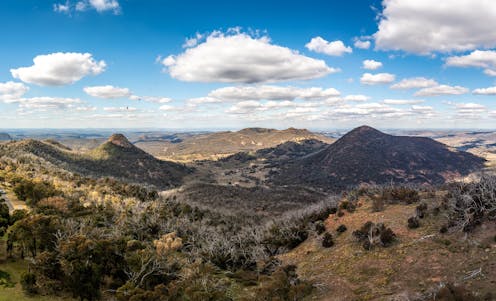
Our new study published in Nature Geoscience on an ancient chain of Australian volcanoes is helping to change our understanding of “hotspot” volcanism.
You may be surprised to learn eastern Australia hosts the longest chain of continental hotspot volcanoes on Earth. These volcanoes erupted during the last 35 million years (for 1 to 7 million years each), as the Australian continent moved over an area of heat (a hotspot) inside the planet, also known as a fixed heat anomaly or mantle plume.
But it appears the Australian hotspot waned with time. And we have found the volcanoes’ inner structure and eruptions changed as a result. Our new findings show hotspot strength has key impacts on the evolution of volcanoes’ inner structure, along with their location and lifespan.
Hotspots change Earth’s surface
Hotspot volcanoes can produce very large volumes of lava and have an important role in Earth’s evolution and atmosphere. Today, famously active hotspot volcanoes include the Hawaiian volcanoes in the Pacific Ocean and the Canary Islands in the Atlantic Ocean. These are known as ocean island volcanoes.
The Australian hotspot chain provides a continental perspective and covers the life cycle of a hotspot – a unique opportunity to better understand how hotspot volcanoes work, why they erupt, and how they evolve with time.
We found the strength of the hotspot and magma supply controls the duration, make-up and explosiveness of volcanoes at the surface. Around 35 to 27 million years ago, the early Australian hotspot was strong and generated enormous, long-lasting volcanoes across Queensland where magma (molten rock) took a direct route to the surface.
In contrast, the more recent (20 to 6 million years ago) New South Wales volcanoes are smaller and had shorter lifetimes, suggesting the hotspot lost strength with time. Interestingly, reduced supply made the magma’s journey to the surface more complicated, with many stops (magma chambers) and more explosive eruptions.
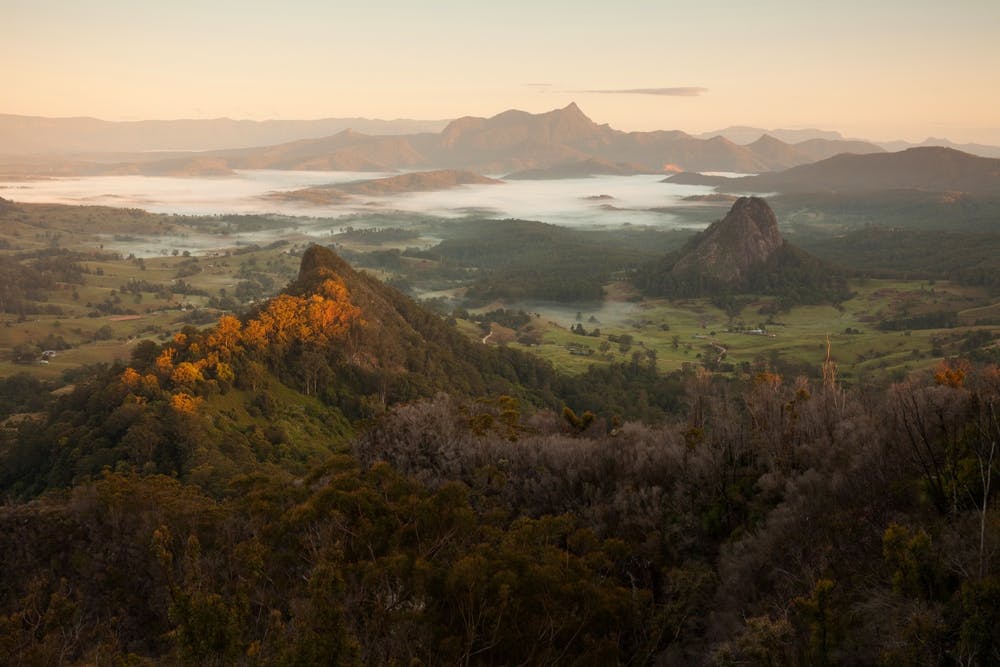
The tipping point occurred at the stunning Tweed-Wollumbin (Mount Warning) volcanic landscape, which formed 21–24 million years ago at today’s border between Queensland and New South Wales.
The secret journey of magma
To discover the journey of magma inside the volcano, and the stops it made on its way to eruption, we analysed volcanic crystals. These are the little heroes that make it all the way to the surface. Mainly composed of silicate minerals like olivine, pyroxene and plagioclase, the crystals grow in the guts of the volcano at high temperature, and register what happens before eruptions start.
These crystals are quite simple in northern volcanoes like Buckland in Queensland, which means they travel through few, simple magma chambers. In contrast, the crystals become very complex in southern volcanoes like Nandewar and Warrumbungle in New South Wales, which means they had a complicated journey through lots of busy magma chambers – lots of stops.
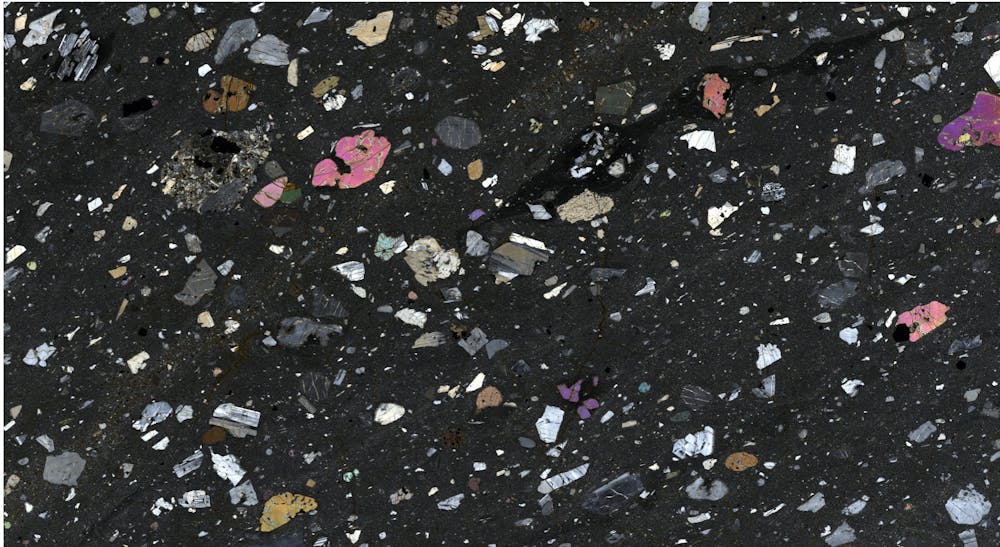 Microscopic view of frozen lavas from Nandewar volcano, NSW. Little crystals transported by magma unlock eruption histories (pink: examples of olivine, grey: examples of plagioclase). Image width 25mm.
Al-Tamini Tapu, Author provided (no reuse)
Microscopic view of frozen lavas from Nandewar volcano, NSW. Little crystals transported by magma unlock eruption histories (pink: examples of olivine, grey: examples of plagioclase). Image width 25mm.
Al-Tamini Tapu, Author provided (no reuse)
Importantly, when magma stops in a chamber, it cools down and becomes more viscous and difficult to erupt – a bit like cold toothpaste, instead of hot coffee. This thick, lazy magma may need new, hotter magma (caffeinated!) to come and push it to erupt.
If that happens, the gases trapped in the colder magma may not be able to escape, since the magma is so thick. This results in a pressure buildup, eventually exploding like a shaken bottle of fizzy drink – an explosive volcanic eruption.
Read more: Volcano crystals could make it easier to predict eruptions
A special clock
The cold and hardened lava flows we see in the form of volcanic rocks contain a special clock – radioactive chemical elements have slowly broken down into stable daughter products that accumulate and increase in concentration as time passes.
The beauty of this process is that we know how fast it occurs. By measuring the ratio of the radioactive element and its stable daughter product we can calculate the age of a volcanic rock. By measuring the age of each lava flow from the bottom to the top of the volcano, we can measure its lifetime.
 Sawn Rock with columnar joints, Nandewar Volcano, NSW, one of the studied volcanoes from the east Australian volcanic chain.
Dr Tracey Crossingham, Author provided (no reuse)
Sawn Rock with columnar joints, Nandewar Volcano, NSW, one of the studied volcanoes from the east Australian volcanic chain.
Dr Tracey Crossingham, Author provided (no reuse)
Our study shows the relevance of Australian volcanoes, even if mostly extinct, in better understanding eruptions that have shaped the evolution of our planet. We demonstrate the fundamental role of hotspot strength and magma supply on Earth’s landscape, as well as the eruption styles and lifetimes of volcanoes.
This breakthrough makes it possible to visualise the inner structure of hotspot volcanoes, and their evolution, uniquely easily accessible in the ancient, exposed Australian landscape.
Read more: Scientists just revealed the most detailed geological model of Earth's past 100 million years
Authors: Al-Tamini Tapu, Geoscientist, The University of Queensland


















