

matrilineal societies exist around the world – it's time to look beyond the patriarchy
- Written by: Camilla Nelson, Associate Professor in Media, University of Notre Dame Australia
Thirty years ago, I travelled to Lijiang, an ancient city in the northwest of China’s Yunnan province in the foothills of the eastern Himalayas. Lijiang’s old town is a tangle of intersecting waterways, arched stone bridges, and cobbled streets. Just north of the city – about five hours by road – is Lugu Lake, and the villages of the Mosuo, one of the world’s oldest continuing matriarchal societies.
Back then, before Lijiang’s UNESCO world heritage listing brought planeloads of tourists, the Sino-Tibetan borderlands were an out-of-the-way place, and difficult to reach. I took a slow boat from Hong Kong, then travelled overland, sleeping on straw mats on riverboats, and the back seats of buses, using a quickly acquired and entirely pragmatic Mandarin vocabulary to negotiate China’s then emerging industrial cities.
I was anxious to catch a glimpse of a society where women and men had chosen to arrange their lives differently from the male-dominated, Australian suburbia in which I grew up.
In Mosuo villages, women are equal, and perhaps superior to men. Mothers and grandmothers head households, women conduct business, and property passes down the female line. Nuclear families do not exist. Instead, women take lovers and have children, but they live separately from their partners. A man’s place is in his grandmother’s house, raising his sister’s children.

It’s a way of life dating from the 13th century, at least – some say 2,000 years – that has steadily resisted being absorbed into the wider, patriarchal Han Chinese culture. When I was there, memories of resistance to the Cultural Revolution ran deep. Between 1966 and 1976 matrilineal families were banned; conformity with Beijing meant putting men in charge.
Reading Angela Saini’s The Patriarchs – How Men Came to Rule, the questions that had preoccupied me then, as a very young woman, came back. Saini’s book is as much about matriarchies as it is about “the patriarchy”, and as much about real and mythical matriarchal societies as it is about the real and imagined ways in which “the patriarchs” overthrew them.
“The word we now use to describe women’s oppression – ‘patriarchy’ – has become devastatingly monolithic, drawing in all the ways in which women and girls around the world are abused and treated unfairly …” she writes.
The problem with this kind of thinking is that male domination is made to look inevitable, omnipresent, natural or biological.
And as Saini points out, “The most dangerous part of any oppression is that it can make people believe that there are no alternatives.”
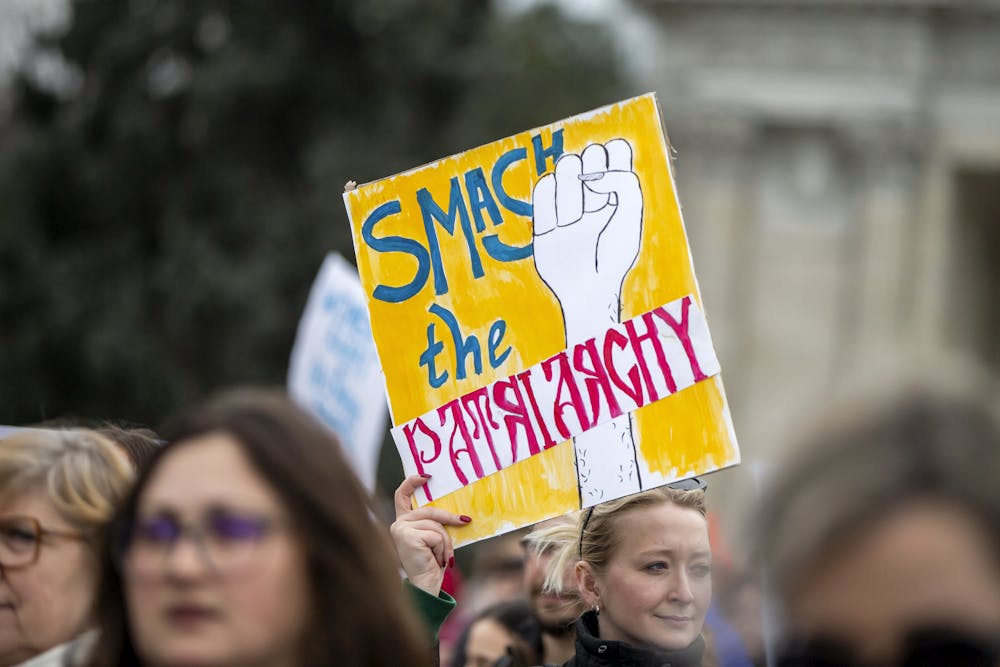 We need to know alternatives exist.
Dumitru Doru/AAP
We need to know alternatives exist.
Dumitru Doru/AAP
Read more: Women's health is better when women have more control in their society
Claims to matriarchy?
Although most dictionaries will tell you matriarchal societies are “hypothetical” – and highly regarded 20th century western historians such as Gerda Lerner have roundly declared “no matriarchal society has ever existed” – recent research drawing on decades old studies in anthropology confirms there are at least 160 matrilineal communities in the world in nations such as India, Africa, Indonesia and the Americas.
Of these, there are likely to be some – like the Mosuo – with strong matriarchal claims.
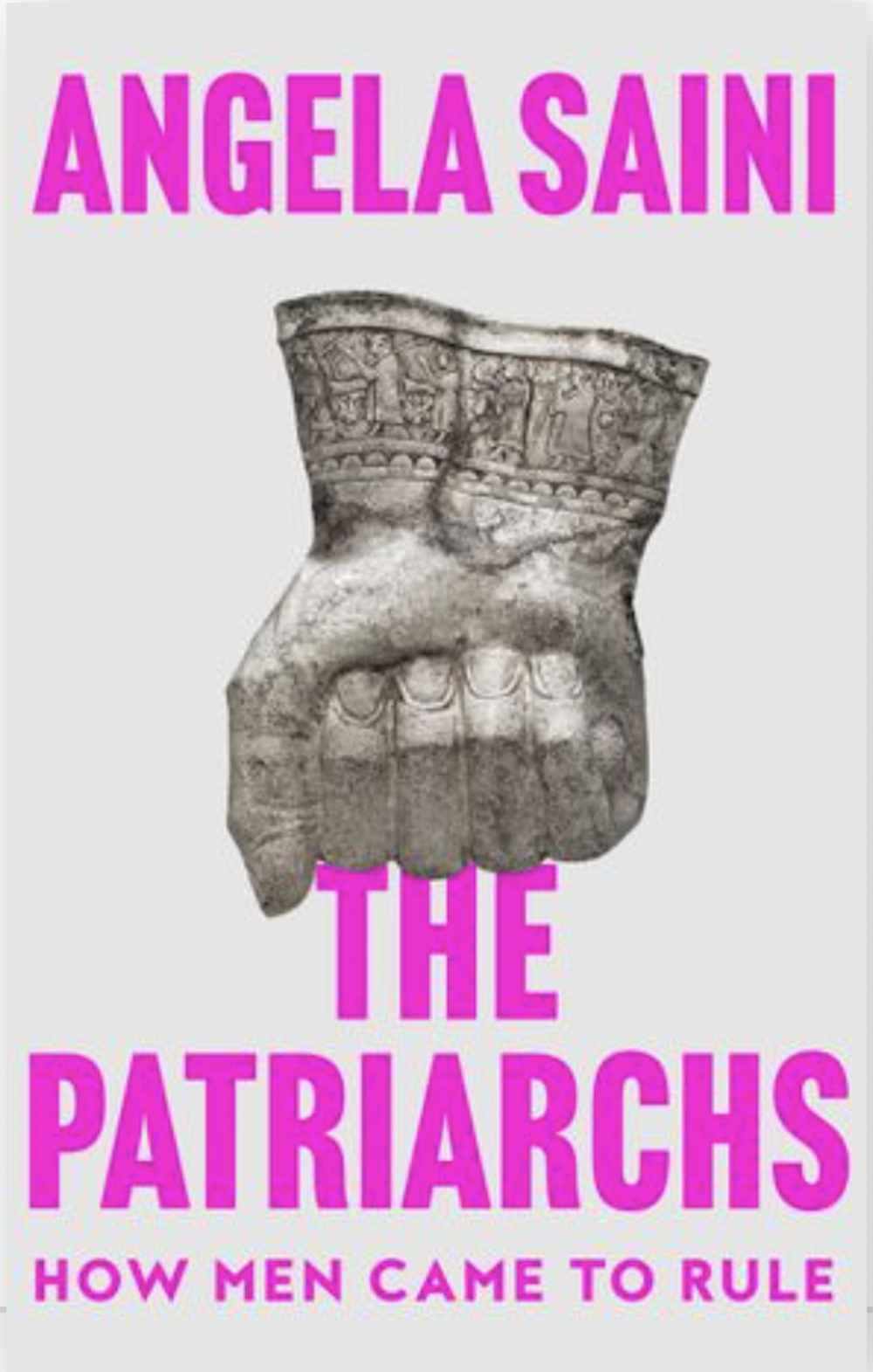 Saini, best known for her science journalism, takes a deep dive into history and archaeology to show the ways in which ancient non-patriarchal societies have organised themselves.
Her interests include “matrilineal societies” (that is, societies in which descent is traced through the female rather than the male line and property is often inherited in the same way); “matrilocal societies” (a woman stays with or near her family after marriage and a man moves to where his wife’s family lives), and “matricentric” or “matrifocal societies” (a woman is the head of the family household, but this does not necessarily extend to social governance).
Of course, the word matriarchy carries a slightly different meaning, in that it is connected to power.
In popular usage, it conveys an idea of female domination – a mirror image of patriarchy – in which women have absolute authority over men and children. And yet, to account for matriarchies through a patriarchal lens seems wrongheaded.
Societies with claims to a real rather than hypothetical or imagined matriarchal status – including the Mosuo in China, the Khasis in north India, and the Minangkabau in West Sumatra – are frequently a lot more complex.
Saini, best known for her science journalism, takes a deep dive into history and archaeology to show the ways in which ancient non-patriarchal societies have organised themselves.
Her interests include “matrilineal societies” (that is, societies in which descent is traced through the female rather than the male line and property is often inherited in the same way); “matrilocal societies” (a woman stays with or near her family after marriage and a man moves to where his wife’s family lives), and “matricentric” or “matrifocal societies” (a woman is the head of the family household, but this does not necessarily extend to social governance).
Of course, the word matriarchy carries a slightly different meaning, in that it is connected to power.
In popular usage, it conveys an idea of female domination – a mirror image of patriarchy – in which women have absolute authority over men and children. And yet, to account for matriarchies through a patriarchal lens seems wrongheaded.
Societies with claims to a real rather than hypothetical or imagined matriarchal status – including the Mosuo in China, the Khasis in north India, and the Minangkabau in West Sumatra – are frequently a lot more complex.
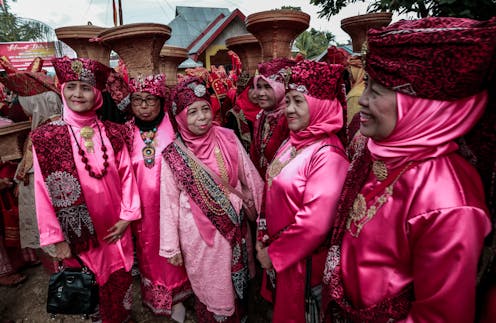
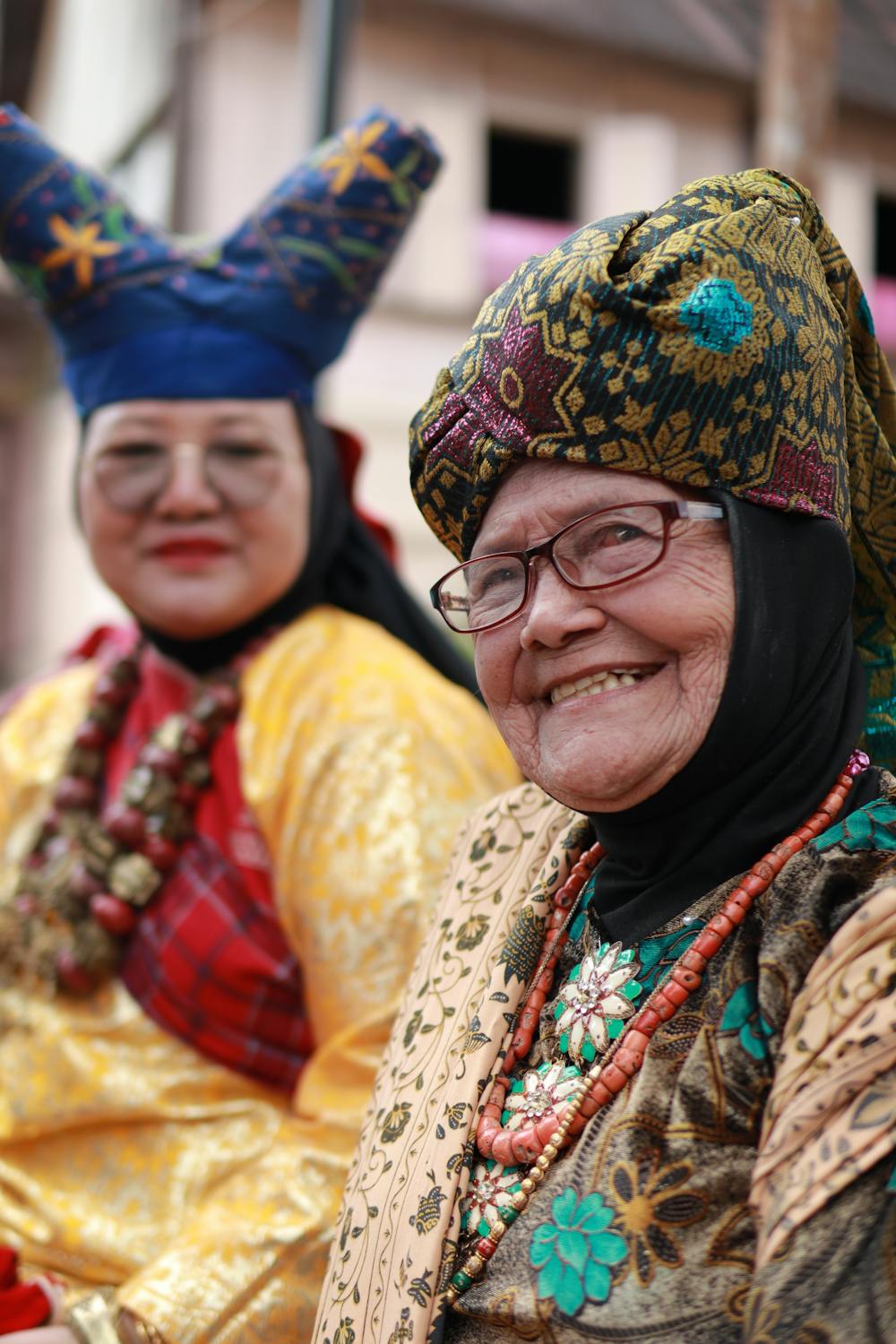 Women wearing traditional Minangkabau dress in Payakumbuh, West Sumatra.
Shutterstock
Among the Minangkabau, for example, the world’s largest continuing matrilineal society, with a population of over 5 million, an ancient culture based on customary practice - called “adat” - has repeatedly transformed itself in the wake of conversion to Islam in the 16th century and more than two centuries of European colonial rule. But women’s ownership of land and property continues to secure their power, and customary practice does not allow men to act without them.
Here, in largely agricultural communities, in the lush volcanic highlands of the Indonesian archipelago, ancestry and family name continue to be passed down through the female line, along with house, land, and livestock, although men may now pass business earnings to their sons, following Islamic law.
Husbands move into their wives’ homes on marriage, and all decision-making requires consensus based on principles of mutual responsibility.
Read more:
Indonesia’s Minangkabau culture promotes empowered Muslim women
In the northeastern Indian state of Meghalaya, which roughly translates as “Abode of the Clouds”, in reference to the mountainous terrain it occupies between Bhutan and Bangladesh, live the Khasi. Theirs is one of few matrilineal societies where a family’s youngest daughter – not the eldest – inherits her mother’s wealth and property.
All children trace their lineage from their mother’s side of the family. The youngest daughter is known as the “khadhuh” or head of the family. Her house is open to everybody, including any orphaned or unmarried male relatives. Her maternal uncles act as advisors, but do not wield authority over her.
Women wearing traditional Minangkabau dress in Payakumbuh, West Sumatra.
Shutterstock
Among the Minangkabau, for example, the world’s largest continuing matrilineal society, with a population of over 5 million, an ancient culture based on customary practice - called “adat” - has repeatedly transformed itself in the wake of conversion to Islam in the 16th century and more than two centuries of European colonial rule. But women’s ownership of land and property continues to secure their power, and customary practice does not allow men to act without them.
Here, in largely agricultural communities, in the lush volcanic highlands of the Indonesian archipelago, ancestry and family name continue to be passed down through the female line, along with house, land, and livestock, although men may now pass business earnings to their sons, following Islamic law.
Husbands move into their wives’ homes on marriage, and all decision-making requires consensus based on principles of mutual responsibility.
Read more:
Indonesia’s Minangkabau culture promotes empowered Muslim women
In the northeastern Indian state of Meghalaya, which roughly translates as “Abode of the Clouds”, in reference to the mountainous terrain it occupies between Bhutan and Bangladesh, live the Khasi. Theirs is one of few matrilineal societies where a family’s youngest daughter – not the eldest – inherits her mother’s wealth and property.
All children trace their lineage from their mother’s side of the family. The youngest daughter is known as the “khadhuh” or head of the family. Her house is open to everybody, including any orphaned or unmarried male relatives. Her maternal uncles act as advisors, but do not wield authority over her.
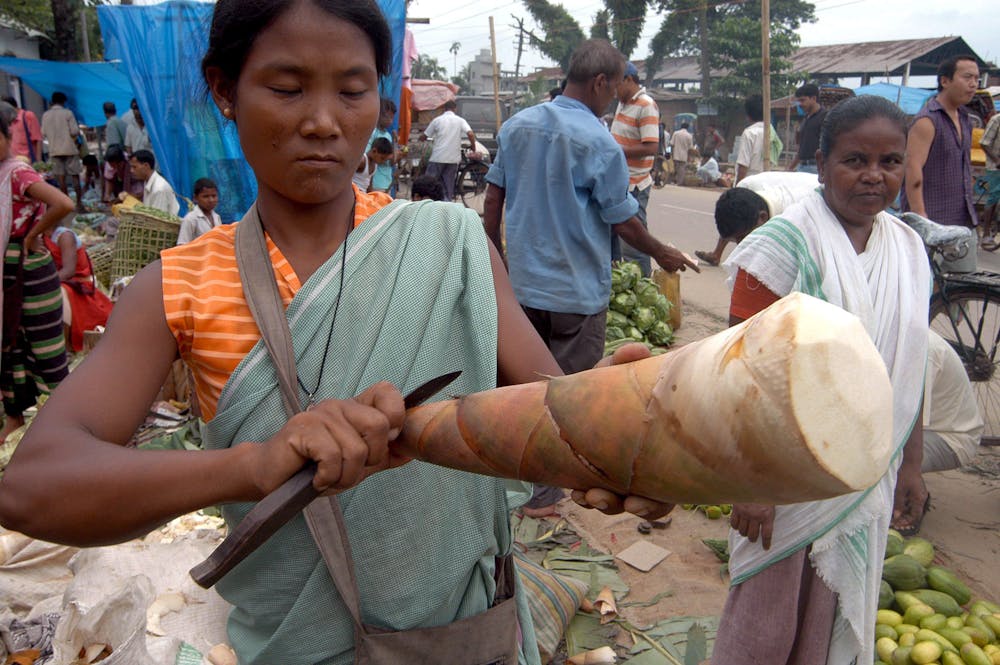 A Khasi woman cleans a bamboo shoot for sale at a market in Guwahati, northeast India.
EPA
There are many more societies in which matriarchal traditions from the past continue to shape social organisation in the present. These include the Haudenosaunee in North America, the Bribri in Costa Rica, the descendants of the ancient Nairs in Kerala, and a significant number of communities in Africa’s “matrilineal belt”.
Africa’s matrilineal societies go back more than 5,000 years. They are commonly thought to originate in an ancient diaspora of Bantu-speaking peoples from an area around modern day Nigeria and Cameroon, spreading out across the continent.
Matrilineal traditions of descent and the inheritance of land are still followed in many Bantu-speaking communities, including the Bemba and the Luapula peoples of Zambia, for example. Matrilineal traditions have strengthened these women’s socio-economic status, compared to neighbouring non-matrilineal societies.
And, of course, there are other societies that do not fall into any of these simple binaries. Australia’s Aboriginal people, for example, have a variety of different gender arrangements, including traditions in which men govern men, and women govern women.
Read more:
The fire-fighting children of the Khasi Hills and the decline of traditional farming in north-east India
A 19th century creation
What is truly fascinating about the whole idea of matriarchy – as Saini points out – is that it is a very modern preoccupation.
Stories about Amazonian warriors, fiery goddesses and powerful queens can be traced back to ancient times, across cultures and continents. But the term “matriarchy” is largely the creation of mid-19th century anthropological writing. It conspicuously appears at a time when Europeans – driven on by the dreams of conquest and “discovery” that marked the imperial project – reacted in shock as they encountered societies different from their own.
In 18th century Kerala, for example, Europeans were baffled to encounter the descendants of the ancient Nairs living in taravads – bustling joint households with a shared female ancestor – in which the rules of monogamous marriage and nuclear family didn’t apply. Sexuality was celebrated. Women were allowed more than one sexual partner, and fathers raised their sisters’ children rather than their own.
One Dutch traveller declared the Nairs to be “most lecherous and unchast [sic] nation in all the Orient”.
A Khasi woman cleans a bamboo shoot for sale at a market in Guwahati, northeast India.
EPA
There are many more societies in which matriarchal traditions from the past continue to shape social organisation in the present. These include the Haudenosaunee in North America, the Bribri in Costa Rica, the descendants of the ancient Nairs in Kerala, and a significant number of communities in Africa’s “matrilineal belt”.
Africa’s matrilineal societies go back more than 5,000 years. They are commonly thought to originate in an ancient diaspora of Bantu-speaking peoples from an area around modern day Nigeria and Cameroon, spreading out across the continent.
Matrilineal traditions of descent and the inheritance of land are still followed in many Bantu-speaking communities, including the Bemba and the Luapula peoples of Zambia, for example. Matrilineal traditions have strengthened these women’s socio-economic status, compared to neighbouring non-matrilineal societies.
And, of course, there are other societies that do not fall into any of these simple binaries. Australia’s Aboriginal people, for example, have a variety of different gender arrangements, including traditions in which men govern men, and women govern women.
Read more:
The fire-fighting children of the Khasi Hills and the decline of traditional farming in north-east India
A 19th century creation
What is truly fascinating about the whole idea of matriarchy – as Saini points out – is that it is a very modern preoccupation.
Stories about Amazonian warriors, fiery goddesses and powerful queens can be traced back to ancient times, across cultures and continents. But the term “matriarchy” is largely the creation of mid-19th century anthropological writing. It conspicuously appears at a time when Europeans – driven on by the dreams of conquest and “discovery” that marked the imperial project – reacted in shock as they encountered societies different from their own.
In 18th century Kerala, for example, Europeans were baffled to encounter the descendants of the ancient Nairs living in taravads – bustling joint households with a shared female ancestor – in which the rules of monogamous marriage and nuclear family didn’t apply. Sexuality was celebrated. Women were allowed more than one sexual partner, and fathers raised their sisters’ children rather than their own.
One Dutch traveller declared the Nairs to be “most lecherous and unchast [sic] nation in all the Orient”.
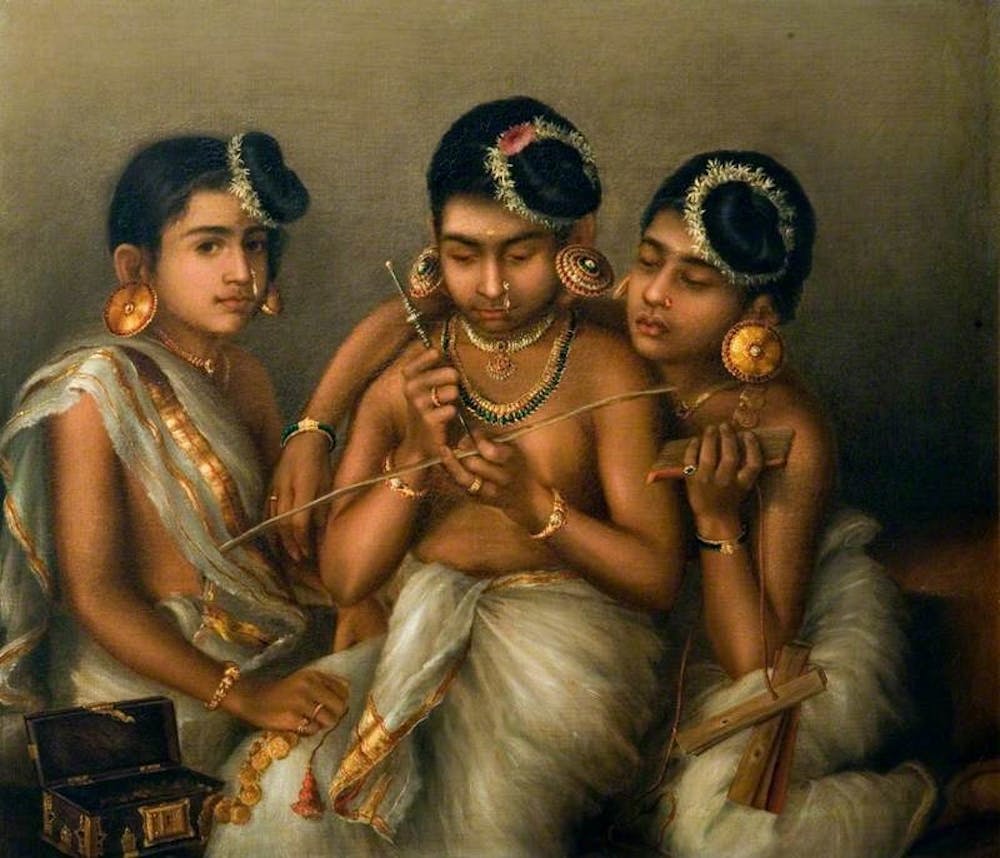 Ramaswami Naidu: Three Nayar Girls of Travancore (1872).
Wikimedia Commons
Similarly, in North America, missionaries who encountered the Haudenosaunee, were surprised by the obstinacy of their children who persistently swapped English pronouns to reflect the Haudenosaunee belief that women were the more important gender. They promptly set themselves to work to “correct” the children’s “errors”.
‘A corrupt phase of human development’
Back “home” in the European metropolis, anthropologists began to search for explanations for this behavior. They drew on a potent mix of nascent evolutionary science and colonial myth. Europe’s so called “civilising mission” wasn’t just about allegedly “dominant races” overtaking other societies, “it was also men who were taking their place as the dominant sex”. Saini writes,
European intellectuals imagined a transition from savagery to civilisation, from irrationality to rationality, from immorality to morality [in which male authority] was believed to be another marker of humanity’s progress.
A plethora of books including Johann Bachofen’s Mother Right, John Ferguson McLellan’s Primitive Marriage, and Henry Morgan’s Ancient Society set out a speculative history of humankind in which society was deemed to have a shared matriarchal origin, before men seized power.
Mostly, these 19th century intellectuals defined matriarchy as a “corrupt” phase of human development that later gave way to a “rational” male dominated society, either cataclysmically or by a process of evolution.
Many – including Karl Marx – decided women’s inferior social status was due women’s intrinsic weakness, not the material conditions in which they found themselves.
Unlike Marx, Friedrich Engels gave the decline of matriarchies a material and historical dimension, arguing it was the creation of private property in archaic societies that had ushered in the “world historical defeat of the female sex”.
These sweeping accounts of human civilisation were based on gender stereotypes, which frequently characterised women as “too weak” and men as “too strong”.
According to Saini, even suffragettes fell into the trap of accepting that “peaceful, women-centred societies” had been overthrown by “violent marauding men who shared an unstoppable lust for power and control” during a single “big turning point in prehistory”.
By the 1960s, she argues, a new generation of myth makers believed they had identified this crucial “turning point” and its location.
Elder, goddess?
Just beyond the metropolis of Konya, in modern day Türkiye, “buried under a bump in the otherwise flat, arid plains of southern Anatolia”, lie the ruins of Çatalhöyük. Saini describes these ruins as the remains of a “society in which nothing follows the rules as we might expect them to be”.
Humans lived in Çatalhöyük at the end of the Stone Age, around 7400BCE – that is, before the Indus Valley societies and 5,000 years before the pyramids.
Here, ancient houses are built “back to back, side to side” like boxes stuck together. They have flat roofs with no doors or windows. The original inhabitants came and went through ladders in the roof, walking across the tops of buildings rather than around or between them.
Interior walls are covered in dramatic red frescoes, featuring human figures, birds, or possibly vultures. Bulls’ heads are built into clay walls and benches, with horns protruding.
Unlike most archaeological sites where there’s often clear evidence of gender hierarchy – with, say, male skeletons being better nourished than female skeletons, or being buried with different status and belongings – in Çatalhöyük, the inhabitants appeared to be, at first glance, extremely egalitarian in their relationships.
But what particularly caught the archaeologists’ attention, Saini writes, were hundreds of tiny clay figures, mostly female. They were considered to be fertility figures but unusually, had not been sexualised. The best known of them, called the “Seated Woman of Çatalhöyük”, depicts a woman seated with her hands on top of two big cats, possibly leopards. Her back is perfectly straight. She is invested with calm authority. Like a respected civic elder.
Ramaswami Naidu: Three Nayar Girls of Travancore (1872).
Wikimedia Commons
Similarly, in North America, missionaries who encountered the Haudenosaunee, were surprised by the obstinacy of their children who persistently swapped English pronouns to reflect the Haudenosaunee belief that women were the more important gender. They promptly set themselves to work to “correct” the children’s “errors”.
‘A corrupt phase of human development’
Back “home” in the European metropolis, anthropologists began to search for explanations for this behavior. They drew on a potent mix of nascent evolutionary science and colonial myth. Europe’s so called “civilising mission” wasn’t just about allegedly “dominant races” overtaking other societies, “it was also men who were taking their place as the dominant sex”. Saini writes,
European intellectuals imagined a transition from savagery to civilisation, from irrationality to rationality, from immorality to morality [in which male authority] was believed to be another marker of humanity’s progress.
A plethora of books including Johann Bachofen’s Mother Right, John Ferguson McLellan’s Primitive Marriage, and Henry Morgan’s Ancient Society set out a speculative history of humankind in which society was deemed to have a shared matriarchal origin, before men seized power.
Mostly, these 19th century intellectuals defined matriarchy as a “corrupt” phase of human development that later gave way to a “rational” male dominated society, either cataclysmically or by a process of evolution.
Many – including Karl Marx – decided women’s inferior social status was due women’s intrinsic weakness, not the material conditions in which they found themselves.
Unlike Marx, Friedrich Engels gave the decline of matriarchies a material and historical dimension, arguing it was the creation of private property in archaic societies that had ushered in the “world historical defeat of the female sex”.
These sweeping accounts of human civilisation were based on gender stereotypes, which frequently characterised women as “too weak” and men as “too strong”.
According to Saini, even suffragettes fell into the trap of accepting that “peaceful, women-centred societies” had been overthrown by “violent marauding men who shared an unstoppable lust for power and control” during a single “big turning point in prehistory”.
By the 1960s, she argues, a new generation of myth makers believed they had identified this crucial “turning point” and its location.
Elder, goddess?
Just beyond the metropolis of Konya, in modern day Türkiye, “buried under a bump in the otherwise flat, arid plains of southern Anatolia”, lie the ruins of Çatalhöyük. Saini describes these ruins as the remains of a “society in which nothing follows the rules as we might expect them to be”.
Humans lived in Çatalhöyük at the end of the Stone Age, around 7400BCE – that is, before the Indus Valley societies and 5,000 years before the pyramids.
Here, ancient houses are built “back to back, side to side” like boxes stuck together. They have flat roofs with no doors or windows. The original inhabitants came and went through ladders in the roof, walking across the tops of buildings rather than around or between them.
Interior walls are covered in dramatic red frescoes, featuring human figures, birds, or possibly vultures. Bulls’ heads are built into clay walls and benches, with horns protruding.
Unlike most archaeological sites where there’s often clear evidence of gender hierarchy – with, say, male skeletons being better nourished than female skeletons, or being buried with different status and belongings – in Çatalhöyük, the inhabitants appeared to be, at first glance, extremely egalitarian in their relationships.
But what particularly caught the archaeologists’ attention, Saini writes, were hundreds of tiny clay figures, mostly female. They were considered to be fertility figures but unusually, had not been sexualised. The best known of them, called the “Seated Woman of Çatalhöyük”, depicts a woman seated with her hands on top of two big cats, possibly leopards. Her back is perfectly straight. She is invested with calm authority. Like a respected civic elder.
 Seated woman of Catalhöyük.
Museum of Anatolian Civilizations/AAP
On this evidence, archaeologist James Mellaart – who dug up the site in the early 1960s – claimed Çatalhöyük as a matriarchy, and the “Seated Woman” as evidence of a goddess worshipping society.
Through the 1970s and 1980s, this “Seated Woman” and other similar archaeological finds gave rise to a series of speculative archaeological bestsellers about possible ancient matriarchal societies. Books included theologian Merlin Stone’s The Paradise Papers, (also published as When God was a Woman), and Riane Eisler’s The Chalice and the Blade. All claimed proof of a goddess-worshipping matriarchal past ransacked by marauding nomads at the end of the Bronze Age.
A tourism industry soon sprang up. “Goddess Tours of Anatolia” and other exotic destinations around the Mediterranean remain popular, frequently led by guides weaving archaeology and optimism together into allegedly life-changing consumer experiences.
All of which has, of course, been fiercely disputed.
But if histories of prehistoric goddess-worshipping societies contain an element of wishful thinking – so too does the popular, triumphal version of patriarchal history that appears to have replaced them.
It is a history that too often refuses to pay attention to alternatives, reducing the history of women to one characterised by marginalisation, victimisation, and deafening silence.
Read more:
Our ancient ancestors may have known more about gender than we do
Looking to the margins
Leaving Yunnan 30 years ago, I took with me memories of the scented air, the emerald trees, the dark wood interiors of village houses, exquisite embroidery, and a mountain landscape unfolding like a fairy tale. But it was also clear that – although people were not impoverished – life was not exactly easy, and women worked hard.
Today, you can fly in and out of Lijiang International Airport and there are tourist facilities at Lugu Lake. Life may – or may not – be more comfortable and secure for the people who live there. It is surely different.
One problem that plagues writing about the world’s living matrilineal societies is the idea that they are “dying” or “surviving” measured against an assumed pristine historical norm.
Saini’s book understands history is fragile, power is contested, and change is a constant in any human society. She is absolutely right to direct the reader’s attention to the “exceptions” and the “margins where people live differently from how we might expect”.
It’s here – in unfamiliar surroundings – that our assumptions can be questioned.
Authors: Camilla Nelson, Associate Professor in Media, University of Notre Dame Australia
Seated woman of Catalhöyük.
Museum of Anatolian Civilizations/AAP
On this evidence, archaeologist James Mellaart – who dug up the site in the early 1960s – claimed Çatalhöyük as a matriarchy, and the “Seated Woman” as evidence of a goddess worshipping society.
Through the 1970s and 1980s, this “Seated Woman” and other similar archaeological finds gave rise to a series of speculative archaeological bestsellers about possible ancient matriarchal societies. Books included theologian Merlin Stone’s The Paradise Papers, (also published as When God was a Woman), and Riane Eisler’s The Chalice and the Blade. All claimed proof of a goddess-worshipping matriarchal past ransacked by marauding nomads at the end of the Bronze Age.
A tourism industry soon sprang up. “Goddess Tours of Anatolia” and other exotic destinations around the Mediterranean remain popular, frequently led by guides weaving archaeology and optimism together into allegedly life-changing consumer experiences.
All of which has, of course, been fiercely disputed.
But if histories of prehistoric goddess-worshipping societies contain an element of wishful thinking – so too does the popular, triumphal version of patriarchal history that appears to have replaced them.
It is a history that too often refuses to pay attention to alternatives, reducing the history of women to one characterised by marginalisation, victimisation, and deafening silence.
Read more:
Our ancient ancestors may have known more about gender than we do
Looking to the margins
Leaving Yunnan 30 years ago, I took with me memories of the scented air, the emerald trees, the dark wood interiors of village houses, exquisite embroidery, and a mountain landscape unfolding like a fairy tale. But it was also clear that – although people were not impoverished – life was not exactly easy, and women worked hard.
Today, you can fly in and out of Lijiang International Airport and there are tourist facilities at Lugu Lake. Life may – or may not – be more comfortable and secure for the people who live there. It is surely different.
One problem that plagues writing about the world’s living matrilineal societies is the idea that they are “dying” or “surviving” measured against an assumed pristine historical norm.
Saini’s book understands history is fragile, power is contested, and change is a constant in any human society. She is absolutely right to direct the reader’s attention to the “exceptions” and the “margins where people live differently from how we might expect”.
It’s here – in unfamiliar surroundings – that our assumptions can be questioned.
Authors: Camilla Nelson, Associate Professor in Media, University of Notre Dame Australia 

















