

Modern Australian
Times Advertising

commercial fishers help monitor rising temperatures in coastal seas

  • Written by Julie Jakoboski, Oceanographic Data Scientist, Moana Project's Te Tiro Moana Team Lead, MetService — Te Ratonga Tirorangi
commercial fishers help monitor rising temperatures in coastal seas

The world’s oceans are buffering us from the worst climate impacts by taking up more than 90% of the excess heat generated by greenhouse gas emissions. This has warmed them by 0.88℃ (on average globally), according to the latest climate report released this week.

The warming of the ocean affects marine ecosystems, drives changes in ocean circulation and heat distribution, and strongly influences atmospheric weather systems. All these processes are critically important to the health of our planet.

Read more: Ocean heat is at record levels, with major consequences

Scientists measure subsurface ocean temperature around the world, but there is a coastal gap in those measurements. This is where fishing, aquaculture, recreation and ocean managers need good data the most.

MetService’s Moana Project is changing that. We have joined forces with the commercial fishing sector to deploy sensors on vessels nationwide to gain insights into how ocean temperatures are changing near the coast.

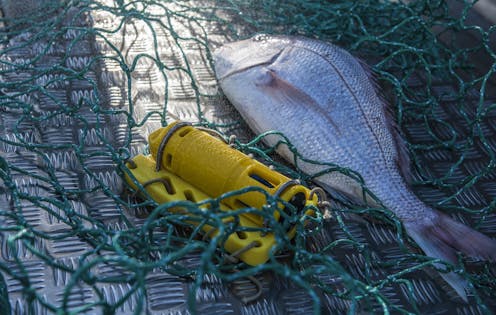
A small sensor in a yellow container is attached to fishing gear.
A temperature sensor is attached to fishing gear to track temperature data in coastal waters. John Radford/ZebraTech, CC BY-SA

Monitoring coastal changes

Ocean temperature measurements are critical for understanding and accurately predicting extreme events, including severe storms and unusually warm coastal waters, which have serious economic and societal impacts.

During the past few years, Aotearoa New Zealand has been plagued by extreme rainfall and persistent marine heatwaves. This has severely affected marine life, fisheries and aquaculture.

Increased ocean temperatures can exacerbate severe weather events like Cyclone Gabrielle, contributing to the conditions for intense rainfall and potential devastation.

Read more: Floods, cyclones, thunderstorms: is climate change to blame for New Zealand's summer of extreme weather?

To prepare for a changing climate and provide early alerts for extreme events, we need to monitor temperature changes below the ocean’s surface. These measurements are usually expensive, often requiring oceanographic research vessels to deploy instruments.

Pioneering international programmes like Argo (autonomous floats that move with the world’s ocean currents collecting measurements) provide unprecedented world coverage of deeper waters.

But they are not primarily designed to measure coastal and shelf seas. The lack of coastal observations is recognised in New Zealand and globally, and is a priority for the United Nations Decade of Ocean Science 2021-2030.

A map of coverage by the Argo programme and by sensors on fishing vessels
This graph shows the average number of Argo profiles per month around Aotearoa New Zealand (left, blue colours) and the average number of sensor deployments (right, red colours) from June 2020 to February 2023, highlighting the coverage obtained by these complementary programmes. Moana project, CC BY-ND

Crowd-sourcing ocean observations

As part of the Moana Project, MetService and the commercial fishing industry partnered with Nelson-based company ZebraTech to develop the Mangōpare sensor, a small, lightweight, robust and accurate temperature sensor that attaches to commercial fishing gear.

The Mangōpare sensor
The Mangōpare sensor, named by Moana Project partner Whakatōhea iwi, fits into the palm of a hand. Moana project, CC BY-ND

The sensor was distributed to volunteer inshore and deep-water fishing vessels and citizen scientists. Thanks to more than 200 skippers and crew, there are now 300 sensors on commercial fishing vessels, providing more than one million subsurface observations a month from across Aotearoa New Zealand.

The sensor attaches to any type of fishing gear and automatically collects ocean temperature and depth measurements through the water column. This information is automatically sent to the cloud, quality checked, returned to the fisher collecting it and incorporated into MetService ocean forecasts.

Vital temperature record to improve forecasts

Temperature observations are used to improve ocean forecasting models and verify the depth of marine heatwaves around Aotearoa New Zealand.

Similar to a weather station on land collecting real-time data that improves weather forecasts, sensor data helps improve three-dimensional predictions of ocean temperature, currents and sea level. These forecasts are used to prepare coastal communities for approaching storms, optimise fishing and alert aquaculture to extreme ocean temperatures.

Read more: Māori hold a third of NZ’s fishing interests, but as the ocean warms and fish migrate, these rights don't move with them

Scientists use the sensor data to understand how ocean temperature affects our marine ecosystems. Recently, severe marine heatwaves have affected coastal and offshore areas leading to changes in fish distribution and impacts on sensitive species.

The sensor provides measurements exactly where fishing occurs, helping fishers make sense of changes in their catch.

A sensor attached a commercial fishing pot.
Like weather stations on land, sensors attached to fishing gear help collect data to improve three-dimensional predictions of ocean temperature. William Maclardy, CC BY-SA

Temperature measurements are an invaluable record of subsurface ocean structure, allowing scientists to determine impacts of marine heatwaves, such as the bleaching of Fjordland sponges. Increased understanding is essential to a climate-resilient future for our oceans and marine species over the coming decades.

Partnering with technology innovators, the commercial fishing sector, citizen scientists and researchers from across New Zealand, this project breaks down traditional barriers.

This approach demonstrates how we can solve critical environmental issues and provide important insight into our changing oceans. The continuation of this system will lead the way toward informing a climate-resilient blue economy and understanding the coastal ocean, providing measurements that will only become more critical in the coming years.

Authors: Julie Jakoboski, Oceanographic Data Scientist, Moana Project's Te Tiro Moana Team Lead, MetService — Te Ratonga Tirorangi


Read more https://theconversation.com/fishing-for-data-commercial-fishers-help-monitor-rising-temperatures-in-coastal-seas-202115

What People Mean by “Alternative Doctor” And Why Expectations Around Care Are Changing

When people search for an “alternative doctor,” they’re usually looking for something specific, even if they haven’t fully defined it yet. I...

Why Does My Power Keep Tripping? Common Causes Explained by Electricians Sydney

The electrical system is the lifeblood of your home, powering everything from your phones to cooking utensils and more. But from time to time, your po...

Interstate Car Transporter Urges Buyers to Book Early

As the conflict in the Middle East continues to put increasing pressure on local fuel supply, Australian transport companies are experiencing increasi...

Digital Minimalism for Business Owners: Fewer Tools, Better Systems

Be honest. How many apps are open right now? One for scheduling, another for invoices, a third for customer notes, plus a spreadsheet someone email...

The Importance Of Proactive NDIS Renewal Preparation For Sustaining Your Provider Business

Your NDIS renewal notice is not a signal to start preparing. By the time it arrives, preparation should already be well underway. For new providers, s...

Why Fire Extinguisher Testing in Sydney Is Becoming a Records Game, Not Only a Maintenance Job

A fire extinguisher used to feel like one of the simpler parts of building safety. It hung on the wall, wore a service tag, and sat there quietly unle...

The Switchboard Upgrade Question Every Melbourne Renovator Should Ask Before the Walls Close Up

Renovations have a funny way of making people think on surfaces first. Splashback, stone, joinery, tapware, paint. Fair enough too. That is the exciti...

Winter Sanitation Gaps in Parramatta Kitchens: A Hidden Pest Risk

Winter brings a host of changes to our homes, from the chill in the air to the cozy warmth indoors. However, this season also introduces sanitation ch...

When to Seek Advice from Employment Lawyers in Melbourne

Australian employment law is detailed and, at times, complex, with rights and obligations that aren't always obvious to employees or employers witho...

7 Benefits of Professional Gutter Cleaning for Australian Homeowners

Gutters aren't exactly glamorous. They sit up there on the edge of your roof, doing their job quietly - until they stop working. Clogged, overflowing ...

Pipe Floats Strengthening Pipeline Performance In Demanding Environments

Pipelines often travel through environments that are anything but predictable, water currents shift, terrain changes, and materials keep moving unde...

Why Ceiling Fans Are Essential For Comfort, Efficiency, And Modern Living

Creating a comfortable indoor environment is not just about temperature; it is about how air moves, how a room feels, and how efficiently energy is ...

Why Duct Cleaning In Melbourne Is A Smart Investment For Healthier Living Spaces

Behind your walls, ceilings, and vents lies a network quietly working every day to keep your home comfortable. Yet over time, this system can become...

Disability Service Providers Supporting Inclusive And Independent Living

Finding the right support system can feel like assembling a puzzle where every piece must fit just right. For individuals and families navigating di...

A Beginner's Guide to Owning a Caravan in Australia

Owning a caravan opens up a style of travel that's hard to match for freedom and flexibility. However, for those just starting out, the process of c...

Preparing Your Air Conditioner for Summer: What Most Homeowners Overlook

As temperatures rise, many homeowners switch on their air conditioning for the first time in months — only to find it’s not performing the way i...

What Actually Adds Value to Properties in Newcastle

Newcastle has seen steady growth over the past few years, with more buyers looking beyond Sydney for lifestyle, space, and long-term value. As dema...

What is Design and Build in Construction?

Imagine you’re about to start a new construction project, maybe it’s a custom home or a commercial building. You’ve got the idea, the land, an...
















